Limpkin
Aramus guarauna
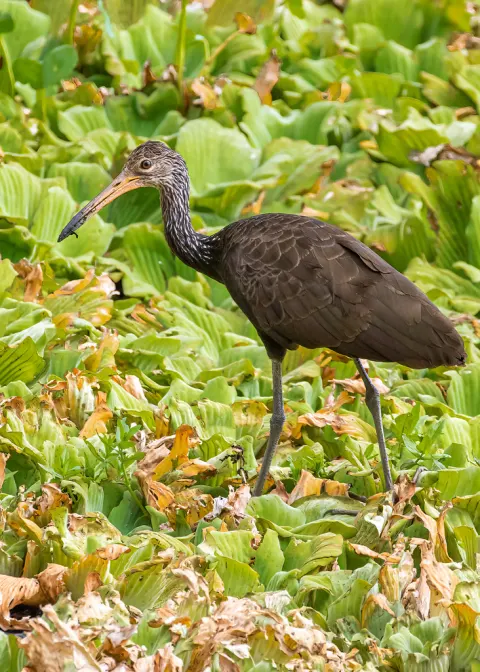
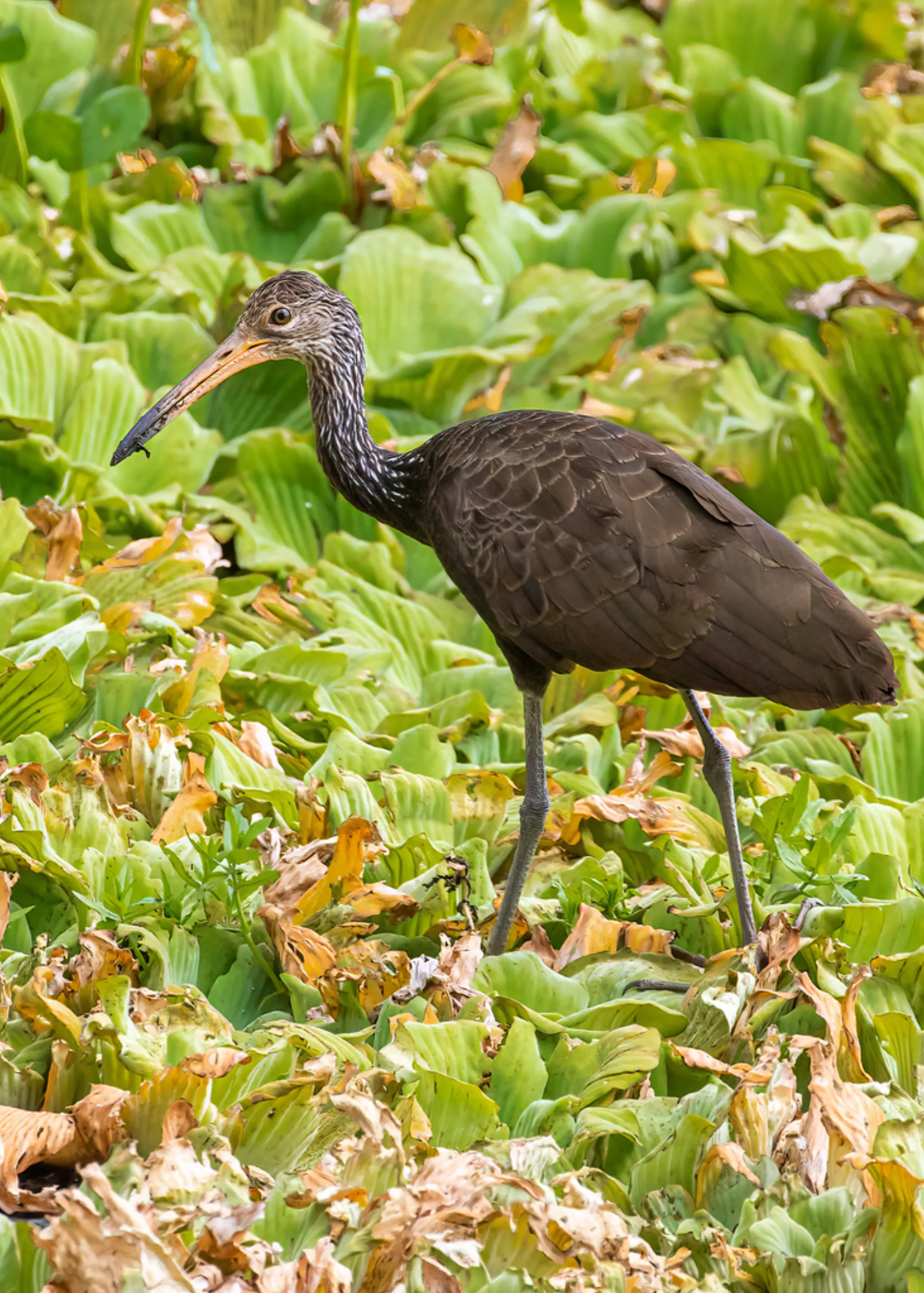
A loud, rattling wail at dawn or dusk may reveal a Limpkin before the bird comes into view. This large wading bird has dark brown plumage with an olive sheen, white streaks across much of its body, and a pale grey-looking head and neck. Long dark-grey legs, a long neck and a heavy, slightly curved yellowish bill with a dark tip complete the picture. Its slow walk can give the impression of a limp, and it is often found close to cover.
Limpkins live mainly in wetlands across warm parts of the Americas, from Florida and southern Mexico through Central America and the Caribbean to northern Argentina. Look for them in freshwater marshes and swamps, often among tall reeds, or in mangroves. In the Caribbean they also inhabit dry brushland. They are active by day and feed at night too, searching shallow water and floating vegetation for food. Apple snails dominate their diet, although they also eat freshwater mussels, other snails and a range of smaller prey. A bird carrying an apple snail takes it to land or shallow water, removes the lid and pulls out the snail, usually leaving the shell intact. Piles of empty shells can mark a favoured feeding spot.
Males defend territories, sometimes in large nesting colonies in extensive swamps. The bulky nests may be on the ground, among floating plants, in bushes or in trees. A clutch contains three to eight eggs, and both parents feed the downy young. American alligators prey on Limpkins, while snakes, raccoons, crows and muskrats apparently raid their nests.
Written from the English Wikipedia article Limpkin (CC BY-SA 4.0).
- Records
- 388,052
- Countries
- 21
- Atlas places
- 8
These are open occurrence records, so they show where people looked for and recorded the Limpkin as much as where it lives. Cells are up to 25 km across, and every location is generalised to its cell.
Generalised encounter areas, not exact locations. Each shape is a grid cell coloured by how likely the species is there.
- Very likelyUnited States25 km zone · high confidence · 283303 records · updated 80 days ago
- Very likelyArgentina25 km zone · high confidence · 21817 records · updated 80 days ago
- Very likelyBrazil25 km zone · high confidence · 16303 records · updated 80 days ago
- Very likelyBelize25 km zone · high confidence · 13529 records · updated 80 days ago
- Very likelyMexico25 km zone · high confidence · 10974 records · updated 80 days ago
- Very likelyCosta Rica25 km zone · high confidence · 9731 records · updated 80 days ago
- Very likelyColombia25 km zone · high confidence · 6973 records · updated 80 days ago
- Very likelyEcuador25 km zone · high confidence · 4652 records · updated 80 days ago
- Very likelyPeru25 km zone · high confidence · 2961 records · updated 80 days ago
- Very likelyGuatemala25 km zone · high confidence · 2920 records · updated 80 days ago
Conservation status not assessed here yet, so every location is generalised to its grid cell.