Military Macaw
Ara militaris
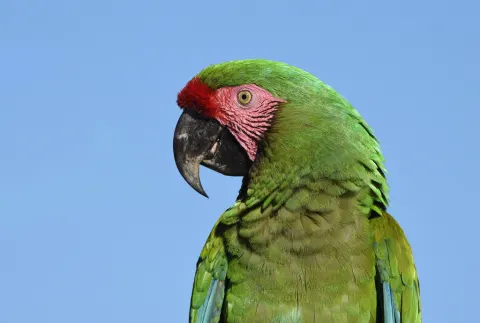
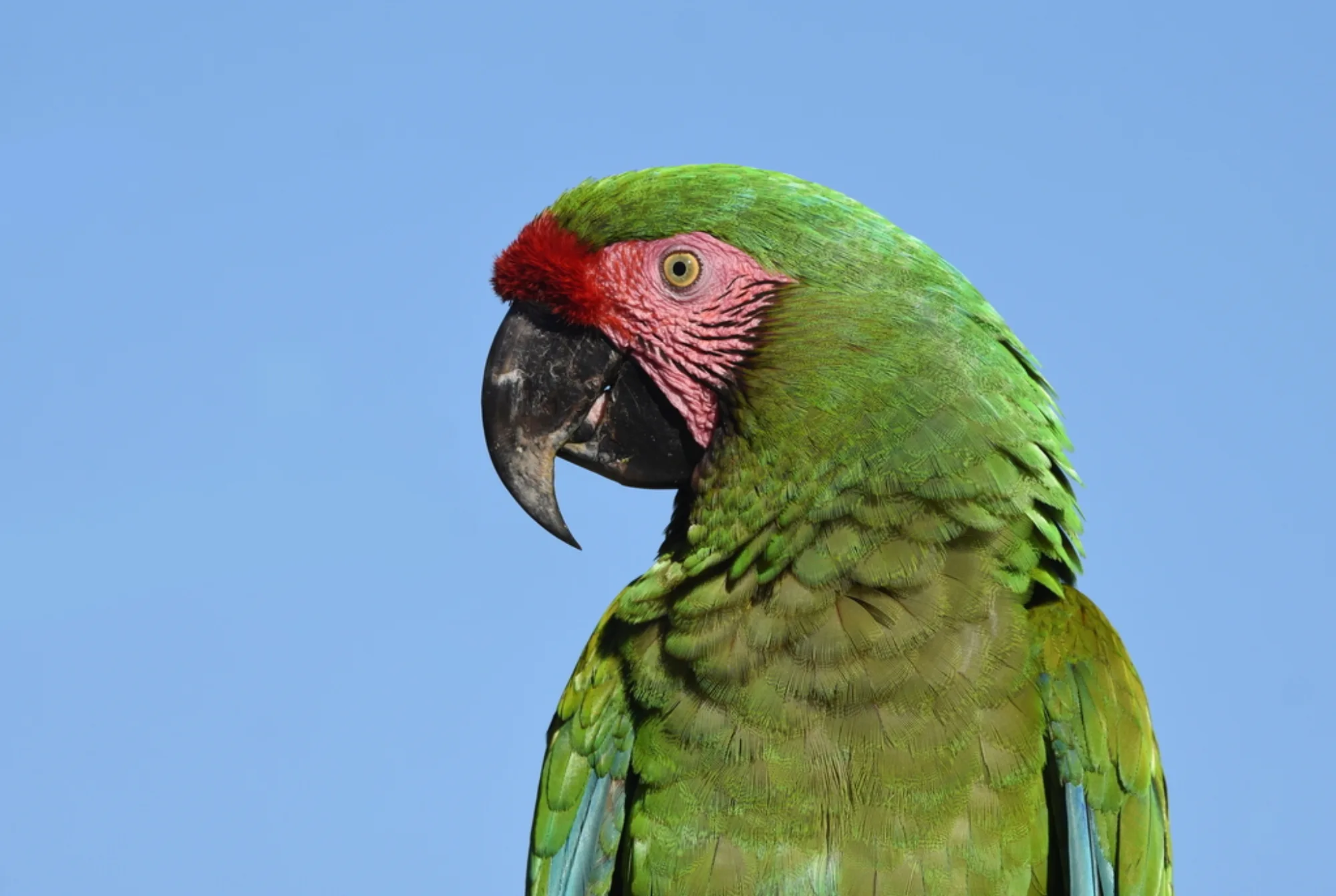
Mostly green, with a bright red forehead and flashes of light blue and yellow in its flight and tail feathers, the Military Macaw is a large, colourful bird. Its whitish, bare face has black markings, and its strong bill is dark. It measures 70 to 85 centimetres long on average, with a wingspan of 99 to 110 cm. Similar great green macaws are larger and paler, with different calls, and tend to favour humid forest.
Military Macaws range from west-central Mexico south to northern Argentina and Bolivia. They favour tropical forests where trees shed all or some of their leaves, using large canopy trees for food, nesting and shelter from heat and predators. Their usual elevation is 600 to 1,500 m, although they may fly down seasonally to humid forests and thorny woodlands in the lowlands. These noisy birds live in large flocks and can often be heard before they are seen, calling with loud cracks and shrieks. They leave their roosts around dawn to forage, mainly for seeds, but also eat fruit and leaves. Flocks also gather at clay deposits, often along riverbanks, where the clay appears to provide salt and remove toxins from their food.
Pairs groom each other during and outside the breeding season. They nest in natural cavities in trees or cliffs, with chicks leaving the nest between January and March. Habitat loss from crops, deforestation, mining and roads has fragmented their populations, while trafficking of parrots between South and North America remains common. Their relatively narrow diet is another concern: losing access to too many food plants could have a serious effect.
Written from the English Wikipedia article Military macaw (CC BY-SA 4.0).
- Records
- 16,938
- Countries
- 10
- Atlas places
- 4
These are open occurrence records, so they show where people looked for and recorded the Military Macaw as much as where it lives. Cells are up to 25 km across, and every location is generalised to its cell.
Generalised encounter areas, not exact locations. Each shape is a grid cell coloured by how likely the species is there.
- Very likelyColombia25 km zone · high confidence · 5798 records · updated 80 days ago
- Very likelyMexico25 km zone · high confidence · 4270 records · updated 80 days ago
- Very likelyEcuador25 km zone · high confidence · 3445 records · updated 80 days ago
- Very likelyBolivia25 km zone · high confidence · 1315 records · updated 80 days ago
- Very likelyPeru25 km zone · high confidence · 1039 records · updated 80 days ago
- Very likelyVenezuela25 km zone · high confidence · 972 records · updated 80 days ago
- LikelyArgentina25 km zone · medium confidence · 70 records · updated 80 days ago
- PossibleUnited States25 km zone · medium confidence · 14 records · updated 80 days ago
- PossibleHonduras25 km zone · medium confidence · 11 records · updated 80 days ago
- PossibleBahamas25 km zone · medium confidence · 4 records · updated 80 days ago
Conservation status not assessed here yet, so every location is generalised to its grid cell.