Blue-throated Macaw
Ara glaucogularis
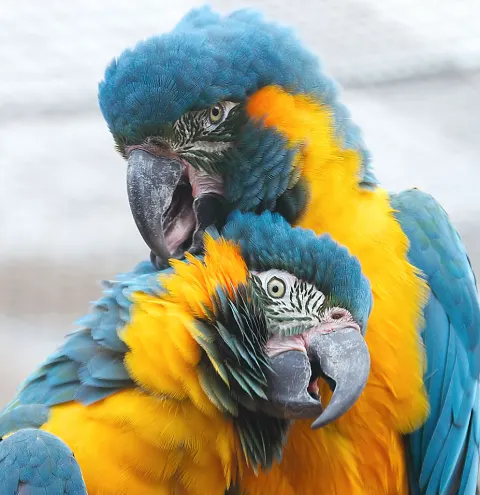
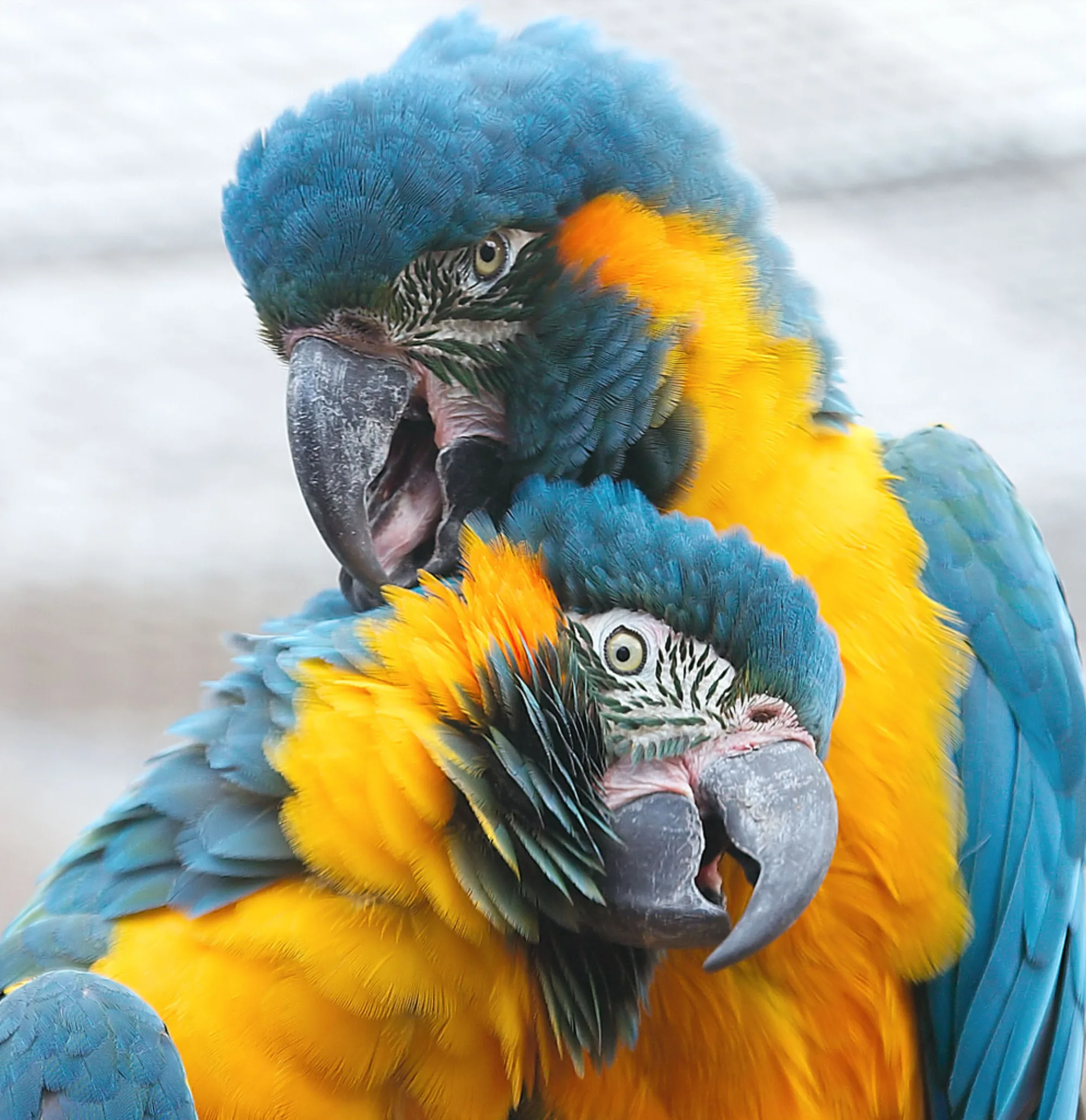
Turquoise-blue above and bright yellow below, the Blue-throated Macaw carries its namesake colour across its throat and lower cheeks. A narrow yellow stripe separates the blue throat and cheek from the crown, while fine blue feather stripes mark the bare skin beside its large black bill. Adults can be recognised individually by the pattern of these facial stripes. About 85 cm long including its tail, it resembles the slightly larger blue-and-yellow macaw, but has a blue rather than black throat and a blue rather than green crown.
This macaw lives only in Los Llanos de Moxos in north-central Bolivia, in a landscape of grasslands, marshes, forest islands and wooded corridors along waterways. It nests in palm islands scattered across the plains, usually in cavities in dead palms. Active by day, the birds are most often seen in pairs, though small groups also occur. They communicate with quiet caws, but give a loud alarm and fly away when they sense danger. Fruit from large palms makes up most of their diet, including ripe and nearly ripe fruit. They usually breed once a year, laying one to three eggs, and young birds may remain with their parents for up to a year.
Suitable nest trees have declined with deforestation, and the macaws compete with other birds, bats and bees for nesting holes. Hunting and trapping remain threats, alongside tree cutting, invasive species, disease and substances used to extinguish fires. Capture for the pet trade and hunting for feathers have also contributed to the species' decline.
Written from the English Wikipedia article Blue-throated macaw (CC BY-SA 4.0).
- Records
- 6
- Countries
- 1
No atlas park has a record of the Blue-throated Macaw in or around it yet.
These are open occurrence records, so they show where people looked for and recorded the Blue-throated Macaw as much as where it lives. Cells are up to 25 km across, and every location is generalised to its cell.
Generalised encounter areas, not exact locations. Each shape is a grid cell coloured by how likely the species is there.
- Very likelyBolivia25 km zone · medium confidence · 6 records · updated 81 days ago
Conservation status not assessed here yet, so every location is generalised to its grid cell.