Red-and-green Macaw
Ara chloropterus
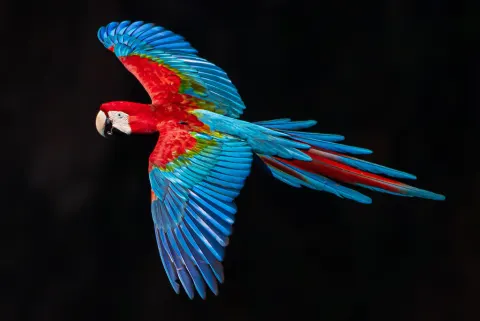
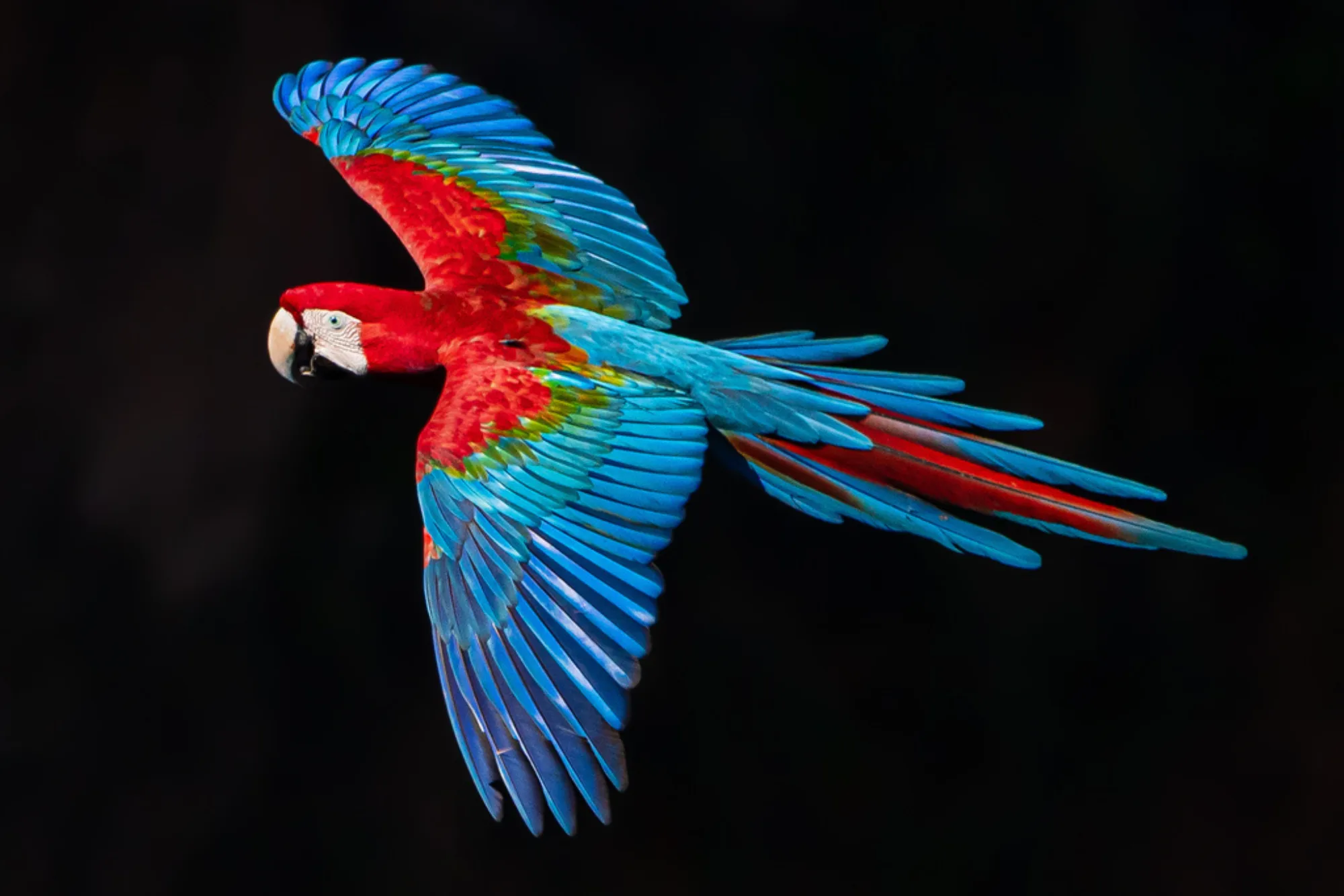
Look for a large, mostly red parrot with green across much of its upper wings and fine red lines around its eyes. The Red-and-green Macaw, also called the green-winged macaw, has bare white skin around those lines and teal feathers framed by red on its tail. Adults reach 90 to 95 cm in total length. Its red breast resembles that of the scarlet macaw, but the scarlet typically has more yellow on the upper wings. If the two are seen together, the Red-and-green Macaw is visibly larger.
The species is widespread in forests and woodlands across northern and central South America. Its former range is thought to have reached south into Argentina, including Misiones, Formosa, Corrientes and Chaco. Birds were discovered in Iguazú National Park in the mid-2010s and had apparently spread into nearby Parque provincial Puerto Península by 2019. A population has also appeared on Trinidad since 1999, although its origin is uncertain: the birds may have escaped captivity or arrived from the wild. Red-and-green Macaws generally pair for life. The female usually lays two or three eggs in a hole in a tree, then incubates them for about 28 days. Chicks leave the nest about 90 days after hatching.
In recent years, numbers have declined markedly as habitat has been lost and birds have been captured illegally for the parrot trade. In Argentina, land-use changes, capture for the pet trade and hunting for meat are thought to have wiped it out across its former range by the 1960s. A reintroduction programme is under way at Iberá Provincial Reserve in Corrientes, where a pair brought from Britain was released in February 2019.
Written from the English Wikipedia article Red-and-green macaw (CC BY-SA 4.0).
- Records
- 34,798
- Countries
- 19
- Atlas places
- 12
- Tambopata National Reserve· Peru
- Manú National Park· Peru
- Iberá Park· Argentina
- Serra da Bodoquena National Park· Brazil
- Yasuní National Park· Ecuador
- Chapada dos Guimarães National Park· Brazil
- Cuyabeno Wildlife Reserve· Ecuador
- Pacaya-Samiria National Reserve· Peru
- Pantanal Matogrossense National Park· Brazil
- Anavilhanas National Park· Brazil
- Iguaçu National Park· Brazil
- Iguazú National Park· Argentina
These are open occurrence records, so they show where people looked for and recorded the Red-and-green Macaw as much as where it lives. Cells are up to 25 km across, and every location is generalised to its cell.
Generalised encounter areas, not exact locations. Each shape is a grid cell coloured by how likely the species is there.
- Very likelyBrazil25 km zone · high confidence · 12840 records · updated 86 days ago
- Very likelyPeru25 km zone · high confidence · 9734 records · updated 86 days ago
- Very likelyGuyana25 km zone · high confidence · 3791 records · updated 86 days ago
- Very likelyVenezuela25 km zone · high confidence · 2692 records · updated 86 days ago
- Very likelyParaguay25 km zone · high confidence · 1261 records · updated 86 days ago
- Very likelyBolivia25 km zone · high confidence · 1191 records · updated 86 days ago
- Very likelyColombia25 km zone · high confidence · 997 records · updated 86 days ago
- Very likelyPanama25 km zone · high confidence · 746 records · updated 86 days ago
- Very likelyArgentina25 km zone · high confidence · 479 records · updated 86 days ago
- Very likelyEcuador25 km zone · high confidence · 389 records · updated 86 days ago
Conservation status not assessed here yet, so every location is generalised to its grid cell.