Verreaux's Eagle
Aquila verreauxii
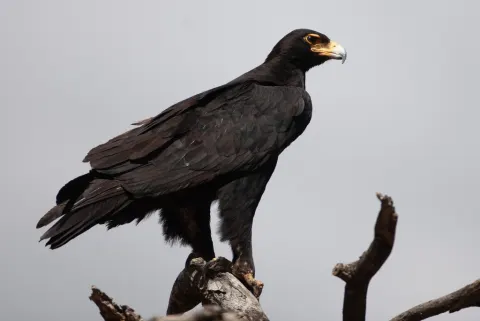
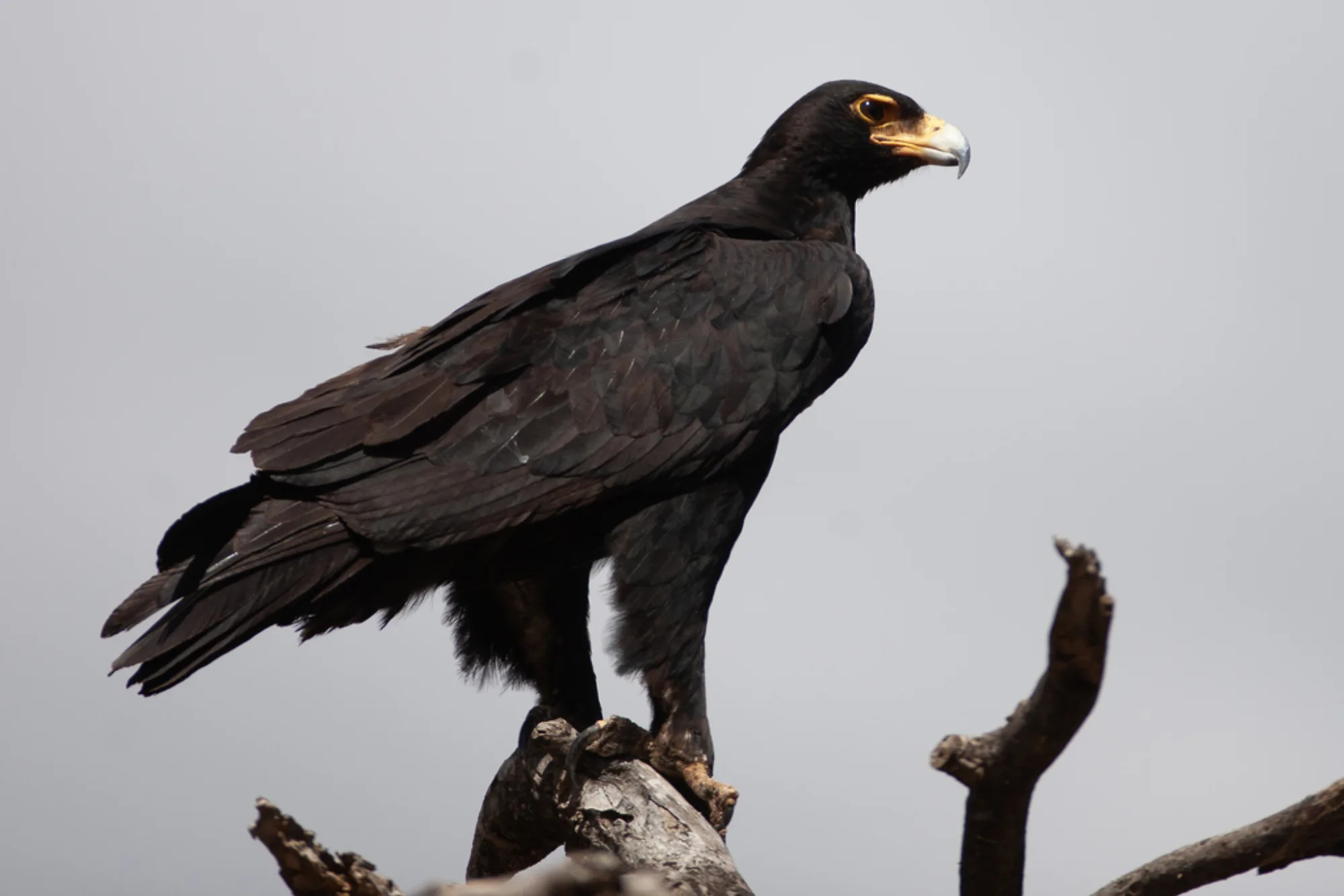
Across rocky hills and mountain cliffs, the Verreaux's Eagle cuts a distinctive shape in the air, soaring with its wings raised in a shallow V. This large bird of prey measures 75 to 96 cm long, with wings spanning 1.81 to 2.3 m. Adults are mostly black, with white patches on the wings and a white V across the back that is most visible from above in flight. Younger birds look different: their plumage is mainly dark brown, with a golden crown, ginger colouring on the neck and extensive white mottling beneath the wings.
The eagle lives mainly in southern and eastern Africa, with a sparse presence elsewhere on the continent and a very local range in the Middle East. Look for it around dry, rocky hills, cliffs and gorges, often surrounded by savanna, thornbush or semi-desert. Adults generally stay within their home ranges, while young birds wander more widely after leaving their parents' territory. Though usually quiet, the eagle gives loud, ringing calls when contacting another bird or chasing an intruder.
Rock hyraxes are its principal prey, and the eagle often hunts low over the ground, using the shape of the terrain to surprise them before diving. Where hyraxes decline, it may turn to other animals, including hares, monkeys and gamebirds, with mixed success. Pairs usually nest on cliffs, sometimes in an overhung crevice or small cave, and both birds help build the nest. Two eggs are generally laid, but the older chick normally kills its younger sibling. Persecution and habitat change affect eagles in the Karoo, while declines in their favoured hyrax prey can force them to find other food.
Written from the English Wikipedia article Verreaux's eagle (CC BY-SA 4.0).
- Records
- 23,756
- Countries
- 10
- Atlas places
- 27
- uKhahlamba-Drakensberg Park· South Africa
- Kruger National Park· South Africa
- Golden Gate Highlands National Park· South Africa
- Karoo National Park· South Africa
- Kunene / Kaokoveld· Namibia
- Table Mountain National Park· South Africa
- Addo Elephant National Park· South Africa
- Augrabies Falls National Park· South Africa
- Lake Manyara National Park· Tanzania
- Mapungubwe National Park· South Africa
- Matobo National Park· Zimbabwe
- Nairobi National Park· Kenya
- Ngorongoro Conservation Area· Tanzania
- Pilanesberg National Park· South Africa
- Tsavo East National Park· Kenya
- Tsavo West National Park· Kenya
- Waterberg Plateau Park· Namibia
- Zambezi National Park· Zimbabwe
- Aberdare National Park· Kenya
- Gonarezhou National Park· Zimbabwe
- Hell's Gate National Park· Kenya
- Lake Nakuru National Park· Kenya
- Madikwe Game Reserve· South Africa
- Mountain Zebra National Park· South Africa
- Namib-Naukluft· Namibia
- Samburu National Reserve· Kenya
- West Coast National Park· South Africa
These are open occurrence records, so they show where people looked for and recorded the Verreaux's Eagle as much as where it lives. Cells are up to 25 km across, and every location is generalised to its cell.
Generalised encounter areas, not exact locations. Each shape is a grid cell coloured by how likely the species is there.
- Very likelySouth Africa25 km zone · high confidence · 20078 records · updated 80 days ago
- Very likelyNamibia25 km zone · high confidence · 1229 records · updated 80 days ago
- Very likelyKenya25 km zone · high confidence · 1144 records · updated 80 days ago
- Very likelyZimbabwe25 km zone · medium confidence · 464 records · updated 80 days ago
- Very likelyOman25 km zone · high confidence · 348 records · updated 80 days ago
- Very likelyEthiopia25 km zone · high confidence · 239 records · updated 80 days ago
- Very likelyLesotho25 km zone · high confidence · 149 records · updated 80 days ago
- Very likelyTanzania25 km zone · medium confidence · 105 records · updated 80 days ago
Conservation status not assessed here yet, so every location is generalised to its grid cell.