Tawny Eagle
Aquila rapax
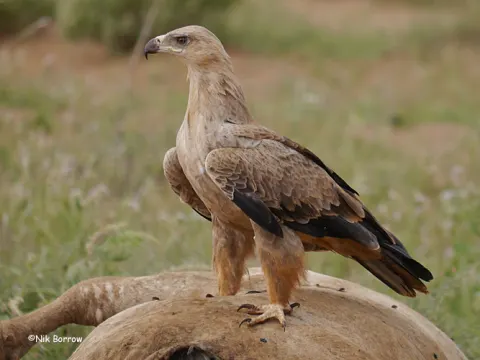
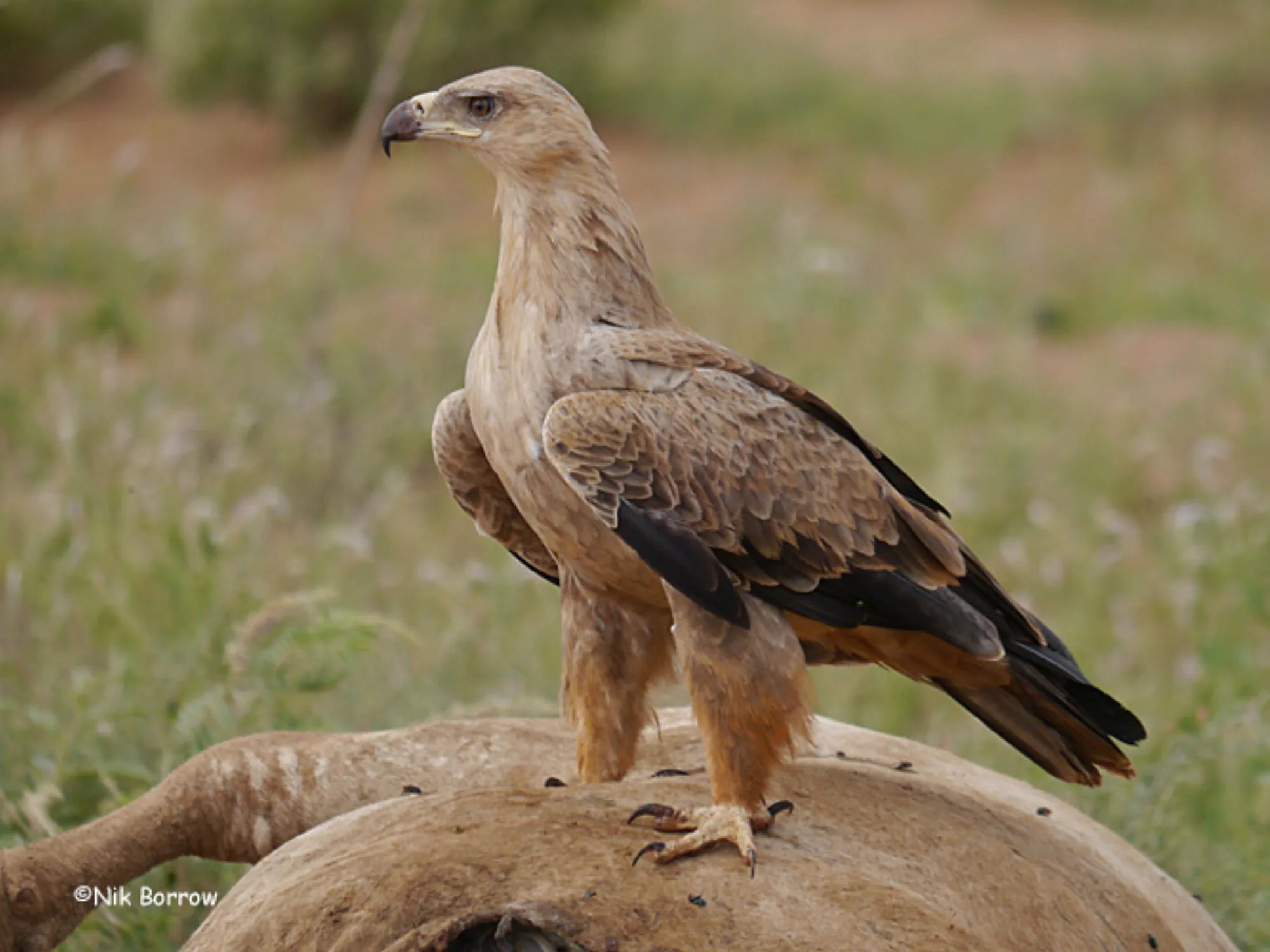
Look for a large bird of prey sitting upright on a stump, post or treetop, sometimes for long stretches of the day. The Tawny Eagle has a long neck, broad wings and a relatively short tail, while the feathers on its legs can look baggy. Its colouring varies considerably: adults may be grey-brown, reddish tawny or buffish yellow, and pale birds show a contrast between their light bodies and darker flight feathers and tails. In flight, it soars with its wings flat or slightly raised, and its deep wingbeats can look heavy and slow.
The eagle breeds across much of Africa and the Indian subcontinent, and is rarely resident in the southern Middle East. It favours open, dry country, including savanna and semi-desert, but seldom lives where trees are entirely absent. Although largely sedentary, some birds make seasonal movements, and others seek new areas when rainfall is lacking. Usually solitary, it may gather in small groups where food is concentrated, and spends much of the day perched.
Its diet is varied: it scavenges carrion, steals food from other birds of prey and hunts live animals. It often drops from a perch or dives from a soaring flight, targeting prey on the ground, though it sometimes catches birds in the air. Pairs may hunt together during the breeding season, and the female lays between one and three eggs in a nest of sticks, usually in a tree crown. Populations have declined across its range, with nesting habitat lost to logging and global warming, while poisoning and contact with human-made objects also contribute to deaths.
Written from the English Wikipedia article Tawny eagle (CC BY-SA 4.0).
- Records
- 63,241
- Countries
- 37
- Atlas places
- 41
- Kruger National Park· South Africa
- Serengeti National Park· Tanzania
- Kgalagadi Transfrontier Park· South Africa
- Ngorongoro Conservation Area· Tanzania
- Okavango Delta· Botswana
- Chobe National Park· Botswana
- Etosha National Park· Namibia
- Tsavo East National Park· Kenya
- Maasai Mara National Reserve· Kenya
- Tsavo West National Park· Kenya
- iSimangaliso Wetland Park· South Africa
- Tarangire National Park· Tanzania
- Hluhluwe-iMfolozi Park· South Africa
- Hwange National Park· Zimbabwe
- Akagera National Park· Rwanda
- Bandipur National Park· India
- Lake Manyara National Park· Tanzania
- Queen Elizabeth National Park· Uganda
- Samburu National Reserve· Kenya
- Zambezi National Park· Zimbabwe
- Amboseli National Park· Kenya
- Gonarezhou National Park· Zimbabwe
- Mapungubwe National Park· South Africa
- Murchison Falls National Park· Uganda
- Nairobi National Park· Kenya
- Nkasa Rupara National Park· Namibia
- Ruaha National Park· Tanzania
- South Luangwa National Park· Zambia
- Aberdare National Park· Kenya
- Arusha National Park· Tanzania
- Bwabwata National Park· Namibia
- Hell's Gate National Park· Kenya
- Kilimanjaro National Park· Tanzania
- Lake Mburo National Park· Uganda
- Lake Nakuru National Park· Kenya
- Liuwa Plain National Park· Zambia
- Lower Zambezi National Park· Zambia
- Mana Pools National Park· Zimbabwe
- Meru National Park· Kenya
- Mount Kenya National Park· Kenya
- Volcanoes National Park· Rwanda
These are open occurrence records, so they show where people looked for and recorded the Tawny Eagle as much as where it lives. Cells are up to 25 km across, and every location is generalised to its cell.
Generalised encounter areas, not exact locations. Each shape is a grid cell coloured by how likely the species is there.
- Very likelySouth Africa25 km zone · high confidence · 25233 records · updated 86 days ago
- Very likelyTanzania25 km zone · high confidence · 9959 records · updated 86 days ago
- Very likelyKenya25 km zone · high confidence · 9736 records · updated 86 days ago
- Very likelyIndia25 km zone · high confidence · 6548 records · updated 86 days ago
- Very likelyNamibia25 km zone · high confidence · 3093 records · updated 86 days ago
- Very likelyBotswana25 km zone · high confidence · 2689 records · updated 86 days ago
- Very likelyEthiopia25 km zone · high confidence · 2049 records · updated 86 days ago
- Very likelyUganda25 km zone · high confidence · 1138 records · updated 86 days ago
- Very likelyZimbabwe25 km zone · high confidence · 872 records · updated 86 days ago
- Very likelyZambia25 km zone · high confidence · 548 records · updated 86 days ago
Conservation status not assessed here yet, so every location is generalised to its grid cell.