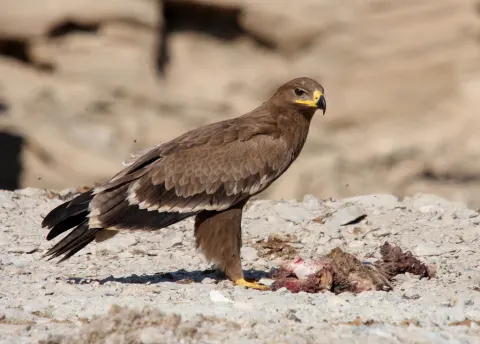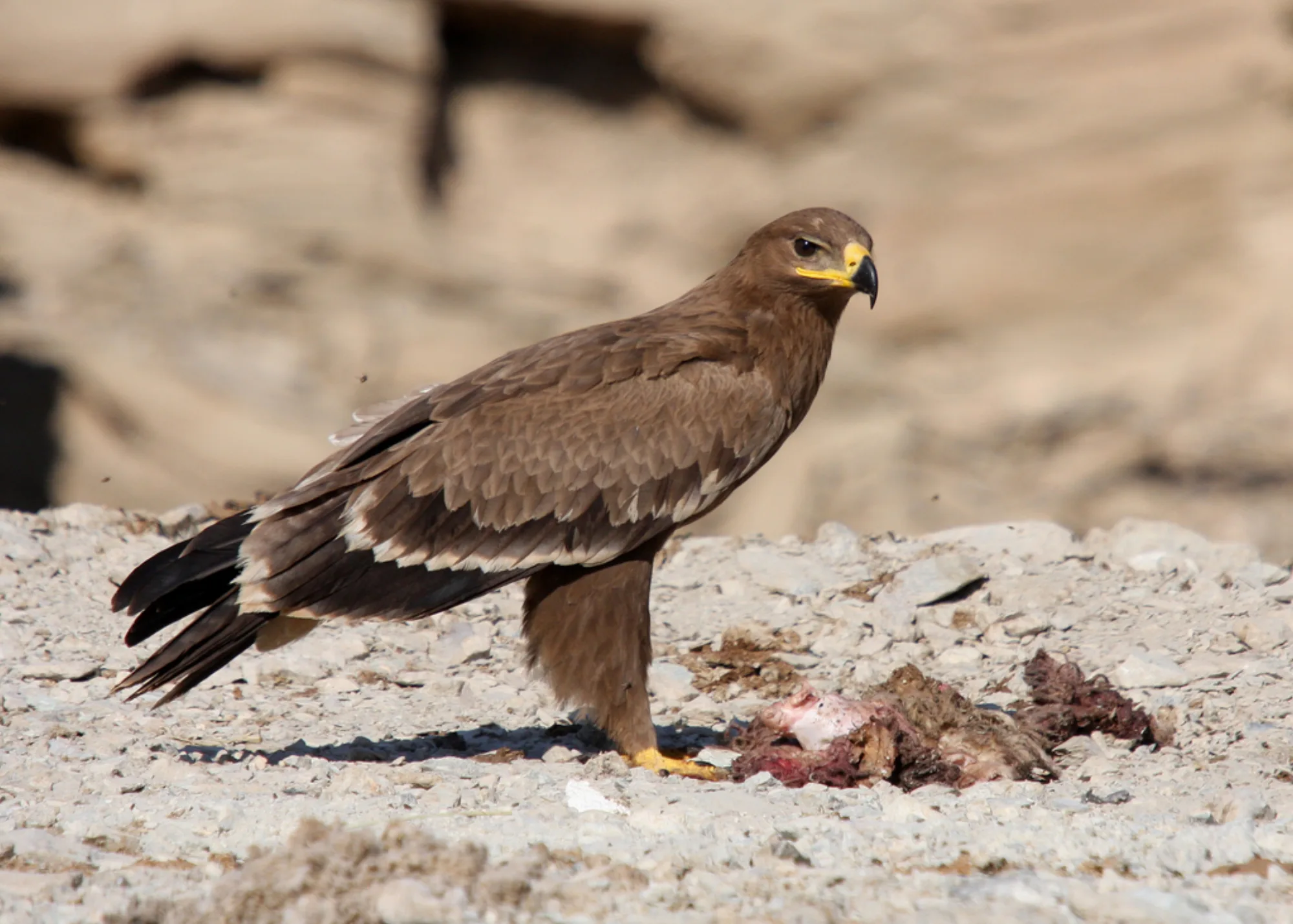
Steppe Eagle
Aquila nipalensis
Broad-winged and bulky, the Steppe Eagle (Aquila nipalensis) is a large bird of prey, mainly dark brown, with a thick neck, a relatively small head and a rounded tail. Adults often have a pale rufous to yellow-brown patch on the back of the head and neck, especially in the east of the range. Young birds are usually paler, with conspicuous white markings on their wings and tail. Look for an eagle perched upright on an isolated tree, post or rock, or standing on open ground for long periods.
Its breeding range extends across Russia, Kazakhstan, Mongolia and China, with smaller marginal populations in northeastern Kyrgyzstan and perhaps northern Uzbekistan. It favours open, dry steppe, including plains, arid grassland, semi-desert and desert edges. Migrating birds gather along routes through the Middle East and the Himalayas, while wintering areas include eastern and southern Africa, the Arabian Peninsula and south Asia. In Africa, wintering birds often use savanna and grassland; elsewhere they may visit wetlands, landfills and livestock carcass dumps. During migration they often travel in flocks, and outside the breeding season they can gather at productive feeding sites.
On the breeding grounds, ground squirrels are a mainstay, although the eagle also takes other small mammals and other prey. It usually nests on the ground, often on or near a rocky outcrop, and lays one to three eggs. Winter feeding includes insect swarms, carrion and food found at landfills. Fires, nest pests, human disturbance and persecution, and livestock trampling nests all contribute to its decline. Electrocution on wires and pylons also kills large numbers, particularly in Kazakhstan.
Written from the English Wikipedia article Steppe eagle (CC BY-SA 4.0).
- Records
- 50,190
- Countries
- 25
- Atlas places
- 23
- Serengeti National Park· Tanzania
- Kruger National Park· South Africa
- Ngorongoro Conservation Area· Tanzania
- Jim Corbett National Park· India
- Maasai Mara National Reserve· Kenya
- Kaziranga National Park· India
- Annapurna Conservation Area· Nepal
- Chitwan National Park· Nepal
- Samburu National Reserve· Kenya
- Tarangire National Park· Tanzania
- Aberdare National Park· Kenya
- Amboseli National Park· Kenya
- Bandipur National Park· India
- Hell's Gate National Park· Kenya
- Koshi Tappu Wildlife Reserve· Nepal
- Lake Manyara National Park· Tanzania
- Lake Nakuru National Park· Kenya
- Langtang National Park· Nepal
- Manas National Park· India
- Murchison Falls National Park· Uganda
- Nairobi National Park· Kenya
- Tsavo East National Park· Kenya
- Tsavo West National Park· Kenya
These are open occurrence records, so they show where people looked for and recorded the Steppe Eagle as much as where it lives. Cells are up to 25 km across, and every location is generalised to its cell.
Generalised encounter areas, not exact locations. Each shape is a grid cell coloured by how likely the species is there.
- Very likelyIndia25 km zone · medium confidence · 21288 records · updated 80 days ago
- Very likelyNepal25 km zone · high confidence · 4431 records · updated 80 days ago
- Very likelyJordan25 km zone · high confidence · 4050 records · updated 80 days ago
- Very likelyGeorgia25 km zone · high confidence · 3936 records · updated 80 days ago
- Very likelyIsrael25 km zone · high confidence · 3230 records · updated 80 days ago
- Very likelyOman25 km zone · high confidence · 1601 records · updated 80 days ago
- Very likelyKenya25 km zone · high confidence · 1541 records · updated 80 days ago
- Very likelyIran25 km zone · high confidence · 1523 records · updated 80 days ago
- Very likelyTanzania25 km zone · high confidence · 1467 records · updated 80 days ago
- Very likelyKuwait25 km zone · high confidence · 1452 records · updated 80 days ago
Conservation status not assessed here yet, so every location is generalised to its grid cell.