Eastern Imperial Eagle
Aquila heliaca
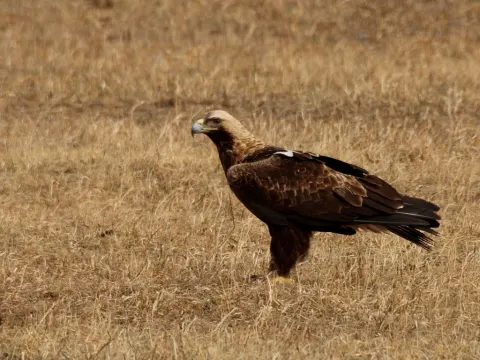
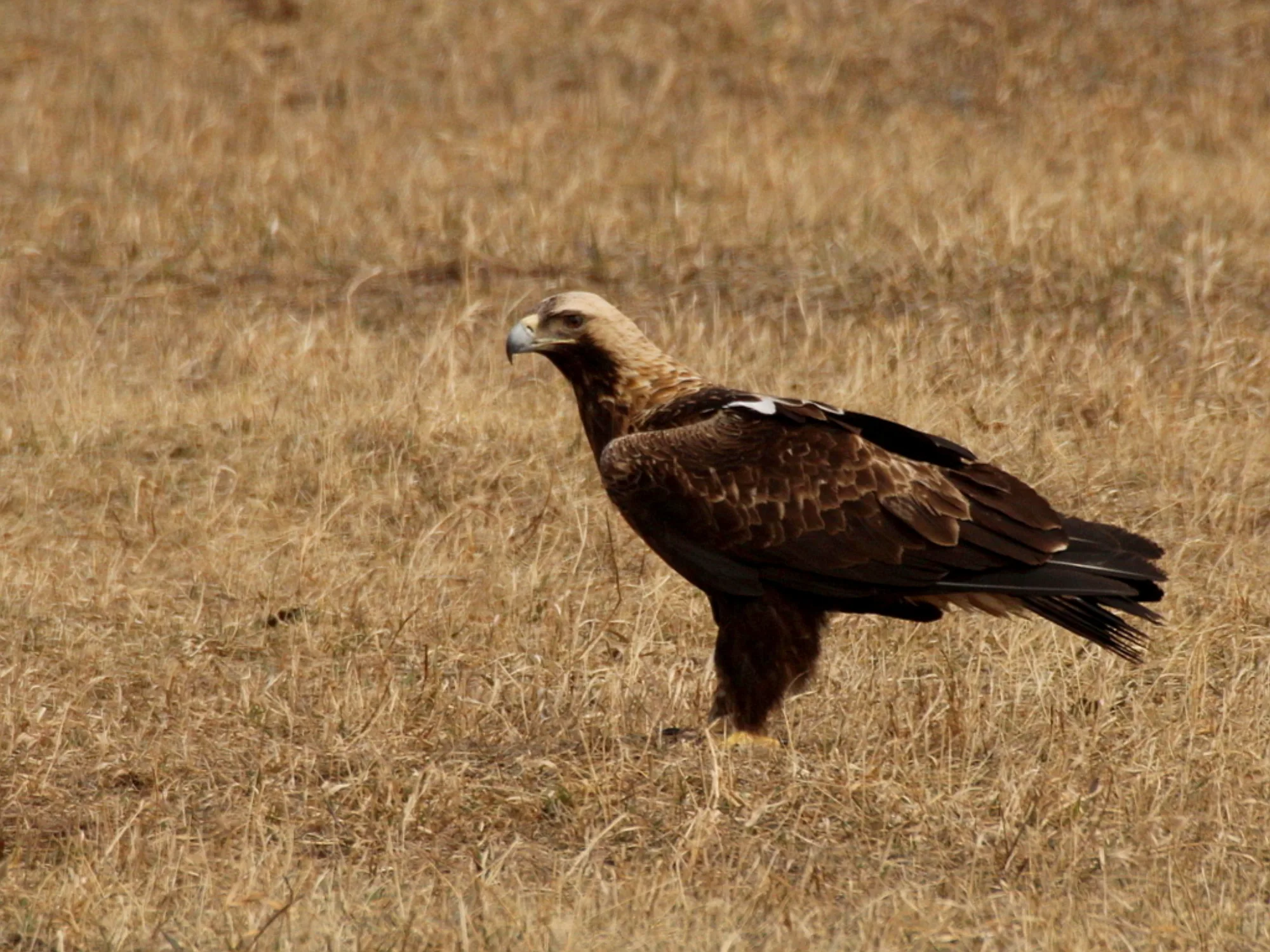
A large, dark bird of prey, the Eastern Imperial Eagle typically spans 1.76 to 2.2 m from wingtip to wingtip. Adults are largely blackish-brown, with a contrasting creamy to golden crown and neck, and conspicuous white marks on the shoulders. Young birds look quite different, with pale sandy plumage and dark brown streaks across the breast. When perched, the eagle often sits upright on an exposed branch, rock or low mound; in flight, it soars with its wings held fairly flat.
Its breeding range stretches from southeastern Europe across much of West and Central Asia, with isolated populations in places including Cyprus and northern Iran. Most populations migrate, with wintering grounds extending from northeastern Africa through the Middle East to parts of South and East Asia. Look for it in open country with scattered trees, along woodland edges or among the wooded mosaics of the steppe. It also hunts around wetlands and farmland, and generally favours lowland areas. In winter it uses open grasslands, plains, cultivated land and wetlands, as well as semi-desert.
The eagle usually watches from a low perch before diving towards prey on the ground, though it can also hunt from a low soaring flight. Its varied diet includes hares, ground squirrels and other small mammals, as well as birds, reptiles and carrion. Parents usually nest in large, mature trees and bring up about one or two young to the fledgling stage. The global population is small and declining, with persecution and the loss of habitat and prey among the pressures it faces.
Written from the English Wikipedia article Eastern imperial eagle (CC BY-SA 4.0).
- Records
- 28,410
- Countries
- 34
- Atlas places
- 2
These are open occurrence records, so they show where people looked for and recorded the Eastern Imperial Eagle as much as where it lives. Cells are up to 25 km across, and every location is generalised to its cell.
Generalised encounter areas, not exact locations. Each shape is a grid cell coloured by how likely the species is there.
- Very likelyIndia25 km zone · high confidence · 8205 records · updated 80 days ago
- Very likelyIsrael25 km zone · medium confidence · 3749 records · updated 80 days ago
- Very likelyHungary25 km zone · medium confidence · 2244 records · updated 80 days ago
- Very likelyOman25 km zone · high confidence · 1993 records · updated 80 days ago
- Very likelyAustria25 km zone · high confidence · 1876 records · updated 80 days ago
- Very likelyIran25 km zone · high confidence · 1599 records · updated 80 days ago
- Very likelyHong Kong SAR China25 km zone · high confidence · 1249 records · updated 80 days ago
- Very likelyTürkiye25 km zone · medium confidence · 1123 records · updated 80 days ago
- Very likelyKuwait25 km zone · medium confidence · 932 records · updated 80 days ago
- Very likelyUnited Arab Emirates25 km zone · medium confidence · 745 records · updated 80 days ago
Conservation status not assessed here yet, so every location is generalised to its grid cell.