Wedge-tailed Eagle
Aquila audax
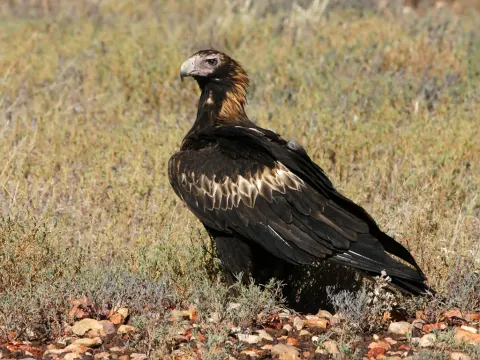
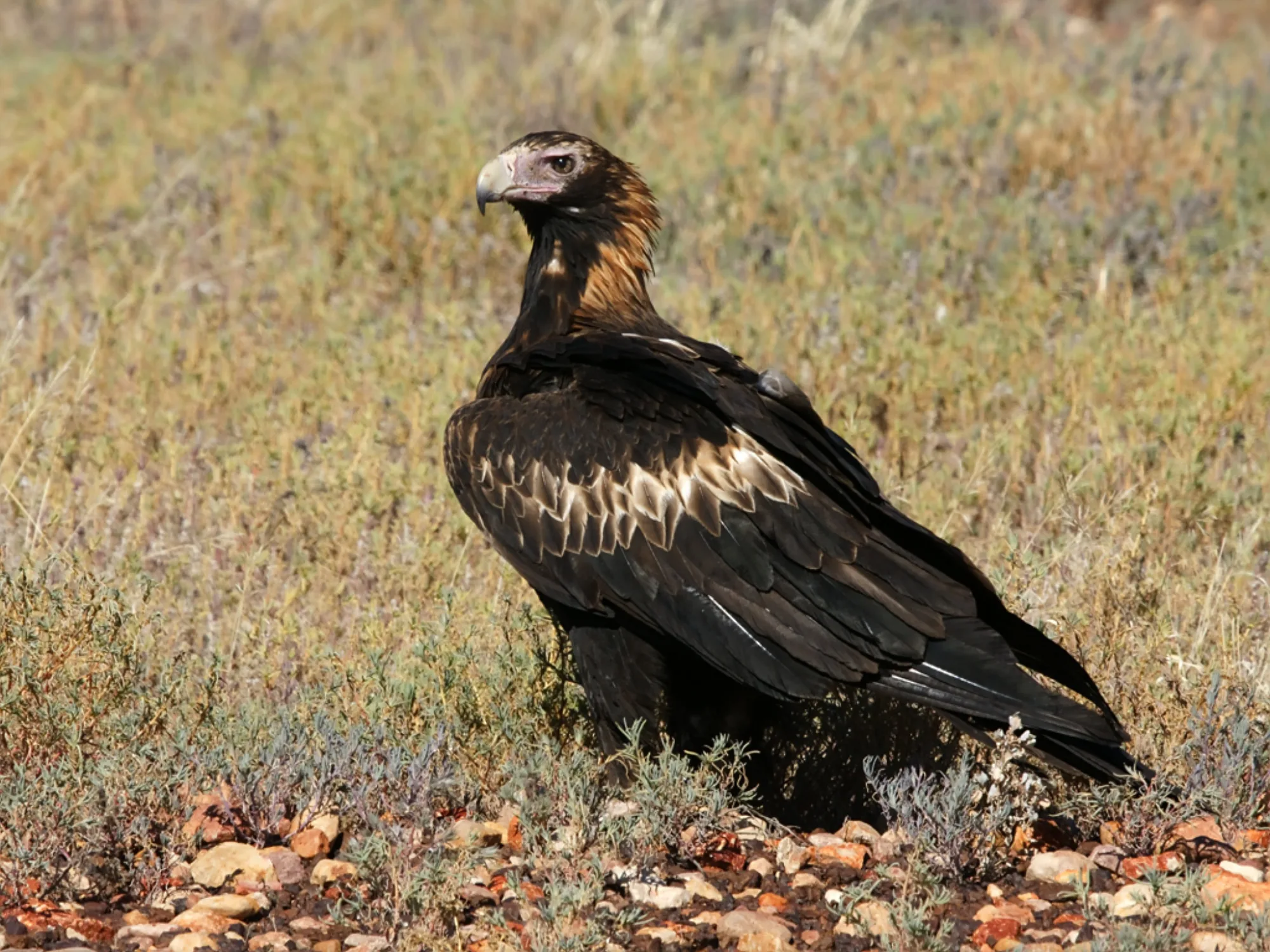
Australia's largest bird of prey, the Wedge-tailed Eagle (Aquila audax) is a dark, long-winged eagle with a distinctive wedge-shaped tail. In flight, its tail looks diamond-shaped, and it glides and soars on upswept wings. Adults are brown to black, while young birds are generally browner, with reddish feather edges and a paler head. Look for one perched in the open on a dead tree, rock or telegraph pole, or circling high on rising warm air.
The eagle occurs throughout Australia, including Tasmania, and in southern New Guinea. It uses a wide range of country, from desert and grassland to woodland, mountains and some tropical rainforest. It favours varied terrain with rocky places, open ground and native woodland, and often soars over hills, escarpments and plains. Although adults generally stay in one area, young eagles can travel widely after leaving the nest.
Mammals form much of its diet, including rabbits and marsupials, though it also takes birds and reptiles. It often eats carrion, and travellers may see eagles feeding on roadkill in rural Australia. Pairs can stay together for several years and usually build a large stick nest in a substantial tree. They lay one to four eggs, typically two, and usually raise one or two fledglings. Nesting birds are sensitive to human disturbance, which can cause them to abandon their young; logging and other habitat changes can also disrupt breeding. People historically poisoned and shot the eagles over alleged attacks on sheep, but their numbers have since recovered.
Written from the English Wikipedia article Wedge-tailed eagle (CC BY-SA 4.0).
- Records
- 91,151
- Countries
- 1
- Atlas places
- 6
These are open occurrence records, so they show where people looked for and recorded the Wedge-tailed Eagle as much as where it lives. Cells are up to 25 km across, and every location is generalised to its cell.
Generalised encounter areas, not exact locations. Each shape is a grid cell coloured by how likely the species is there.
- Very likelyAustralia25 km zone · high confidence · 91151 records · updated 80 days ago
Conservation status not assessed here yet, so every location is generalised to its grid cell.