Spanish Imperial Eagle
Aquila adalberti
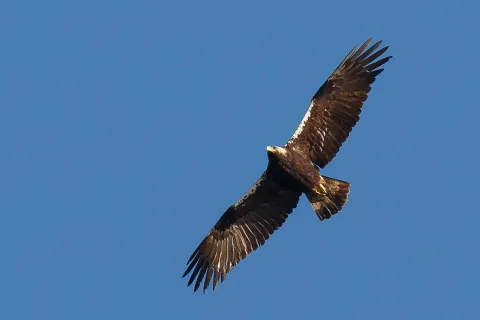
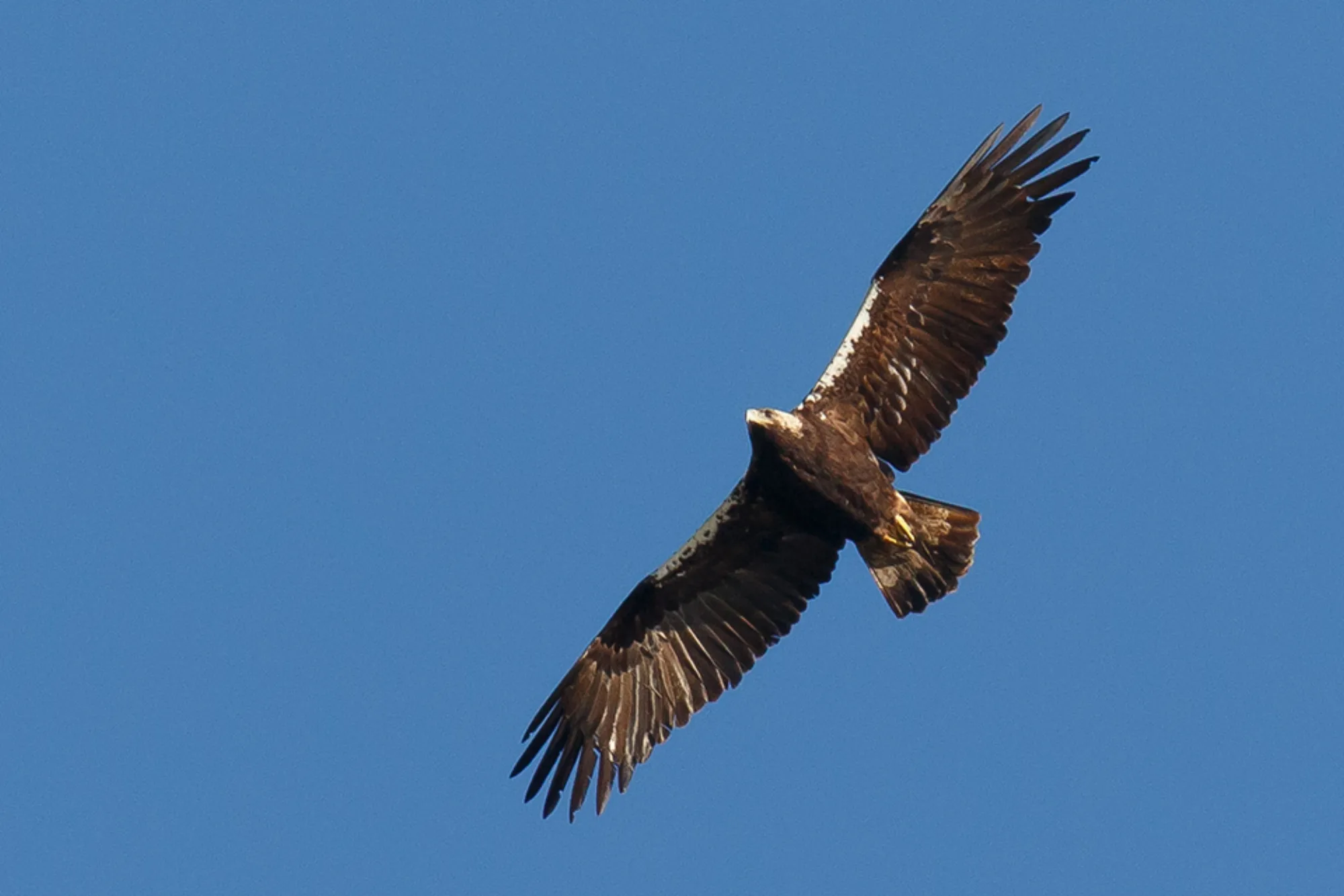
In the woodlands of the Iberian Peninsula, the Spanish Imperial Eagle cuts a large, dark figure, with a wingspan of 177 to 220 cm. Adults are blackish-brown from throat to belly, with a pale tawny crown and nape and a conspicuous white band along the shoulder and front edge of the wing. Young birds look strikingly different, with pale straw-sandy plumage and broad black bands above and below the wings. In flight, its wing profile is generally flatter than that of a golden eagle.
The species lives year-round in central and south-west Spain and neighbouring parts of Portugal, with a stronghold in the dehesa woodlands of Spain. It usually nests in dry, mature woodland, often near scrubby openings and wetlands where prey gathers. Shy around people and strongly territorial, pairs favour nesting places with little human disturbance and tend to keep a stable home range. They nest from February to April, building in mature cork oaks or pines; a new nest can measure as much as 1.5 m across and grows over time. Clutches usually contain two to three eggs, and the young fledge at 63 to 77 days, though they may linger long afterwards.
European rabbits are its main food, but the eagle also takes other mammals and a wide variety of birds, including coots, ducks and geese. Its habitat is shrinking as people encroach, while pylons and illegal poisoning pose further threats. Disease has reduced rabbit populations, while disturbance, destruction and collapsing nests can kill nestlings. Powerline mitigation, supplementary feeding, nest repairs, reintroductions and reduced disturbance of breeding birds have helped the population recover.
Written from the English Wikipedia article Spanish imperial eagle (CC BY-SA 4.0).
- Records
- 29,782
- Countries
- 3
No atlas park has a record of the Spanish Imperial Eagle in or around it yet.
These are open occurrence records, so they show where people looked for and recorded the Spanish Imperial Eagle as much as where it lives. Cells are up to 25 km across, and every location is generalised to its cell.
Generalised encounter areas, not exact locations. Each shape is a grid cell coloured by how likely the species is there.
- Very likelySpain25 km zone · high confidence · 29424 records · updated 80 days ago
- Very likelyMorocco25 km zone · high confidence · 358 records · updated 80 days ago
Conservation status not assessed here yet, so every location is generalised to its grid cell.