Common Swift
Apus apus
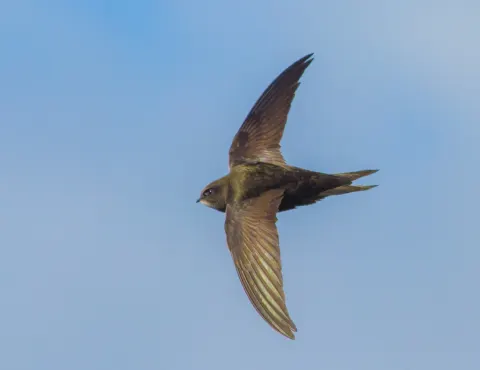
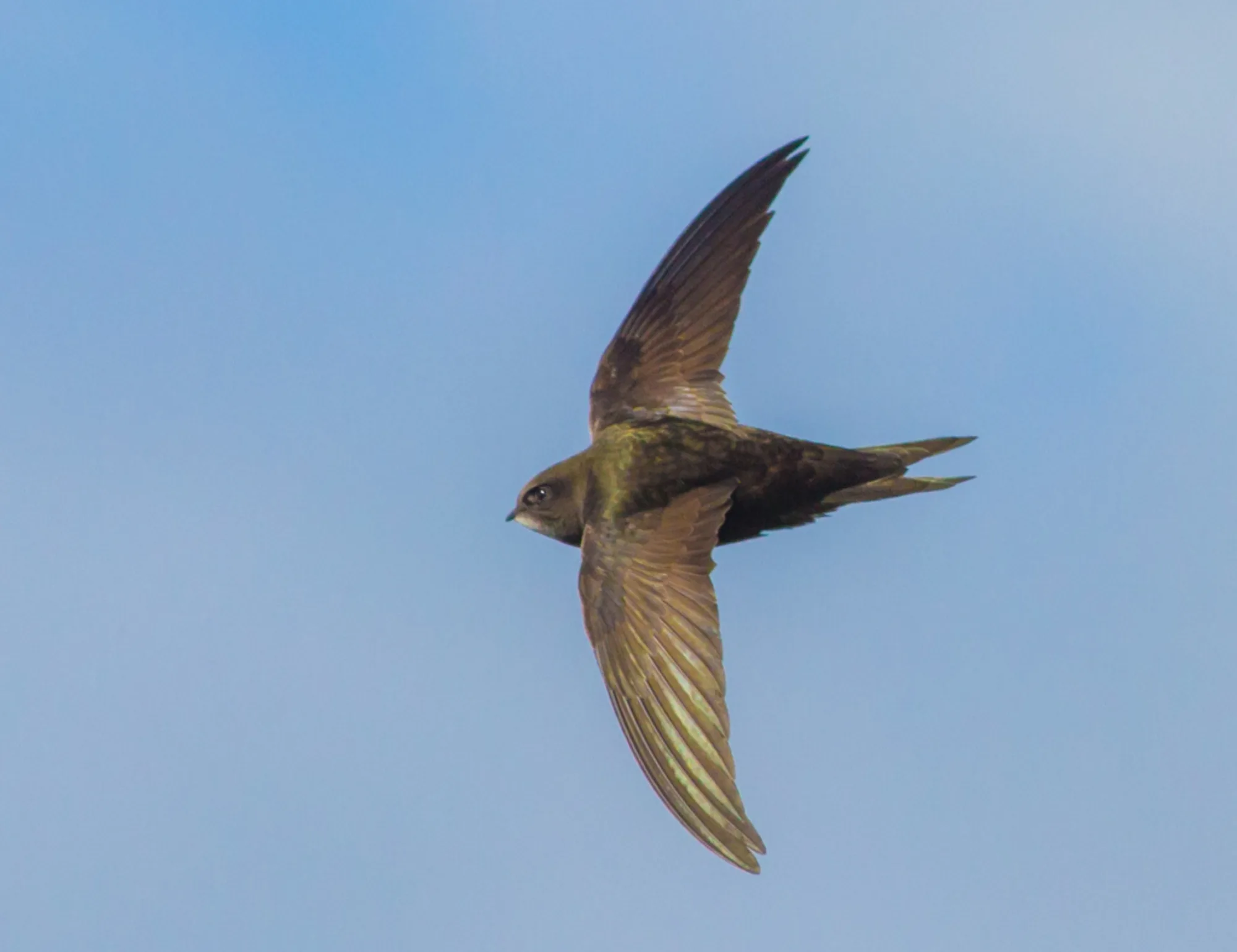
Look up on a summer evening and a Common Swift may announce itself with a loud, high scream. This medium-sized bird is slightly larger than a barn swallow or house martin, with a dark brown underside and a small pale patch under its chin. Its very long, swept-back wings form a crescent or boomerang shape, while its tail is short and forked. Quick, deep wingbeats give way to long glides, helping distinguish it from the more fluttering swallow. Around nesting areas, groups of 10 to 20 swifts often gather in flight, calling to birds at their nests.
The breeding range stretches from Portugal and Ireland across Europe to China and Siberia, reaching northern Africa and parts of the Middle East. Common Swifts migrate to equatorial and sub-equatorial Africa, travelling by several routes. In Central Europe they favour lowlands and places near water, and insect-rich wetlands can draw large feeding parties. Except when nesting, they live in the air, catching insects in flight and drinking and often sleeping on the wing. Some individuals spend 10 months without landing. In bad weather, migrating swifts follow rivers, where food can be easier to find.
Most nest in buildings, using hollows beneath tiles, window sills and eaves or within gables. They also nest in tree holes, cliffs, crevices and nestboxes. Pairs may stay together for years, returning to the same site and repairing the nest with material caught in flight. As ancient forests have largely disappeared across their nesting range, swifts have adapted to sites made by people. On the ground they are vulnerable to accidents and predators, while insects can consume much of the material in their nests.
Written from the English Wikipedia article Common swift (CC BY-SA 4.0).
- Records
- 702,446
- Countries
- 141
- Atlas places
- 32
- Annapurna Conservation Area· Nepal
- Hemis National Park· India
- Ngorongoro Conservation Area· Tanzania
- Okavango Delta· Botswana
- Zambezi National Park· Zimbabwe
- Akagera National Park· Rwanda
- Chobe National Park· Botswana
- Serengeti National Park· Tanzania
- uKhahlamba-Drakensberg Park· South Africa
- Volcanoes National Park· Rwanda
- Aberdare National Park· Kenya
- Amboseli National Park· Kenya
- Arusha National Park· Tanzania
- Bwabwata National Park· Namibia
- Bwindi Impenetrable National Park· Uganda
- Etosha National Park· Namibia
- Hell's Gate National Park· Kenya
- Hwange National Park· Zimbabwe
- Kasanka National Park· Zambia
- Kgalagadi Transfrontier Park· South Africa
- Kruger National Park· South Africa
- Lake Manyara National Park· Tanzania
- Lake Mburo National Park· Uganda
- Lake Nakuru National Park· Kenya
- Liuwa Plain National Park· Zambia
- Mana Pools National Park· Zimbabwe
- Murchison Falls National Park· Uganda
- Nairobi National Park· Kenya
- Queen Elizabeth National Park· Uganda
- Skeleton Coast· Namibia
- Tsavo East National Park· Kenya
- Tsavo West National Park· Kenya
These are open occurrence records, so they show where people looked for and recorded the Common Swift as much as where it lives. Cells are up to 25 km across, and every location is generalised to its cell.
Generalised encounter areas, not exact locations. Each shape is a grid cell coloured by how likely the species is there.
- Very likelyUnited Kingdom25 km zone · high confidence · 202796 records · updated 86 days ago
- Very likelySpain25 km zone · high confidence · 88253 records · updated 86 days ago
- Very likelyNorway25 km zone · high confidence · 79674 records · updated 86 days ago
- Very likelyBelgium25 km zone · high confidence · 53564 records · updated 86 days ago
- Very likelyFrance25 km zone · high confidence · 53167 records · updated 86 days ago
- Very likelyPortugal25 km zone · high confidence · 31631 records · updated 86 days ago
- Very likelyFinland25 km zone · high confidence · 29759 records · updated 86 days ago
- Very likelyPalestinian Territories25 km zone · high confidence · 15001 records · updated 86 days ago
- Very likelySweden25 km zone · high confidence · 11878 records · updated 86 days ago
- Very likelyCzechia25 km zone · high confidence · 10293 records · updated 86 days ago
Conservation status not assessed here yet, so every location is generalised to its grid cell.