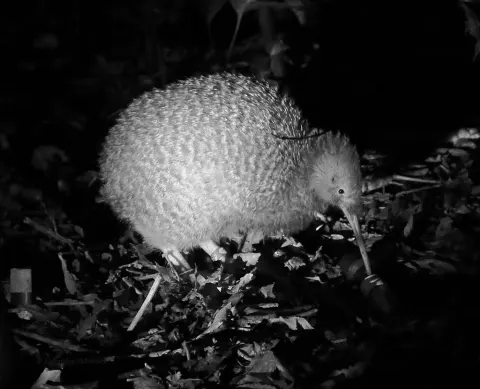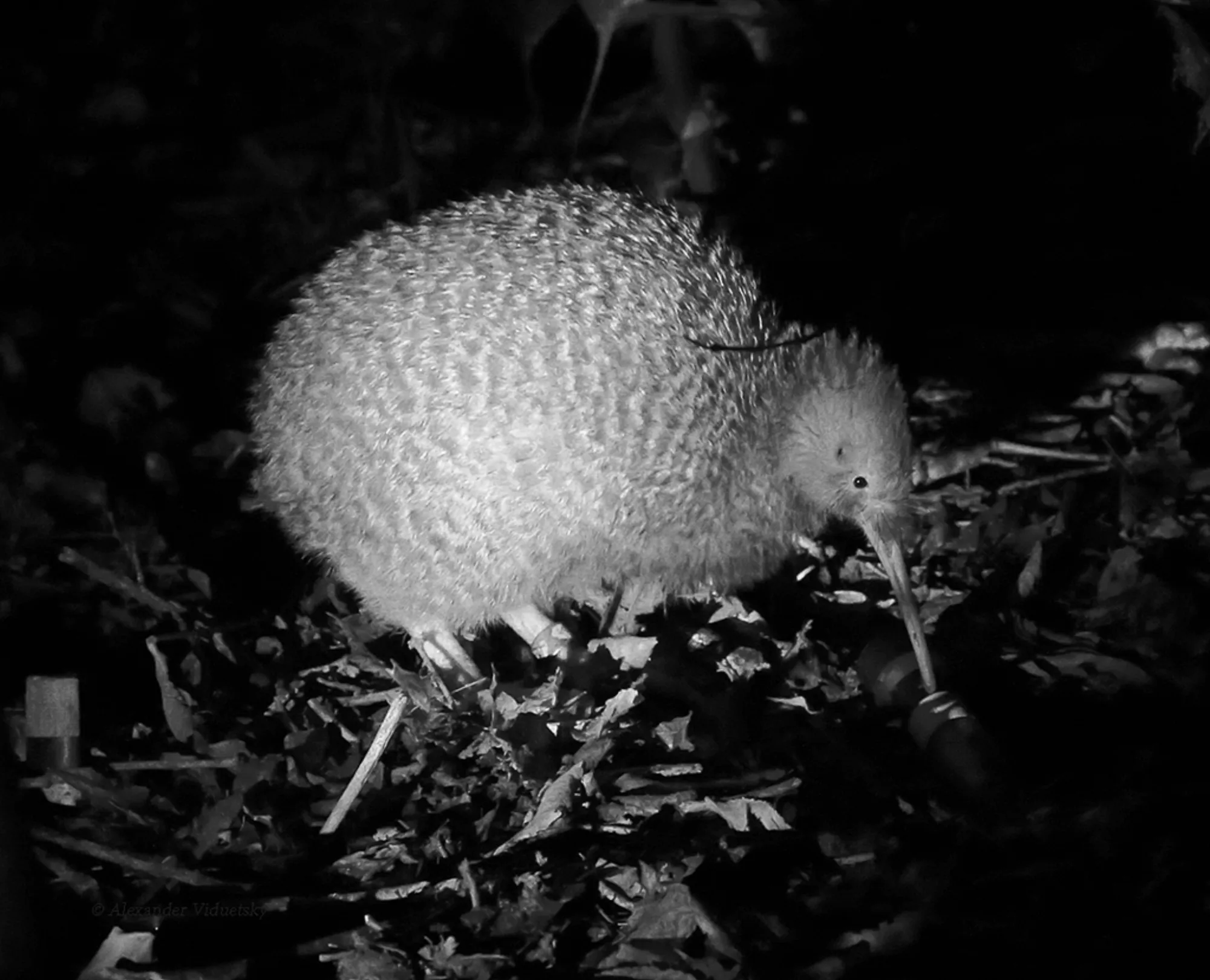
Little Spotted Kiwi
Apteryx owenii
Small enough to be compared with a bantam, the Little Spotted Kiwi is a flightless New Zealand bird with shaggy, pale grey feathers flecked with white. It has a long, ivory-coloured bill, pale legs and no tail, and measures 35 to 45 cm in length. Once found on both main islands, it now lives mainly on small offshore islands and in mainland reserves protected by pest-exclusion fences. On Kapiti Island, it favours flax and forest habitats, with fewer birds in rough grassland and scrub. In 2025, two birds were found outside a fenced sanctuary in the South Island's Adams Wilderness Area, the first mainland rediscovery outside a sanctuary since 1978.
Little spotted kiwis are nocturnal, calling at night to mark territory and keep in touch with their partners, sometimes singing as a pair. They are strongly territorial and can fight other kiwis with their claws. With poor eyesight, they rely on smell, their long bills and their claws to find food, digging into the soil before probing it. Earthworms, insect larvae, caterpillars and spiders are among their common foods, and they also eat fruit. Both birds excavate a nesting burrow, which they may line with plant material. Between July and January, the female lays one or two eggs, which the male incubates for 63 to 76 days. After hatching, the young remain in their nest for 2 to 3 weeks and need food for 4 weeks.
Cats, dogs and stoats are major threats, while the kiwi's small range also puts it at risk. Offshore island reserves, largely free of introduced predators, provide protection for much of the population.
Written from the English Wikipedia article Little spotted kiwi (CC BY-SA 4.0).
- Records
- 1,592
- Countries
- 1
- Atlas places
- 1
These are open occurrence records, so they show where people looked for and recorded the Little Spotted Kiwi as much as where it lives. Cells are up to 25 km across, and every location is generalised to its cell.
Generalised encounter areas, not exact locations. Each shape is a grid cell coloured by how likely the species is there.
- Very likelyNew Zealand25 km zone · high confidence · 1592 records · updated 80 days ago
Conservation status not assessed here yet, so every location is generalised to its grid cell.