Black Ghost
Apteronotus albifrons
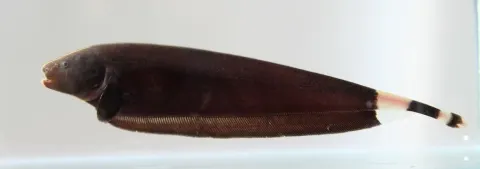
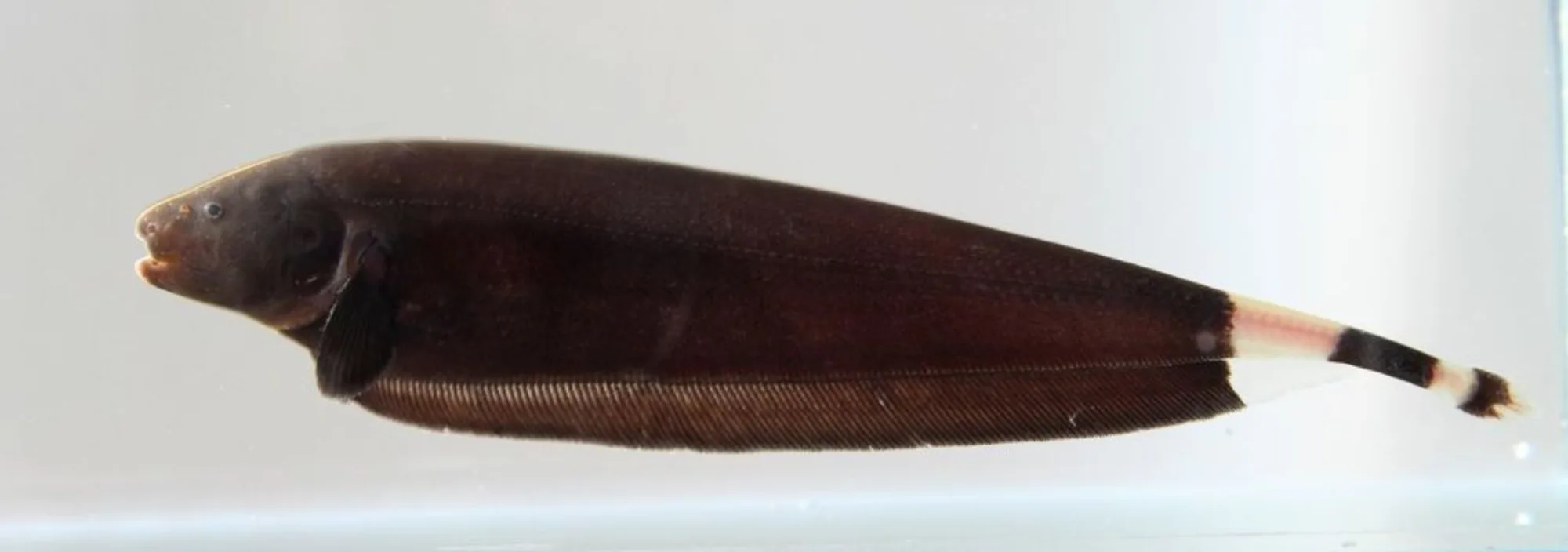
At night in South American freshwaters, the Black Ghost hunts with the help of weak electric signals. This tropical knifefish has a long, flattened black body, a large mouth and two pale rings near its tail. A white blaze marks its nose and sometimes continues as a stripe down its back. Adults can reach 45 to 50 centimetres in length. A long fin underneath the body ripples to move the fish through the water, while its back has no fin. It can swim forwards, backwards and sideways, hover, and even turn upside down.
Its range extends from Venezuela to the Paraguay, Paraná River and includes the Amazon Basin. It lives in river systems and small creeks, using both the water column and the bottom. In darkness or muddy water, it uses electrical sensing to find prey, and can detect water disturbances as it navigates. It mainly eats insect larvae, along with small fish and crustaceans, sometimes catching them in a quick lunge. Black Ghosts lay sticky eggs irregularly, choosing concealed sites and placing eggs singly in tiny holes or gaps. Eggs are deposited from night to early morning, and young fish can reach maturity at around 1 year old or earlier.
Predatory fish attack Black Ghosts in the wild, sometimes leaving damage near the tail. People also take them from their natural habitats to supply demand for ornamental fish. Many ornamental fish collected in the Amazon are absent from official export registers, and intensive fishing could exhaust populations commercially.
Written from the English Wikipedia article Black ghost knifefish (CC BY-SA 4.0).
- Records
- 59
- Countries
- 6
No atlas park has a record of the Black Ghost in or around it yet.
These are open occurrence records, so they show where people looked for and recorded the Black Ghost as much as where it lives. Cells are up to 25 km across, and every location is generalised to its cell.
Generalised encounter areas, not exact locations. Each shape is a grid cell coloured by how likely the species is there.
- Very likelySuriname25 km zone · medium confidence · 43 records · updated 80 days ago
- Very likelyColombia25 km zone · medium confidence · 7 records · updated 80 days ago
- LikelyParaguay25 km zone · medium confidence · 3 records · updated 80 days ago
- LikelyPeru25 km zone · medium confidence · 3 records · updated 80 days ago
- PossibleBrazil25 km zone · medium confidence · 3 records · updated 80 days ago
- PossibleArgentina25 km zone · low confidence · 0 records · updated 80 days ago
Conservation status not assessed here yet, so every location is generalised to its grid cell.