King Penguin
Aptenodytes patagonicus
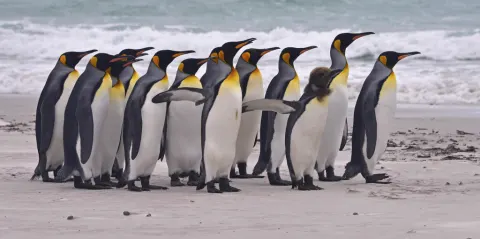
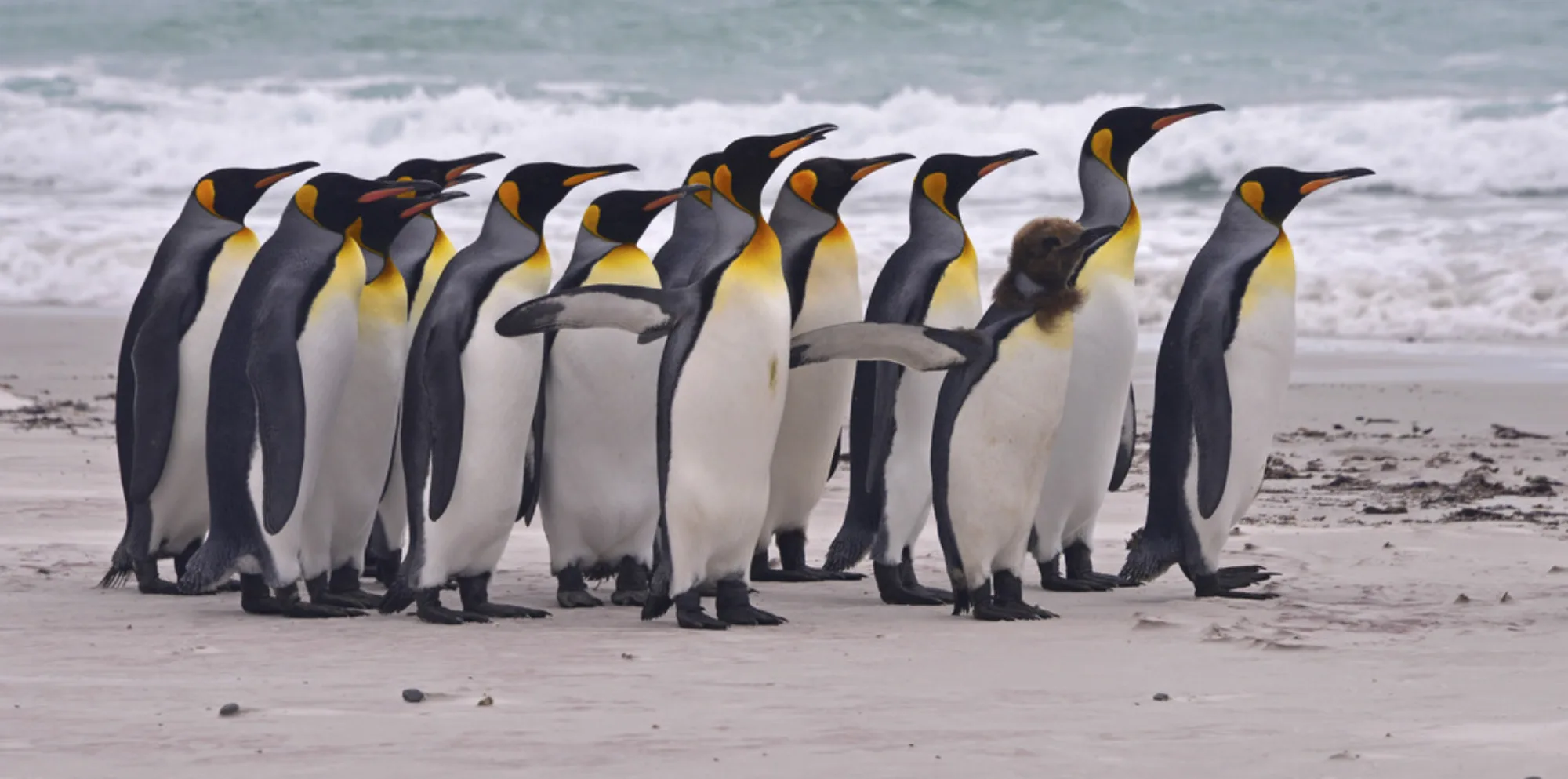
Standing 70 to 100 cm tall, the King Penguin is the second largest penguin, with a sleek body and a long, straight bill. Adults have bright orange cheek patches, orange on the upper chest and a sooty-grey back, while chicks wear thick, dark brown down. Its breeding range includes subantarctic islands near Antarctica, South Georgia, the Falkland Islands, southern Argentina and other temperate islands. Macquarie Island in the Southern Ocean is another place where it lives.
At sea, these flightless birds hunt mainly lanternfish, squid and krill, diving repeatedly below 100 metres on foraging trips. On land they walk with a wobble or slide across ice on their bellies, pushing themselves along with their feet and flippers. King Penguins gather in huge breeding colonies that remain occupied throughout the year by adults and chicks. They build no nests: parents take turns keeping their single egg on their feet, then shelter and feed the chick. Older chicks gather in groups called crèches while most parents go out to forage. The long breeding cycle takes around 14 to 16 months from laying until the young bird fledges.
Giant petrels and skuas take chicks and eggs, while leopard seals and orcas hunt penguins at sea. Warming oceans could move feeding areas farther from breeding grounds, and changes in prey linked to climate change pose a threat to a bird that seldom varies its diet. Large-scale commercial fishing could also reduce its supply of myctophid fish. In the past, people exploited King Penguins for their oil, meat, feathers and blubber; today the birds are fully protected.
Written from the English Wikipedia article King penguin (CC BY-SA 4.0).
- Records
- 113,161
- Countries
- 8
No atlas park has a record of the King Penguin in or around it yet.
These are open occurrence records, so they show where people looked for and recorded the King Penguin as much as where it lives. Cells are up to 25 km across, and every location is generalised to its cell.
Generalised encounter areas, not exact locations. Each shape is a grid cell coloured by how likely the species is there.
- Very likelyUnnamed area25 km zone · high confidence · 85978 records · updated 80 days ago
- Very likelyHeard & McDonald Islands25 km zone · high confidence · 14976 records · updated 80 days ago
- Very likelySouth Georgia & South Sandwich Islands25 km zone · high confidence · 5488 records · updated 80 days ago
- Very likelyFrench Southern Territories25 km zone · high confidence · 1914 records · updated 80 days ago
- Very likelyAustralia25 km zone · high confidence · 1280 records · updated 80 days ago
- Very likelyFalkland Islands25 km zone · high confidence · 1115 records · updated 80 days ago
- Very likelyChile25 km zone · high confidence · 1035 records · updated 80 days ago
- Very likelySouth Africa25 km zone · high confidence · 1032 records · updated 80 days ago
- Very likelyArgentina25 km zone · high confidence · 343 records · updated 80 days ago
Conservation status not assessed here yet, so every location is generalised to its grid cell.