Emperor Penguin
Aptenodytes forsteri
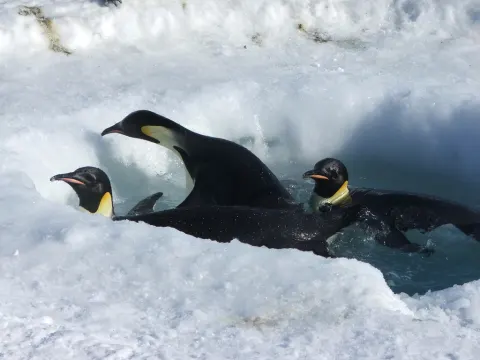
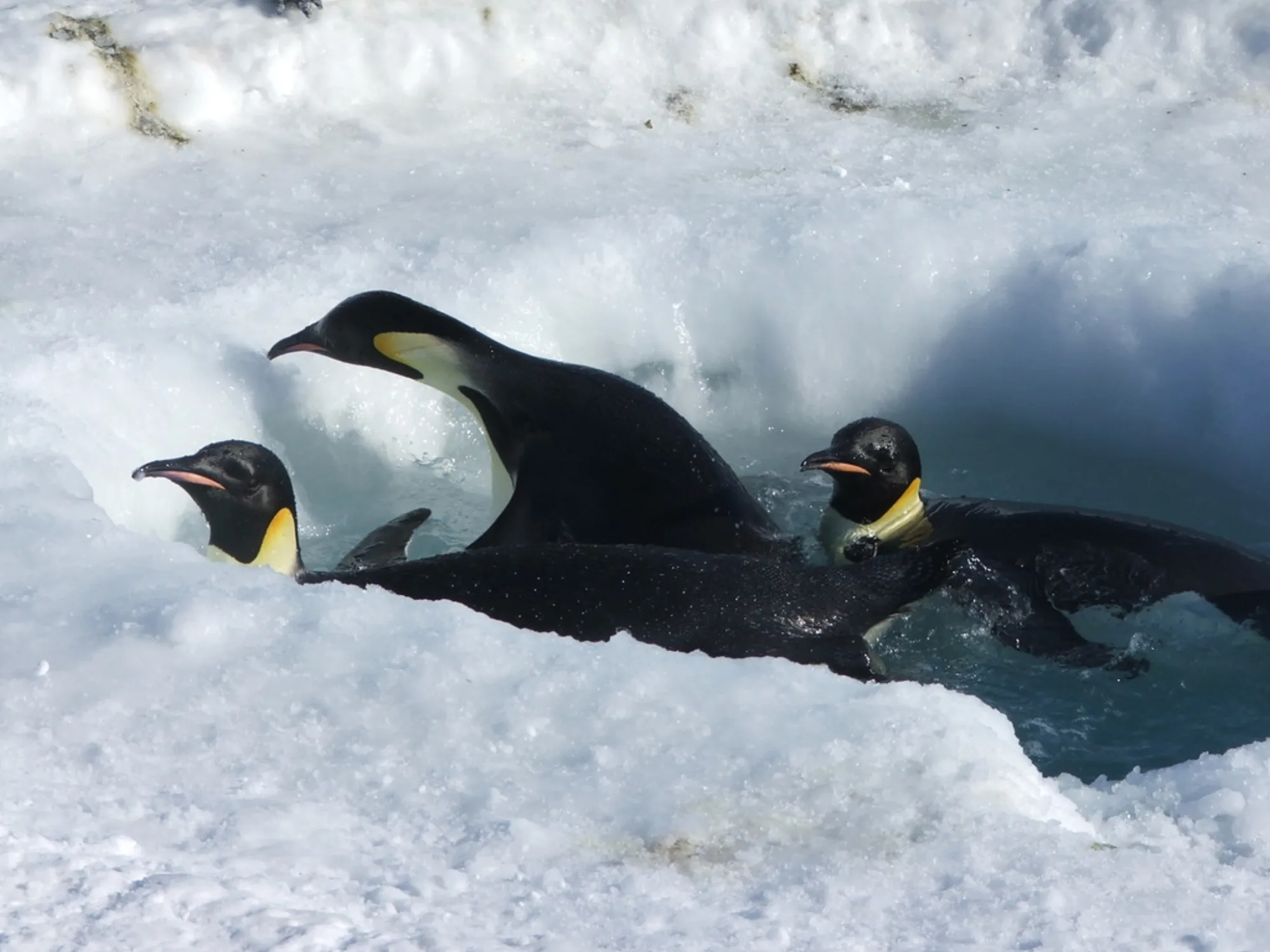
Tallest and heaviest among living penguins, the Emperor Penguin (Aptenodytes forsteri) is found naturally only in Antarctica. Adults have black heads and backs, white bellies, pale yellow breasts and bright yellow patches by the ears. Males and females look similar, while chicks wear silver-grey down, black heads and white masks. Flightless like other penguins, emperors swim with stiff, flat flippers and cross the ice either on foot or sliding on their bellies.
Their breeding colonies are usually on stable pack ice near the coast, often sheltered from the wind by ice cliffs and icebergs. Emperors are social when nesting and hunting, and birds feeding together may coordinate their dives and returns to the surface. They search for fish, krill and squid in open water or cracks in pack ice, and can stay underwater for around 20 minutes. In the Antarctic winter, they travel 50 to 120 km over ice to colonies that can hold several thousand birds. The female lays one egg, then returns to sea to feed while the male incubates it for just over two months. Later, the parents take turns feeding at sea and caring for their chick. Adults also huddle against the cold, slowly moving around the group so each bird can spend time inside.
Climate change and industrial fishing can reduce the fish and crustaceans available to eat. Changes in sea ice can also disrupt breeding: at Halley Bay, low sea ice, strong winds and a strong El Niño brought almost total breeding failure for three consecutive years. Human disturbance at colonies is another concern, with chicks becoming more apprehensive after a helicopter approached.
Written from the English Wikipedia article Emperor penguin (CC BY-SA 4.0).
- Records
- 40,515
- Countries
- 1
No atlas park has a record of the Emperor Penguin in or around it yet.
These are open occurrence records, so they show where people looked for and recorded the Emperor Penguin as much as where it lives. Cells are up to 25 km across, and every location is generalised to its cell.
Generalised encounter areas, not exact locations. Each shape is a grid cell coloured by how likely the species is there.
- Very likelyAntarctica25 km zone · high confidence · 40039 records · updated 80 days ago
- Very likelyUnnamed area25 km zone · high confidence · 476 records · updated 80 days ago
Conservation status not assessed here yet, so every location is generalised to its grid cell.