Wood Mouse
Apodemus sylvaticus
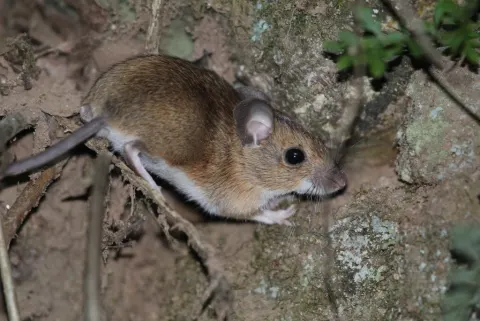
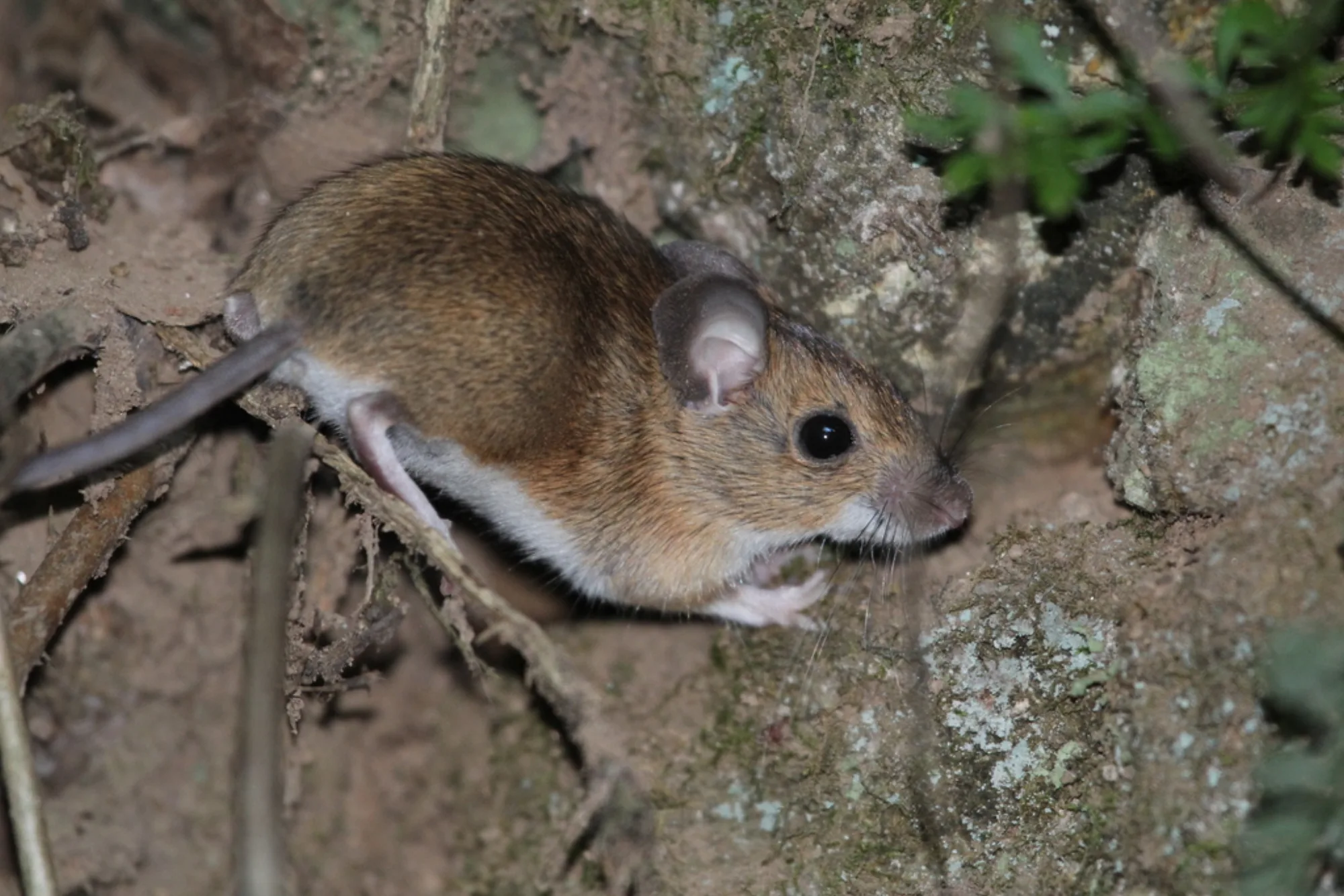
Across much of Europe and northwestern Africa, the Wood Mouse (Apodemus sylvaticus) is a common, widespread rodent that also lives alongside people. It reaches around 90 mm in length and weighs about 23 g. Compared with the closely related yellow-necked mouse, it has slightly smaller ears and lacks a yellow band around its neck. Its European range reaches north to Scandinavia and east to Ukraine, and it also occurs on many Mediterranean islands. It lives in forests, grasslands and cultivated fields, although it favours hedgerows over woodland and seeks more wooded places in winter.
Wood mice are almost entirely nocturnal and live on the ground, digging extensive burrows and building nests from plants. Breeding females may venture out more often in daylight to gather enough food. During exploration they use conspicuous leaves and twigs as landmarks, picking them up and distributing them while foraging. Seeds, especially those of trees such as oak, beech and ash, form much of their diet, and they store plentiful finds in nests or burrows. When seeds are scarce in late spring and early summer, they may eat snails and insects; later they take berries, fruit, fungi and roots. They do not hibernate, though severe winter weather can bring on a state of reduced activity, and they live in buildings during harsh seasons.
Breeding runs from February to October, and females produce an average of four young per year. The young become independent after about three weeks. Owls and other birds of prey hunt wood mice, as do foxes, weasels, snakes, dogs and cats. A mouse caught by the tail can shed its tip, which may never grow back.
Written from the English Wikipedia article Wood mouse (CC BY-SA 4.0).
- Records
- 22,279
- Countries
- 17
No atlas park has a record of the Wood Mouse in or around it yet.
These are open occurrence records, so they show where people looked for and recorded the Wood Mouse as much as where it lives. Cells are up to 25 km across, and every location is generalised to its cell.
Generalised encounter areas, not exact locations. Each shape is a grid cell coloured by how likely the species is there.
- Very likelyUnited Kingdom25 km zone · high confidence · 6741 records · updated 80 days ago
- Very likelyFrance25 km zone · medium confidence · 6113 records · updated 80 days ago
- Very likelySwitzerland25 km zone · high confidence · 5638 records · updated 80 days ago
- Very likelyNorway25 km zone · medium confidence · 1609 records · updated 80 days ago
- Very likelyLuxembourg25 km zone · high confidence · 666 records · updated 80 days ago
- Very likelyBelgium25 km zone · high confidence · 277 records · updated 80 days ago
- Very likelyPoland25 km zone · high confidence · 266 records · updated 80 days ago
- Very likelyItaly25 km zone · high confidence · 166 records · updated 80 days ago
- Very likelyLiechtenstein25 km zone · high confidence · 116 records · updated 80 days ago
- Very likelyCroatia25 km zone · medium confidence · 111 records · updated 80 days ago
Conservation status not assessed here yet, so every location is generalised to its grid cell.