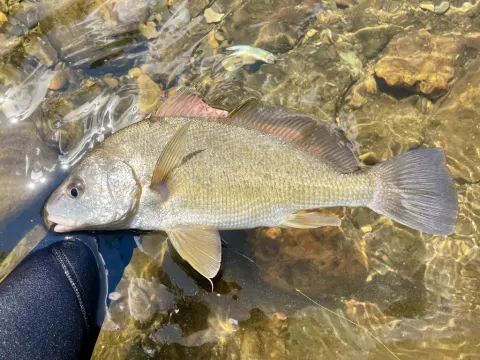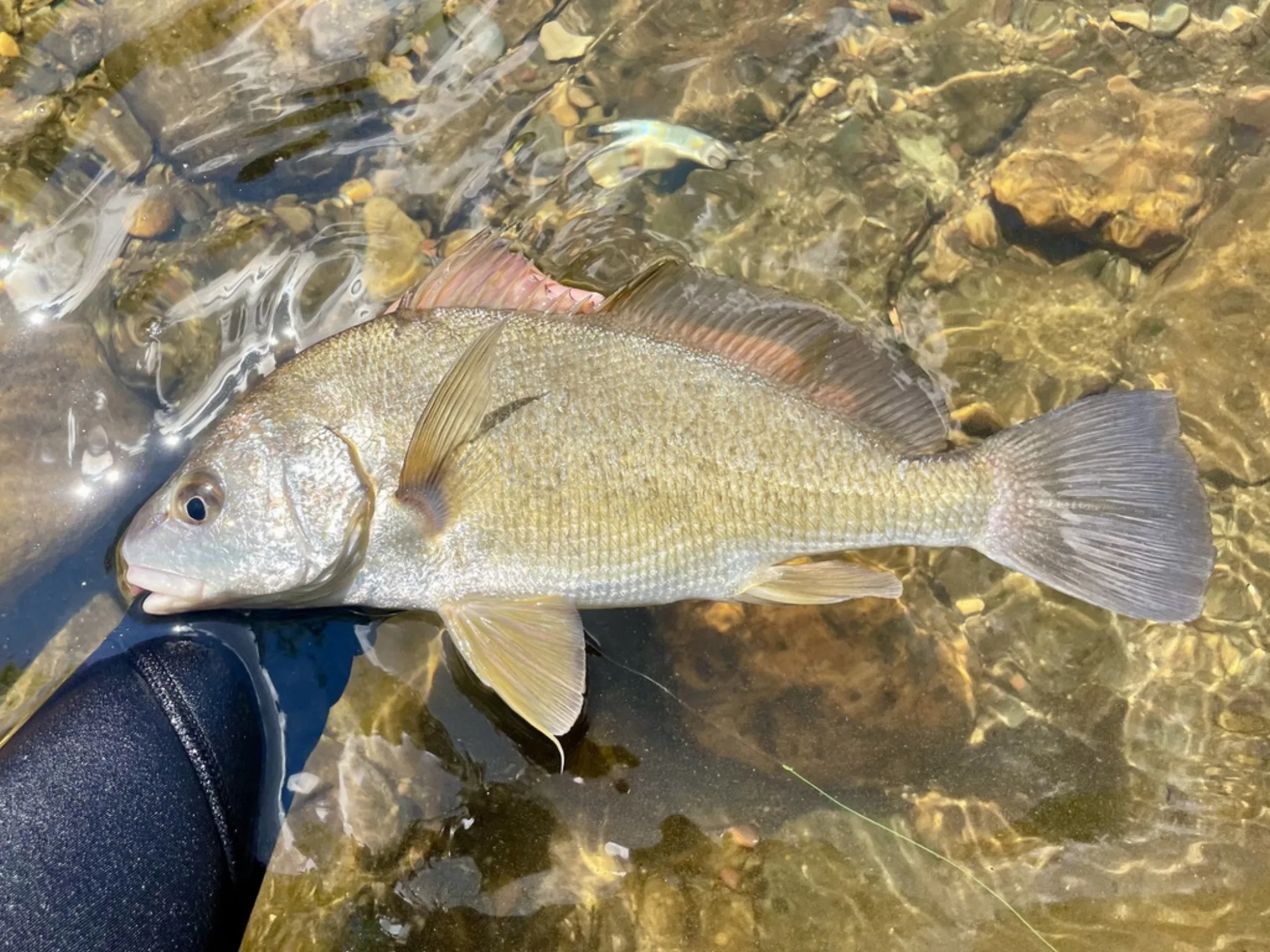
Freshwater Drum
Aplodinotus grunniens
Silvery grey or sometimes bronze-brown, the Freshwater Drum has a deep body and a divided dorsal fin. Its long, pointed side fins and rounded or pointed tail add to its distinctive outline. Typically weighing 2.3 to 6.8 kg, this fish lives only in fresh water throughout its life.
Its range extends from Hudson Bay south to Guatemala, and from the eastern Appalachians west into Texas, Kansas and Oklahoma. It favours clear water over clean sand and gravel, but can tolerate water that is murky. Strongly nocturnal, it is most often caught during night fishing or sampling. In summer, it moves into warm shallows less than 10 m deep. Spawning takes place in open water from June through July, over a period of six to seven weeks, when the water reaches about 18 °C. The eggs float upwards and hatch in two to four days, with no parental care for the larvae.
Freshwater Drum generally feed near the bottom on aquatic insect larvae and bivalve mussels, though small fish also feature in their diet in some ecosystems. Their food changes with the seasons: in April and May they eat flies, while from August through November fish become an important part of the diet. Crayfish and other molluscs are also eaten. Young drum provide food for predatory fish, including smallmouth bass and walleye; after the first year, humans are their main predators. They are caught commercially, particularly on the Mississippi River, and are also taken as bycatch when fisheries target more valuable species. Many eggs and larvae are eaten by predators, especially after hatching.
Written from the English Wikipedia article Freshwater drum (CC BY-SA 4.0).
- Records
- 4,594
- Countries
- 3
No atlas park has a record of the Freshwater Drum in or around it yet.
These are open occurrence records, so they show where people looked for and recorded the Freshwater Drum as much as where it lives. Cells are up to 25 km across, and every location is generalised to its cell.
Generalised encounter areas, not exact locations. Each shape is a grid cell coloured by how likely the species is there.
- Very likelyUnited States25 km zone · medium confidence · 4459 records · updated 80 days ago
- Very likelyCanada25 km zone · high confidence · 135 records · updated 80 days ago
Conservation status not assessed here yet, so every location is generalised to its grid cell.