Black Scabbardfish
Aphanopus carbo
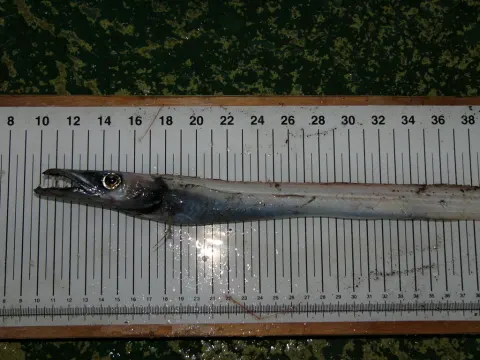
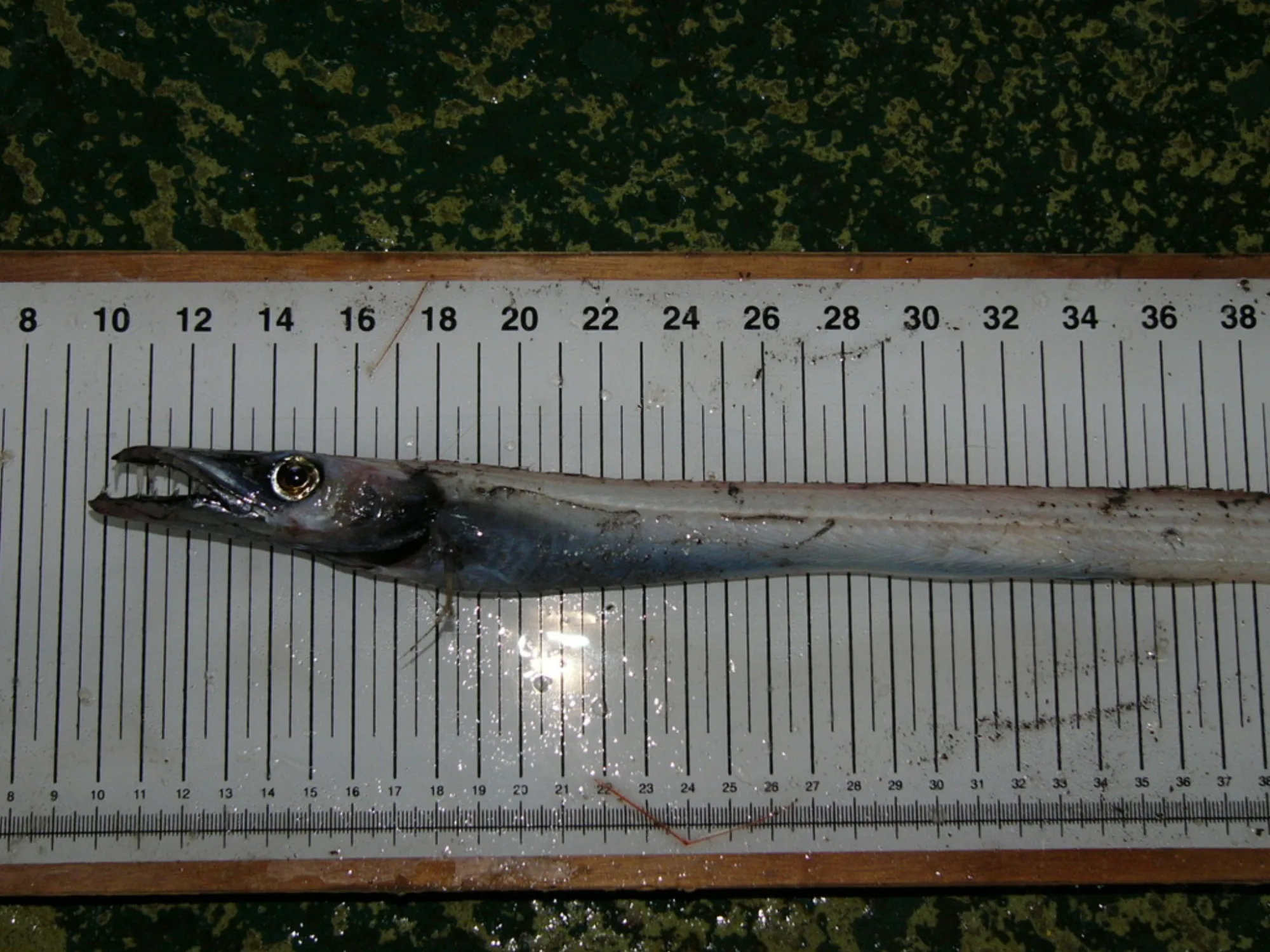
Long and slender, the Black Scabbardfish has a pointed head, large eyes and a mouth armed with fang-like teeth. Its coppery-black colour has an iridescent sheen, while the inside of its mouth is black. A long dorsal fin runs along its elongated body, which is adapted for fast swimming. It can reach 110 cm in length and matures at around 80 to 85 cm.
This deep-water cutlassfish lives in the Atlantic between 69°N and 27°N, at depths of 180 to 1,700 m. It is abundant between 800 and 1,300 m, while juveniles are thought to live at 100 to 500 m. By day it stays in deep water, rising at night to hunt at middle depths. Its varied diet includes crustaceans, cephalopods and other fish, with blue whiting and other midwater fish among its possible preferred prey.
Much of its life cycle remains uncertain, although one hypothesis proposes a broad clockwise migration around the Northeast Atlantic. Young fish reportedly spend several years feeding and growing south of the Faroe Islands and west of the British Isles before moving south. Spawning takes place near Madeira and the Canary Islands, with other possible grounds off northwestern Africa. The fish can spawn more than once during its life, and its eggs and larvae drift with the plankton. It is commercially valuable and caught by line gear in Portuguese waters and by trawlers around France and Ireland. The species is highly vulnerable to overfishing, and its abundance is declining in some parts of the Northeast Atlantic.
Written from the English Wikipedia article Black scabbardfish (CC BY-SA 4.0).
- Records
- 55
- Countries
- 6
No atlas park has a record of the Black Scabbardfish in or around it yet.
These are open occurrence records, so they show where people looked for and recorded the Black Scabbardfish as much as where it lives. Cells are up to 25 km across, and every location is generalised to its cell.
Generalised encounter areas, not exact locations. Each shape is a grid cell coloured by how likely the species is there.
- Very likelyGreenland25 km zone · medium confidence · 13 records · updated 80 days ago
- Very likelyUnited Kingdom25 km zone · medium confidence · 11 records · updated 80 days ago
- Very likelyIreland25 km zone · medium confidence · 9 records · updated 80 days ago
- LikelyUnnamed area25 km zone · medium confidence · 15 records · updated 80 days ago
- LikelyCanada25 km zone · medium confidence · 4 records · updated 80 days ago
- LikelyPortugal25 km zone · medium confidence · 3 records · updated 80 days ago
- UncommonSpain25 km zone · low confidence · 0 records · updated 80 days ago
Conservation status not assessed here yet, so every location is generalised to its grid cell.