Spiny Softshell Turtle
Apalone spinifera
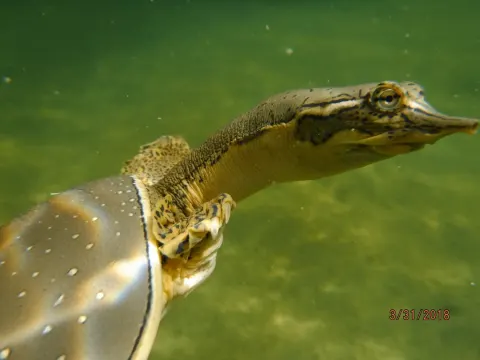
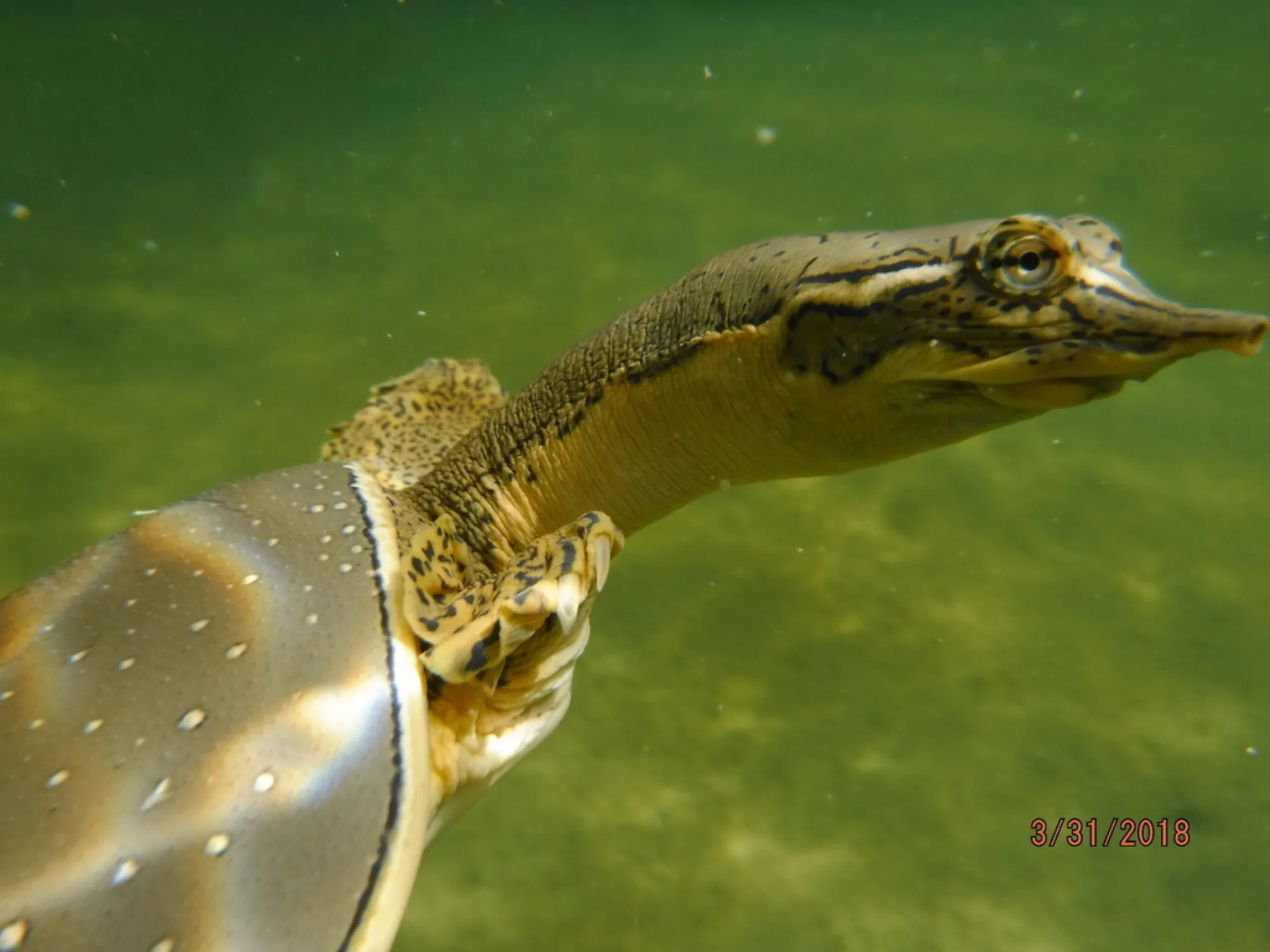
With its leathery, flexible shell and long, fleshy nose, the Spiny Softshell Turtle is one of North America's largest freshwater turtles. Its upper shell can be olive, brown or yellow-brown, and has small, cone-shaped spines along the front edge, more often seen in males. Pale lines edged in black run from the head along the neck, while webbed feet help distinguish the turtle. The shell measures 18 to 54 cm long, and females grow larger than males. Young turtles usually have dark spots, but females often darken or develop blotches as they age, while males tend to keep their original pattern.
The species ranges across much of the United States, north into Ontario and Quebec and south into several Mexican states. It lives in fresh water, from ponds and lakes to rivers, bayous and streams, and can also persist in urban settings. Look for it in clear, slow-moving water with a sandy bottom and clean, sandy banks. The turtles move between seasonal areas and often spend cold months in tributaries, sometimes returning to the same ones the following year. They feed on crayfish, aquatic insects, fish, mussels, algae and other plant material, hunting actively or waiting beneath the sand to ambush prey.
In spring the turtles mate, and females later dig nests near the water on sunny sandbars or gravel banks. A female may nest more than once in a season, laying 9 to 38 eggs, which hatch in late summer or early autumn. Predators are the main influence on hatching success, and some local populations face pressure. Low-oxygen water is another challenge, particularly during winter dormancy, when these turtles depend on underwater breathing.
Written from the English Wikipedia article Spiny softshell turtle (CC BY-SA 4.0).
- Records
- 960
- Countries
- 3
- Atlas places
- 2
These are open occurrence records, so they show where people looked for and recorded the Spiny Softshell Turtle as much as where it lives. Cells are up to 25 km across, and every location is generalised to its cell.
Generalised encounter areas, not exact locations. Each shape is a grid cell coloured by how likely the species is there.
- Very likelyUnited States25 km zone · medium confidence · 847 records · updated 80 days ago
- Very likelyMexico25 km zone · medium confidence · 96 records · updated 80 days ago
- Very likelyCanada25 km zone · medium confidence · 17 records · updated 80 days ago
Conservation status not assessed here yet, so every location is generalised to its grid cell.