African Clawless Otter
Aonyx capensis
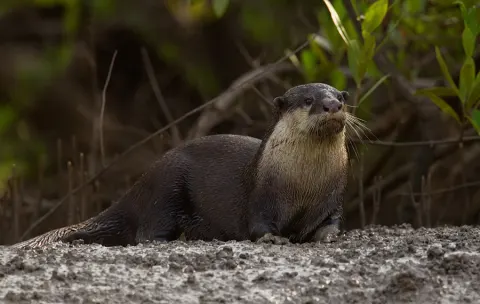
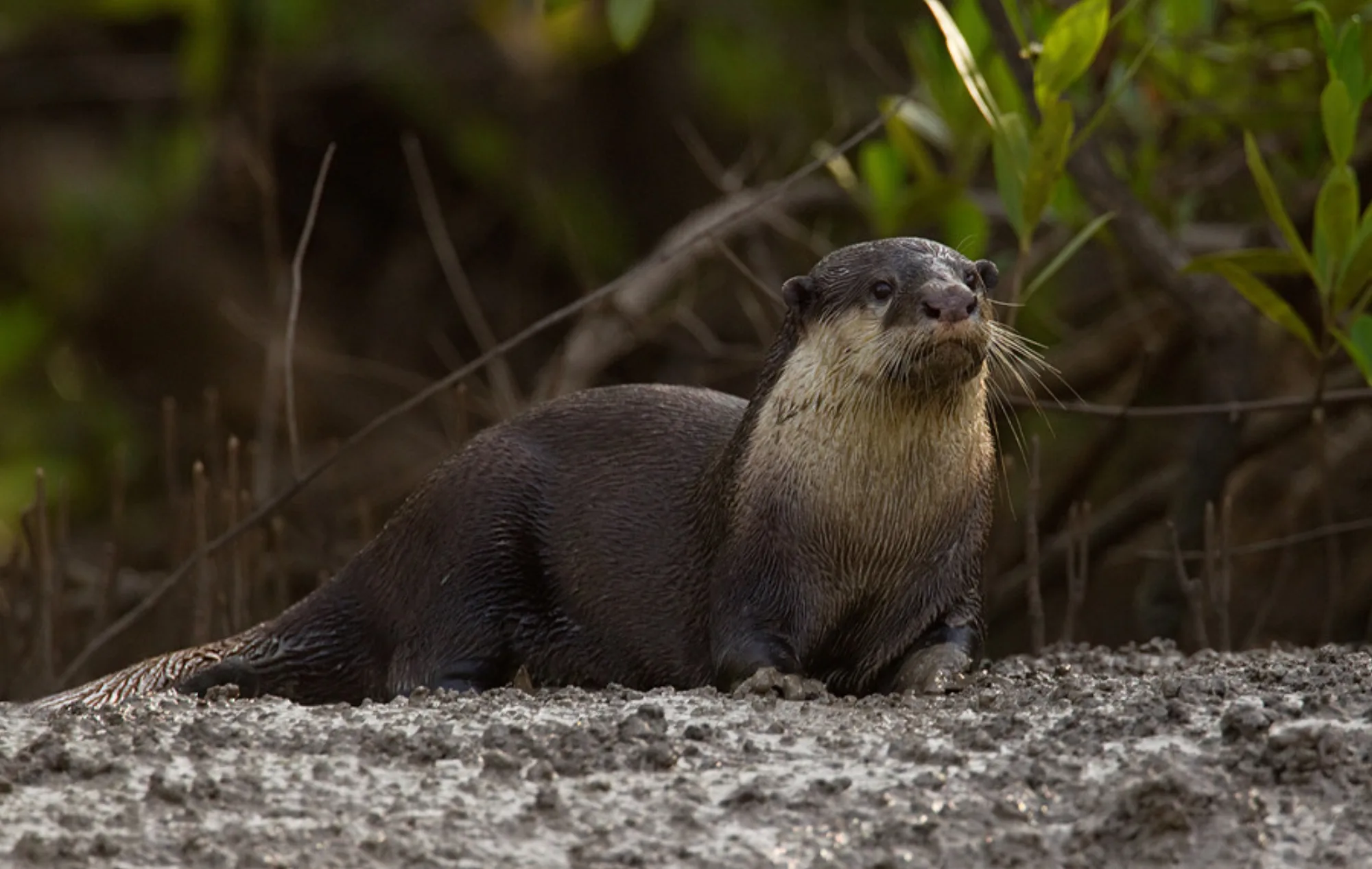
With chestnut-coloured fur and white markings running from its face towards its throat and chest, the African Clawless Otter is a large freshwater otter. Its thick coat is smooth, with an almost silky underside, and its feet are partly webbed. Adults measure 113 to 163 cm including the tail, which accounts for about a third of their length. Despite the name, some toes on the hind feet have claws. Found across much of sub-Saharan Africa, it lives near permanent water in savannah and lowland forest, as well as coastal plains and semiarid areas. Surrounding vegetation offers cover, while logs, branches and loose foliage provide shelter and shade.
In water, the otter uses its tail to propel itself; on land it is slower and rather clumsy. It digs burrows in banks near the water, returning to them for safety and to cool down. In urban areas it is mainly active at night, resting by day in quiet, bushy places. Usually solitary, individuals occupy their own ranges within neighbouring family territories of up to five otters. Crabs are preferred prey, but the otter also eats fish, frogs, worms and insects. It dives for food and brings its catch ashore to eat, using its front paws to search muddy bottoms and look beneath logs. Females give birth to two to five young around early spring and raise them alone.
People pose the greatest threat: otters may be hunted for their pelts or become caught in fishing nets. Overfishing can reduce their food supply, while logging can increase river turbidity and reduce fish populations. Crocodiles and African fish eagles also prey on them, as does the Central African rock python.
Written from the English Wikipedia article African clawless otter (CC BY-SA 4.0).
- Records
- 56
- Countries
- 3
- Atlas places
- 4
These are open occurrence records, so they show where people looked for and recorded the African Clawless Otter as much as where it lives. Cells are up to 25 km across, and every location is generalised to its cell.
Generalised encounter areas, not exact locations. Each shape is a grid cell coloured by how likely the species is there.
- Very likelySouth Africa25 km zone · medium confidence · 52 records · updated 81 days ago
- LikelyBenin25 km zone · medium confidence · 4 records · updated 81 days ago
- UncommonLiberia25 km zone · low confidence · 0 records · updated 81 days ago
Conservation status not assessed here yet, so every location is generalised to its grid cell.