Blackbuck
Antilope cervicapra
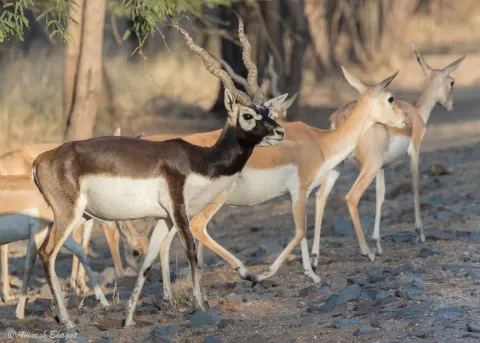
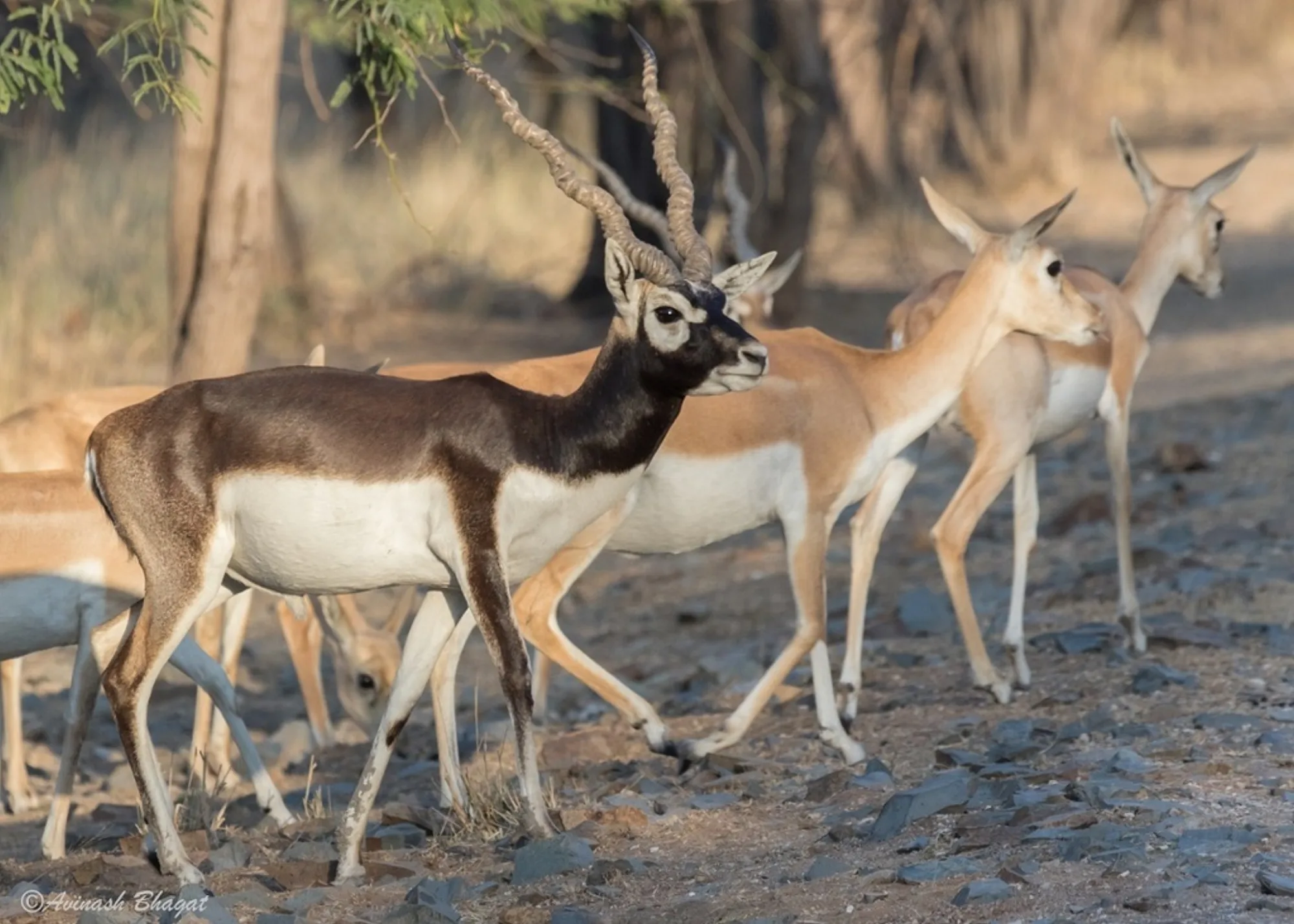
With corkscrew horns and a sharply contrasting coat, the Blackbuck is an antelope of medium size that is native to India and Nepal. Males are dark brown to black over much of the body, with white undersides and inner legs, while females and youngsters are yellowish-fawn to tan. White fur around the eyes and chin stands out against dark facial stripes, and females have a conspicuous white stripe along the side. The horns, usually found on males, measure 35 to 75 cm, although females sometimes grow them too.
Blackbuck live mainly in India, on grassy plains and in lightly wooded country with year-round water. They need to drink daily, and herds may travel long distances to reach water. Once widespread, they now occur mostly in small, scattered herds within protected areas; they have disappeared locally from Pakistan and Bangladesh. In southern Nepal, a surviving population lives in the Blackbuck Conservation Area. The species has also been introduced to Argentina, Australia and the United States, mainly on hunting ranches.
Most activity takes place during the day, although blackbuck are less active at midday in hot summers. They form small groups of females, males or young bachelor males, and herd size changes with habitat and available food. They graze on short grasses and sometimes browse, with Prosopis fruit becoming important when grass is scarce. Breeding occurs throughout the year, and a single calf is born after a pregnancy of about six months. Excessive hunting, deforestation and habitat degradation drove a sharp decline during the 20th century, and some blackbuck are still killed illegally. Floods and droughts can also hit populations hard, while wolves prey on adults and golden jackals hunt juveniles.
Written from the English Wikipedia article Blackbuck (CC BY-SA 4.0).
- Records
- 275
- Countries
- 3
- Atlas places
- 2
These are open occurrence records, so they show where people looked for and recorded the Blackbuck as much as where it lives. Cells are up to 25 km across, and every location is generalised to its cell.
Generalised encounter areas, not exact locations. Each shape is a grid cell coloured by how likely the species is there.
- Very likelyUnited States25 km zone · high confidence · 154 records · updated 80 days ago
- Very likelyIndia25 km zone · medium confidence · 121 records · updated 80 days ago
- PossibleArgentina25 km zone · low confidence · 0 records · updated 80 days ago
Conservation status not assessed here yet, so every location is generalised to its grid cell.