Pronghorn
Antilocapra americana
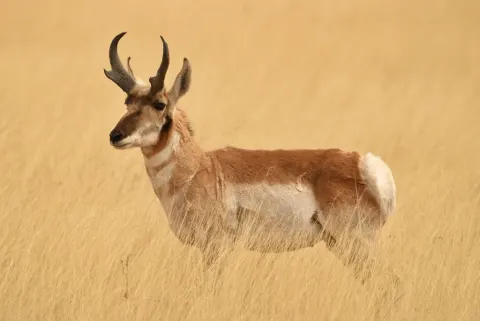
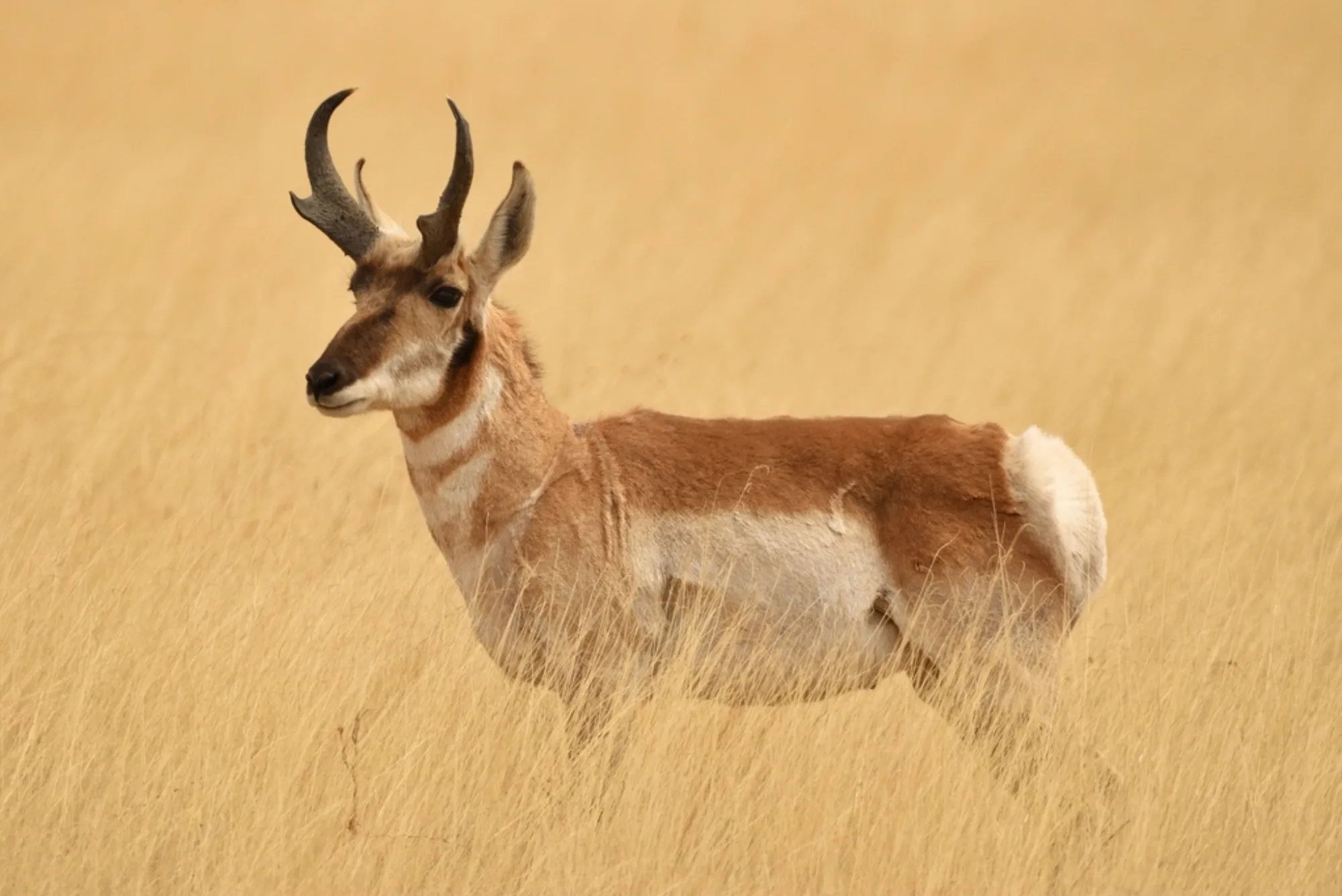
Built for speed, the Pronghorn (Antilocapra americana) can reach 88.5 km/h, making it the quickest land mammal in the Americas. Its white fur marks the rump, sides, belly, breast and throat, while large eyes sit high on its head. Males have pronged horns and a small black patch near the jaw; females have smaller, usually straight horns that can be hard to see. When alarmed, a pronghorn raises its white rump hair, warning others through both sight and scent.
Look for pronghorns west of the Mississippi, from southern Saskatchewan and Alberta through the western United States into Mexico. They favour open terrain, often at elevations of 910 to 1,800 m, and healthy populations tend to stay within 5.0 to 6.5 km of water. They eat a range of plants, including shrubs, grasses and plants that livestock find unpalatable or toxic. In winter, males and females gather in mixed herds; in early spring, these herds separate, with young males forming groups and adult males living alone. One migration route in Idaho covers more than 260 km overland.
Pronghorns breed in mid-September, and females carry their young until late May. Twins are common, and newborns spend time hidden in vegetation during their first 21 to 26 days. Mothers nurse and groom their young, lead them to food and water, and protect them from predators. Habitat fragmentation and blocked routes threaten migrations, while roads, fences, livestock grazing, illegal hunting and shortages of food and water contribute to local declines, particularly among Sonoran pronghorns. Cougars, wolves, coyotes, grizzly bears and bobcats also prey on pronghorns.
Written from the English Wikipedia article Pronghorn (CC BY-SA 4.0).
- Records
- 1,745
- Countries
- 3
- Atlas places
- 7
These are open occurrence records, so they show where people looked for and recorded the Pronghorn as much as where it lives. Cells are up to 25 km across, and every location is generalised to its cell.
Generalised encounter areas, not exact locations. Each shape is a grid cell coloured by how likely the species is there.
- Very likelyUnited States25 km zone · medium confidence · 1553 records · updated 80 days ago
- Very likelyCanada25 km zone · medium confidence · 183 records · updated 80 days ago
- Very likelyMexico25 km zone · medium confidence · 9 records · updated 80 days ago
Conservation status not assessed here yet, so every location is generalised to its grid cell.