Sarus Crane
Antigone antigone
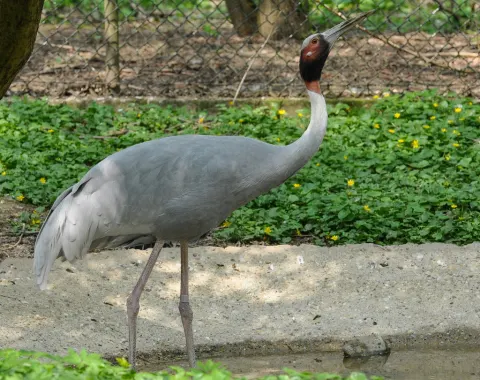
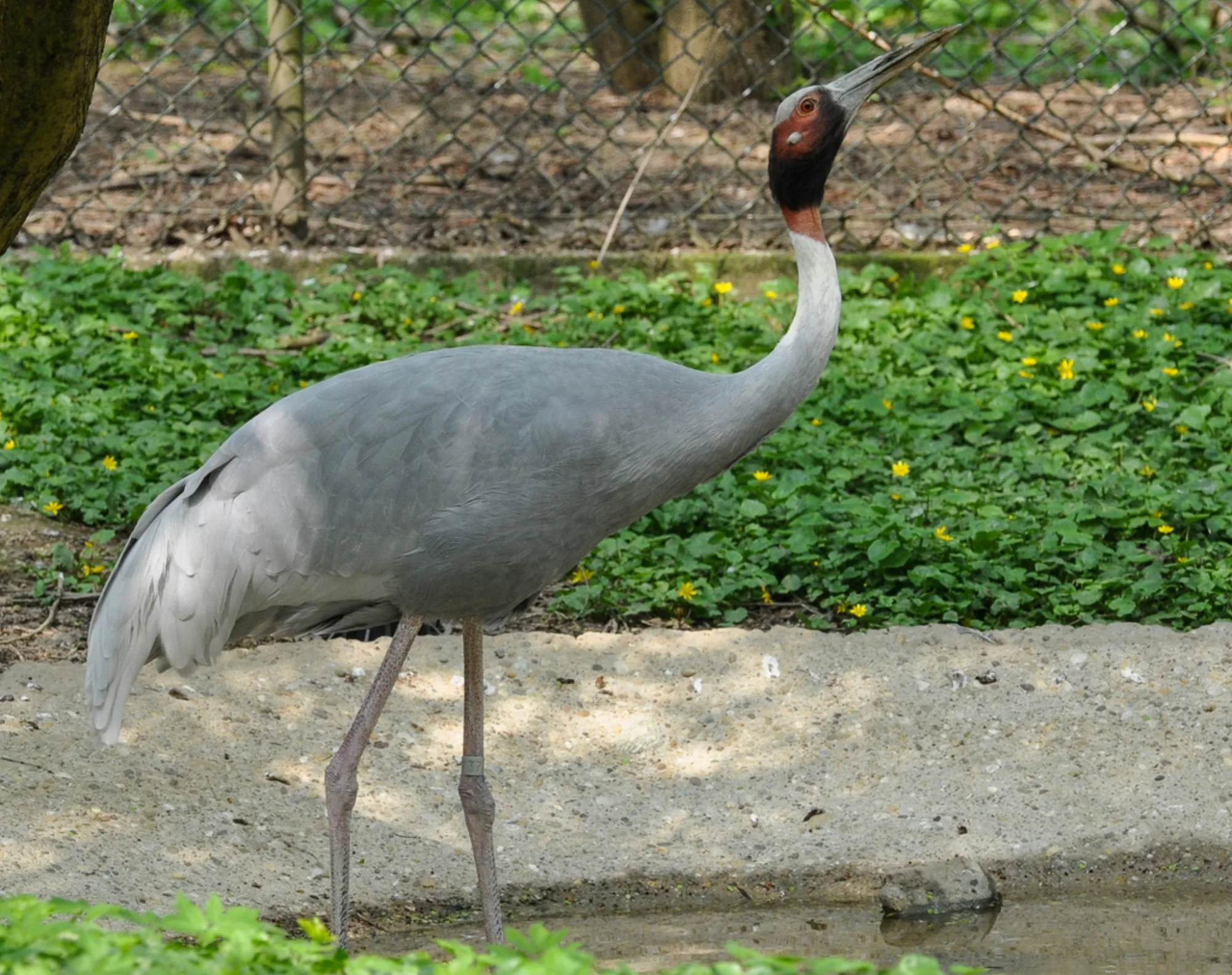
Standing up to 1.8 m tall, the Sarus Crane is a striking bird of open country, with a grey body and a red head and upper neck. In flight, its neck stretches straight ahead, its long pink legs trail behind and black tips show on its wings. Young birds have feathered brown-grey heads, while adults have bare red skin that becomes brighter in the breeding season.
Sarus Cranes occur in northern Australia, Southeast Asia and the Indian subcontinent; India holds their largest known population. Their habitats range from open wetlands in South Asia to seasonally flooded forest in Southeast Asia and woodland and grassland in Australia. In India, they also live close to people on farmland, and may nest among flooded rice paddies. Most stay in the same region, although some populations move short distances. Breeding pairs defend territories with calls and displays, while non-breeding birds gather in flocks. Listen for loud trumpeting and watch for leaps and dance-like movements. The cranes probe in mud or forage in shallow water and fields, eating roots, tubers, insects, crustaceans and small vertebrates.
Breeding takes place mainly in the wet season, when a pair builds a conspicuous platform of reeds and grasses above the surrounding shallow water. Both parents incubate the eggs, and the young remain with them until the next breeding season. The cranes have disappeared from many parts of their former range, and development and intensified farming can affect breeding territories. Eggs may be taken by people or destroyed by crows, while adults can be poisoned by treated seeds or killed by power lines.
Written from the English Wikipedia article Sarus crane (CC BY-SA 4.0).
- Records
- 28,925
- Countries
- 8
- Atlas places
- 6
These are open occurrence records, so they show where people looked for and recorded the Sarus Crane as much as where it lives. Cells are up to 25 km across, and every location is generalised to its cell.
Generalised encounter areas, not exact locations. Each shape is a grid cell coloured by how likely the species is there.
- Very likelyIndia25 km zone · high confidence · 21718 records · updated 80 days ago
- Very likelyAustralia25 km zone · high confidence · 5160 records · updated 80 days ago
- Very likelyCambodia25 km zone · high confidence · 1058 records · updated 80 days ago
- Very likelyNepal25 km zone · high confidence · 492 records · updated 80 days ago
- Very likelyThailand25 km zone · high confidence · 338 records · updated 80 days ago
- Very likelyMyanmar (Burma)25 km zone · medium confidence · 124 records · updated 80 days ago
- LikelyVietnam25 km zone · medium confidence · 22 records · updated 80 days ago
- PossibleUnited States25 km zone · medium confidence · 13 records · updated 80 days ago
Conservation status not assessed here yet, so every location is generalised to its grid cell.