Red Wattlebird
Anthochaera carunculata
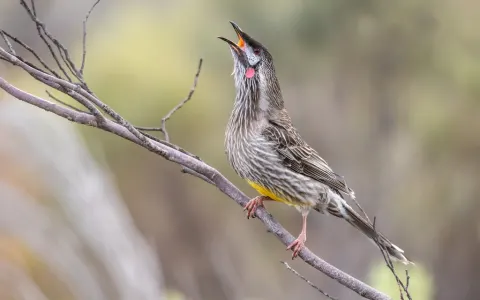
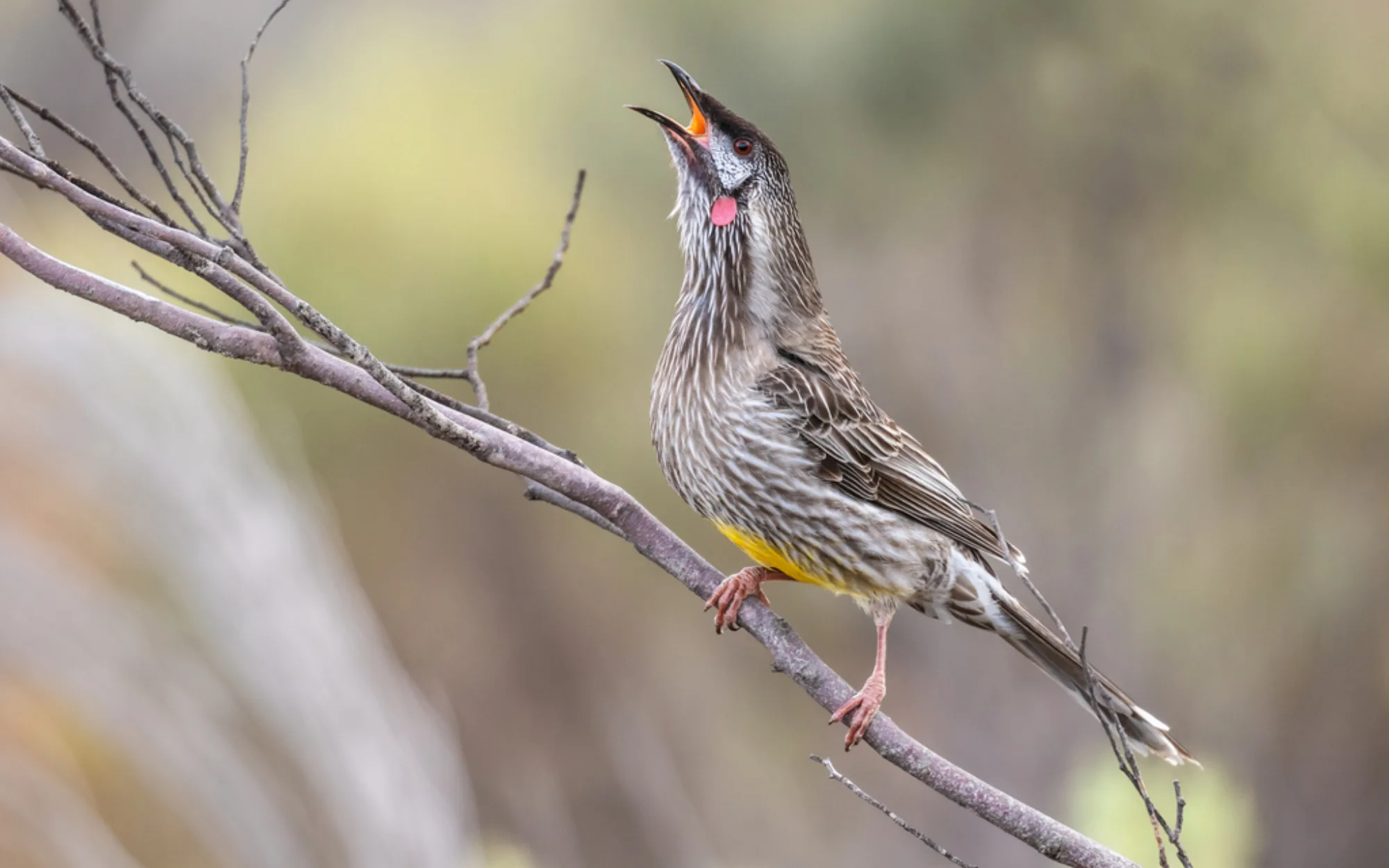
A loud, active honeyeater of southern Australia, the Red Wattlebird can be conspicuous among the trees. It measures 33 to 37 cm long and has grey-brown plumage, red eyes and pinkish-red wattles hanging on either side of its neck. White streaks mark its chest, while a bright yellow patch stands out on its lower belly. Young birds have less obvious wattles, browner eyes and less yellow on the belly. Its raucous calls carry a long way, and a pair may call together at a food source, one bird cackling and the other whistling.
Look for it from southeast Queensland through New South Wales, Victoria and South Australia to southwest Western Australia. It favours open forest and woodland, often among eucalypts with a shrubby or grassy understorey, and also visits urban parks and gardens. It spends much of its time in trees, climbing along branches and probing flowers for nectar, particularly those of eucalypts, banksias, grasstrees and emu bushes. It also eats insects, berries and other fruit, and occasionally forages on the ground. Territorial birds defend food sources and nests, sometimes chasing much larger birds. In winter they can gather in groups of up to several hundred, and some move to flowering plants.
Nesting usually takes place between July and December, with pairs building a cup of sticks and leaves in a tree fork, usually a eucalypt. Both parents feed the young, continuing for 2 to 3 weeks after they leave the nest. Clearing land and undergrowth has caused the bird to disappear from some habitats, while cats, dogs and road traffic also kill birds. Its nests face predators including snakes, possums and birds of prey.
Written from the English Wikipedia article Red wattlebird (CC BY-SA 4.0).
- Records
- 704,854
- Countries
- 1
- Atlas places
- 5
These are open occurrence records, so they show where people looked for and recorded the Red Wattlebird as much as where it lives. Cells are up to 25 km across, and every location is generalised to its cell.
Generalised encounter areas, not exact locations. Each shape is a grid cell coloured by how likely the species is there.
- Very likelyAustralia25 km zone · high confidence · 704854 records · updated 86 days ago
Conservation status not assessed here yet, so every location is generalised to its grid cell.