Children's Python
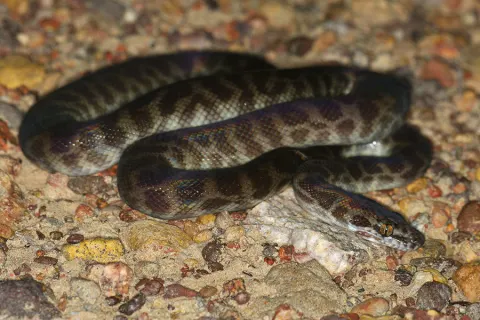
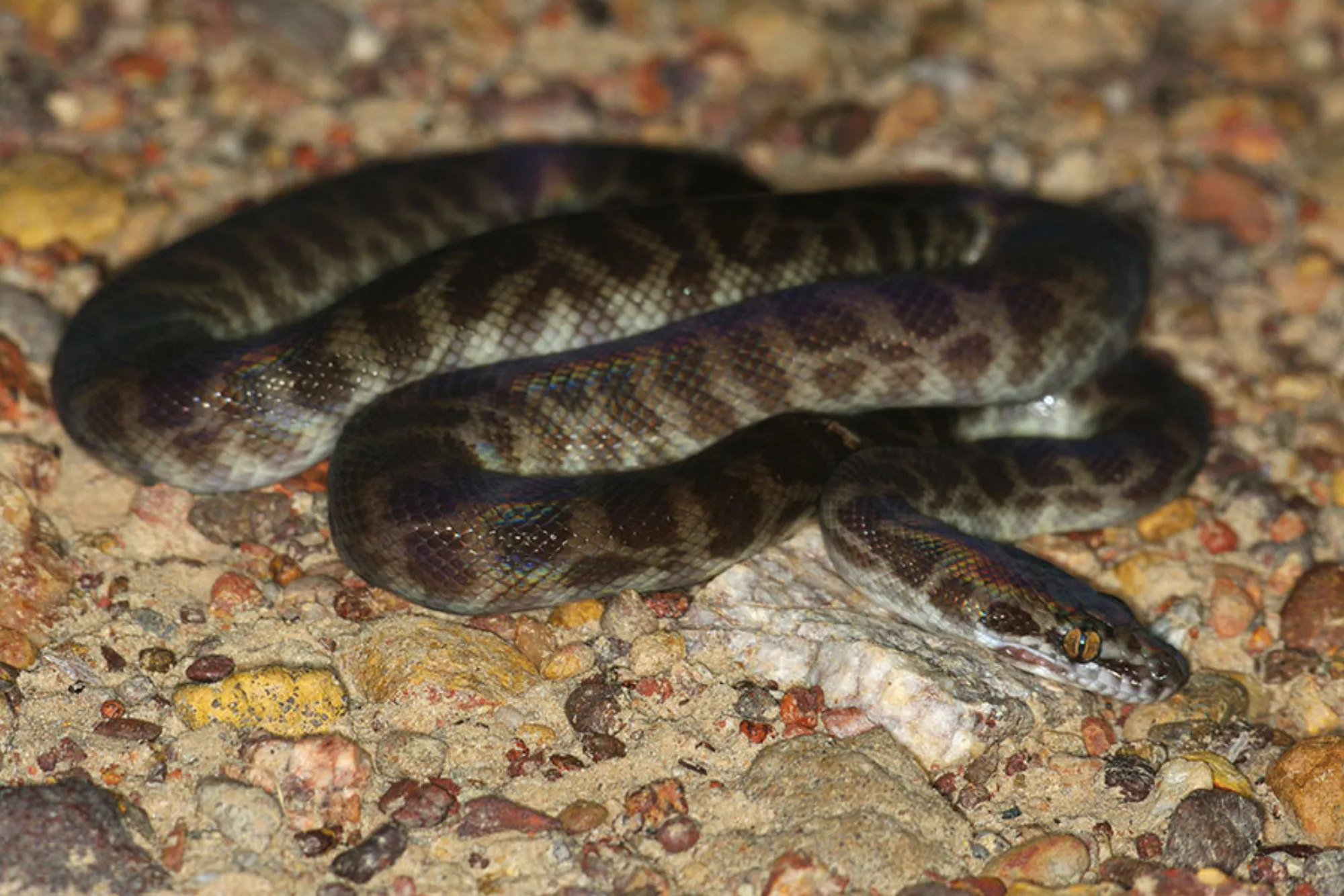
Antaresia childreni
At night across northern Australia, the Children's Python moves mostly on the ground, though it often climbs trees. This nonvenomous snake usually grows to about 1.0 m or more, while adults can reach around 1 to 1.5 m depending on locality and variant. It is typically reddish-brown, darker above and marked with darker blotches that are especially noticeable in young snakes. As they mature, juveniles gradually become reddish-brown or brown. A dark stripe crosses each eye, and the yellowish lips have brown spots. In direct sunlight, its smooth body scales can show a rainbow sheen. The Stimson's python variant often has stronger, more varied colours, with reddish-brown to chocolate blotches on a lighter tan background.
Its range extends across northern Queensland, the Torres Strait islands, the far north of Western Australia and the northern part of the Northern Territory. The Stimson's variant ranges more widely, across much of Australia's interior from Queensland to Perth. It lives in habitats ranging from desert and shrubland to forest, grassland, savanna and freshwater wetlands. In the Darwin region, sightings reported to snake catchers peak in the later wet season, from February to April, when encounters in open grassland and plains are more likely than in other months.
Children's Pythons eat reptiles, birds and small mammals, particularly microbats. They commonly inhabit caves, where they can hang from stalactites and snatch bats from the air. Like other pythons, they constrict prey before swallowing it whole. Females lay up to 25 eggs and coil around them during a seven-week incubation period, sometimes shivering to keep them warm. This brooding also gives the eggs some protection from predators.
Written from the English Wikipedia article Children's python (CC BY-SA 4.0).
- Records
- 1,876
- Countries
- 1
- Atlas places
- 3
These are open occurrence records, so they show where people looked for and recorded the Children's Python as much as where it lives. Cells are up to 25 km across, and every location is generalised to its cell.
Generalised encounter areas, not exact locations. Each shape is a grid cell coloured by how likely the species is there.
- Very likelyAustralia25 km zone · medium confidence · 1876 records · updated 80 days ago
Conservation status not assessed here yet, so every location is generalised to its grid cell.