Swan Goose
Anser cygnoides
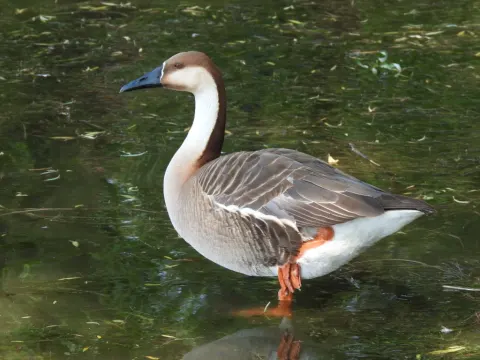
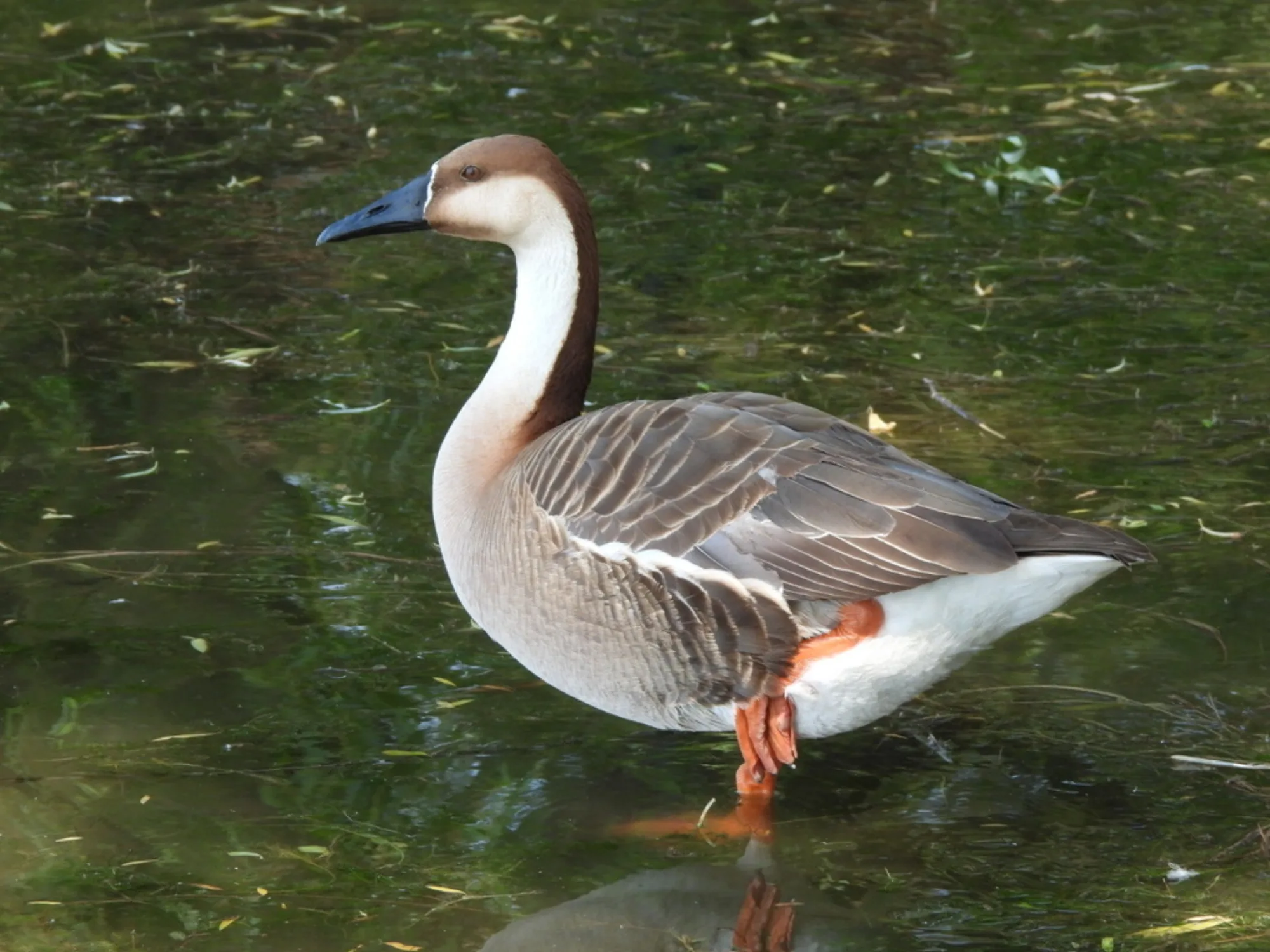
Long-necked and large, the Swan Goose has a greyish-brown back, a maroon cap and hindneck, and a pale front to the neck. Its long, heavy bill is black, with a thin white stripe around the base, while its legs and feet are orange. In flight, its wings look dark and show no conspicuous pattern. Young birds have duller plumage than adults, without a white stripe at the bill base or dark streaks below. Males can give a piercing contact call, while females have shorter, raspier and lower-pitched calls.
Wild birds breed in the Russian Far East, inland Mongolia and Northeast China, then migrate mainly to central and eastern China for winter. They inhabit country from steppe to taiga, as well as mountain valleys near freshwater. Away from the breeding season they form small flocks, grazing on sedges, grasses and water plants, and rarely swim. In winter they graze in stubble fields and across plains, sometimes at a distance from water. The lower Yangtze River area has important wintering sites, as do the Yancheng Coastal Wetlands, Lake Poyang and Lake Dongting.
Birds return from their winter quarters around April, with nesting beginning about May near marshes and other wetlands. Pairs nest alone or in loose groups, making a shallow plant nest directly on the ground, sometimes choosing a small rise to keep it dry. A clutch usually contains 5 to 6 eggs, and the young hatch after about 28 days. Habitat loss, excessive hunting and egg collecting have contributed to population decline, with egg collecting a particular problem on China's Sanjiang Plain. Recent poor breeding success and losses from its range have added to the pressure.
Written from the English Wikipedia article Swan goose (CC BY-SA 4.0).
- Records
- 36,073
- Countries
- 20
- Atlas places
- 3
These are open occurrence records, so they show where people looked for and recorded the Swan Goose as much as where it lives. Cells are up to 25 km across, and every location is generalised to its cell.
Generalised encounter areas, not exact locations. Each shape is a grid cell coloured by how likely the species is there.
- Very likelyUnited States25 km zone · high confidence · 24593 records · updated 80 days ago
- Very likelyChina25 km zone · high confidence · 3438 records · updated 80 days ago
- Very likelyMongolia25 km zone · high confidence · 1797 records · updated 80 days ago
- Very likelyTaiwan25 km zone · high confidence · 1389 records · updated 80 days ago
- Very likelyPortugal25 km zone · high confidence · 875 records · updated 80 days ago
- Very likelyJapan25 km zone · high confidence · 858 records · updated 80 days ago
- Very likelyGermany25 km zone · high confidence · 724 records · updated 80 days ago
- Very likelySpain25 km zone · high confidence · 447 records · updated 80 days ago
- Very likelySerbia25 km zone · high confidence · 388 records · updated 80 days ago
- Very likelySouth Korea25 km zone · high confidence · 351 records · updated 80 days ago
Conservation status not assessed here yet, so every location is generalised to its grid cell.