Snow Goose
Anser caerulescens
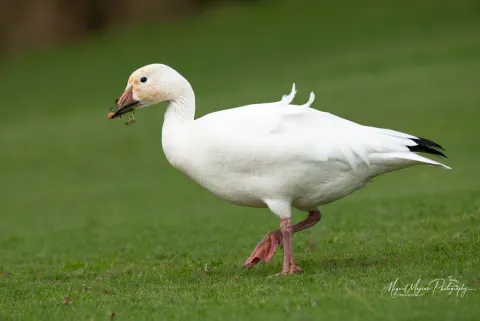
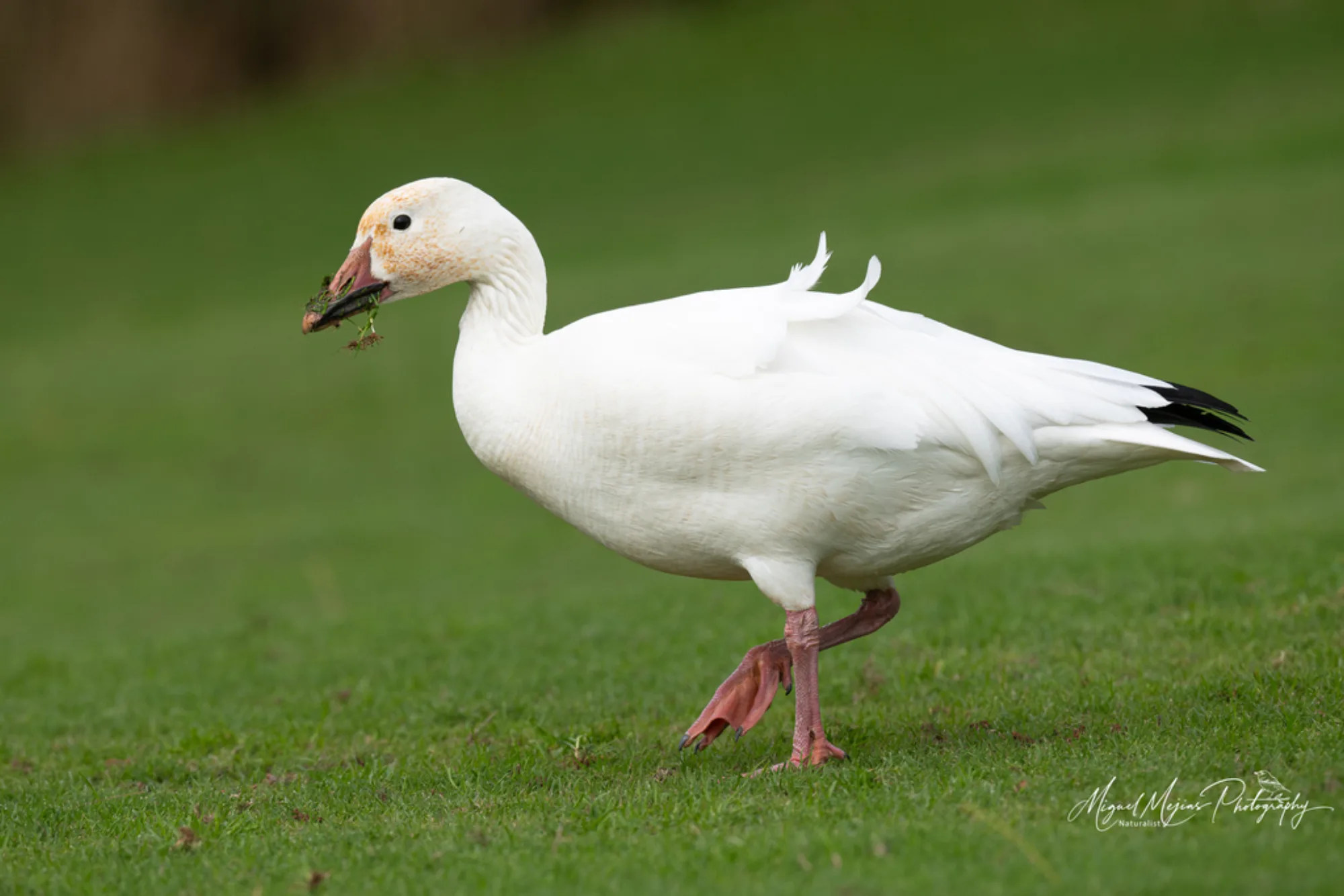
A noisy traveller across North America, the Snow Goose comes in two striking colour forms. White birds have black wingtips, while blue birds are mostly bluish grey with white on the head, neck and tail tip. Both forms have pink bills marked by a black grin, and rose-red legs and feet. Soil minerals can stain the head rusty brown, and immature birds have duller bills and legs.
Breeding grounds lie north of the tree line, across parts of Greenland, Canada, Alaska and the far northeastern tip of Siberia. Wintering birds range south to Mexico, with others found in the United States and southwestern British Columbia. Large flocks fly high during spring migration, following narrow routes from wintering areas to the tundra. On the journey, they often gather in large numbers at traditional stopovers. For much of the year, they feed together in groups, sometimes with greater white-fronted geese. Their food includes grain left in fields and the roots of marsh grasses, which they dig up with their bills.
Nesting often takes place in colonies, beginning between late May and early June according to snow conditions. The female builds a shallow nest on high ground and lays three to five eggs. Both parents protect the young, which feed themselves and can fly after 42 to 50 days. Arctic foxes and skuas prey on eggs and young chicks at the nest, while bald eagles attack wintering geese. Avian cholera can also kill migrating birds: an outbreak in northern Idaho killed 2,000 in March 2015. Large goose populations have degraded Arctic tundra breeding grounds and saltmarsh wintering habitat, affecting other species that use them.
Written from the English Wikipedia article Snow goose (CC BY-SA 4.0).
- Records
- 599,895
- Countries
- 3
No atlas park has a record of the Snow Goose in or around it yet.
These are open occurrence records, so they show where people looked for and recorded the Snow Goose as much as where it lives. Cells are up to 25 km across, and every location is generalised to its cell.
Generalised encounter areas, not exact locations. Each shape is a grid cell coloured by how likely the species is there.
- Very likelyUnited States25 km zone · high confidence · 400936 records · updated 80 days ago
- Very likelyCanada25 km zone · high confidence · 198959 records · updated 80 days ago
Conservation status not assessed here yet, so every location is generalised to its grid cell.