Pink-footed Goose
Anser brachyrhynchus
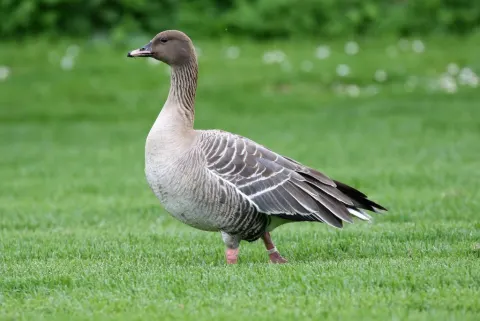
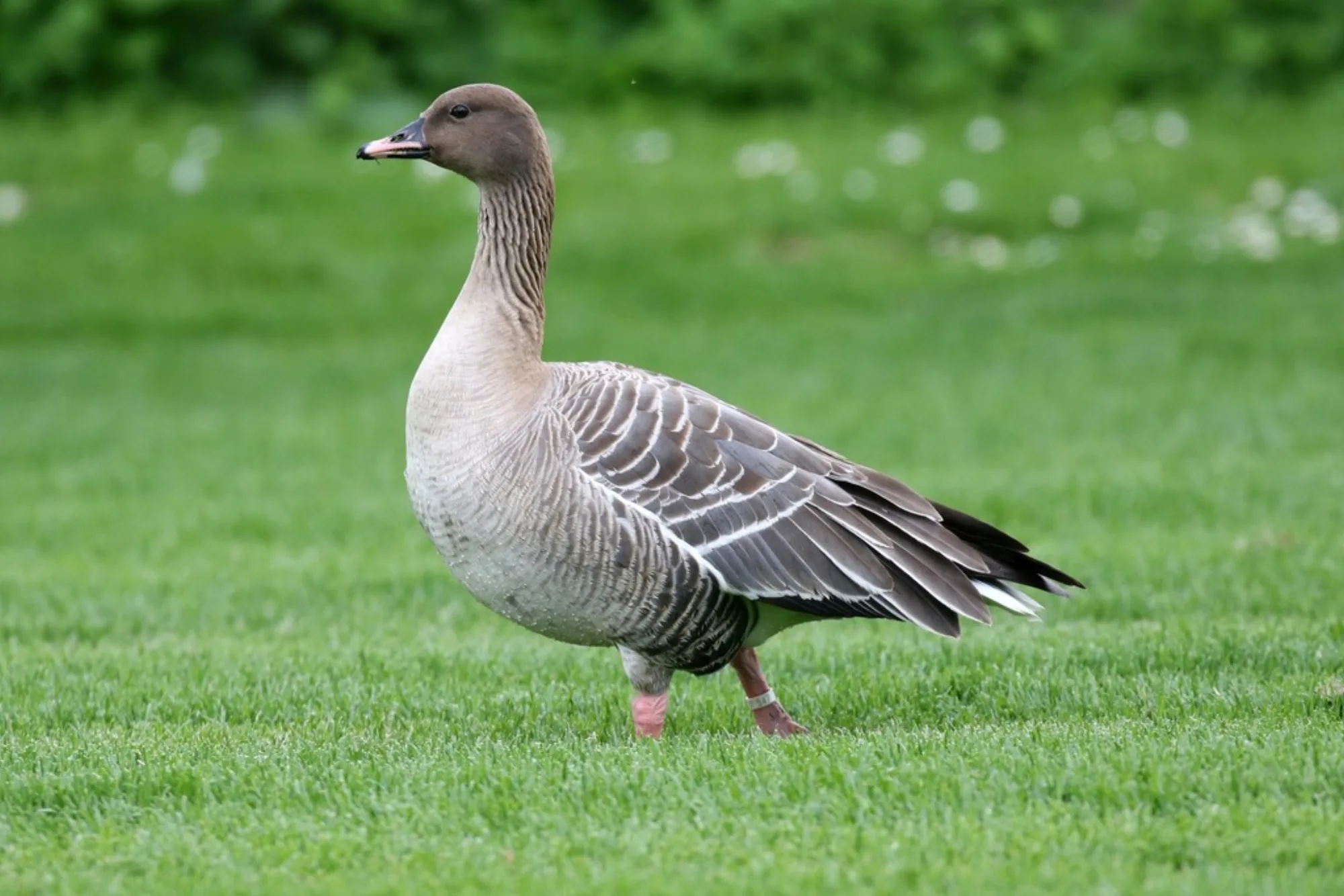
Listen for high-pitched honking overhead: the Pink-footed Goose is especially vocal in flight, and a large flock can be almost deafening. This medium-sized goose has pink feet and a short bill with a bright pink middle and black ends. Its body is grey-brown, with a darker brown head and neck, a white rump and a grey tail tipped broadly with white. It measures 60 to 75 cm long, with a wingspan of 135 to 170 cm.
The goose breeds in eastern Greenland, Iceland, Svalbard and, more recently, Novaya Zemlya. Its winter range includes western Denmark and the Netherlands, as well as Ireland and Great Britain. Birds from Greenland and Iceland spend winter in Great Britain, while those from Svalbard and Novaya Zemlya winter in the Netherlands and Denmark. In Great Britain, Norfolk and Lancashire are important wintering areas, while Aberdeenshire is important during autumn and spring passage. Large winter flocks graze on farmland, feeding mainly on oilseed rape, sugar beet, potatoes and grasses. In summer, the birds eat a variety of tundra plants on land and in water.
Nests are often placed on cliffs near glaciers, where they offer protection from mammalian predators, especially Arctic foxes. Geese also nest on islets in lakes. A clutch holds three to five eggs, which are incubated for 25 to 28 days. After hatching, the goslings walk with their parents to the nearest lake and fledge after about 56 days. Shooting on wintering grounds has been a threat, although increased protection has helped populations rise. Climate change is thought to have helped the geese establish a breeding population on Novaya Zemlya.
Written from the English Wikipedia article Pink-footed goose (CC BY-SA 4.0).
- Records
- 176,396
- Countries
- 13
No atlas park has a record of the Pink-footed Goose in or around it yet.
These are open occurrence records, so they show where people looked for and recorded the Pink-footed Goose as much as where it lives. Cells are up to 25 km across, and every location is generalised to its cell.
Generalised encounter areas, not exact locations. Each shape is a grid cell coloured by how likely the species is there.
- Very likelyNorway25 km zone · high confidence · 82481 records · updated 80 days ago
- Very likelyUnited Kingdom25 km zone · high confidence · 68141 records · updated 80 days ago
- Very likelyBelgium25 km zone · high confidence · 5528 records · updated 80 days ago
- Very likelyIceland25 km zone · high confidence · 4805 records · updated 80 days ago
- Very likelyUnited States25 km zone · high confidence · 4769 records · updated 80 days ago
- Very likelySvalbard & Jan Mayen25 km zone · high confidence · 4562 records · updated 80 days ago
- Very likelyNetherlands25 km zone · high confidence · 2839 records · updated 80 days ago
- Very likelyCanada25 km zone · high confidence · 1768 records · updated 80 days ago
- Very likelyGermany25 km zone · high confidence · 710 records · updated 80 days ago
- Very likelySweden25 km zone · high confidence · 237 records · updated 80 days ago
Conservation status not assessed here yet, so every location is generalised to its grid cell.