Greylag Goose
Anser anser
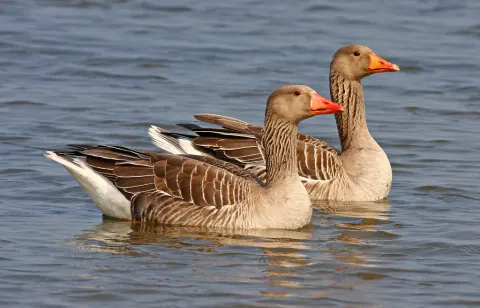
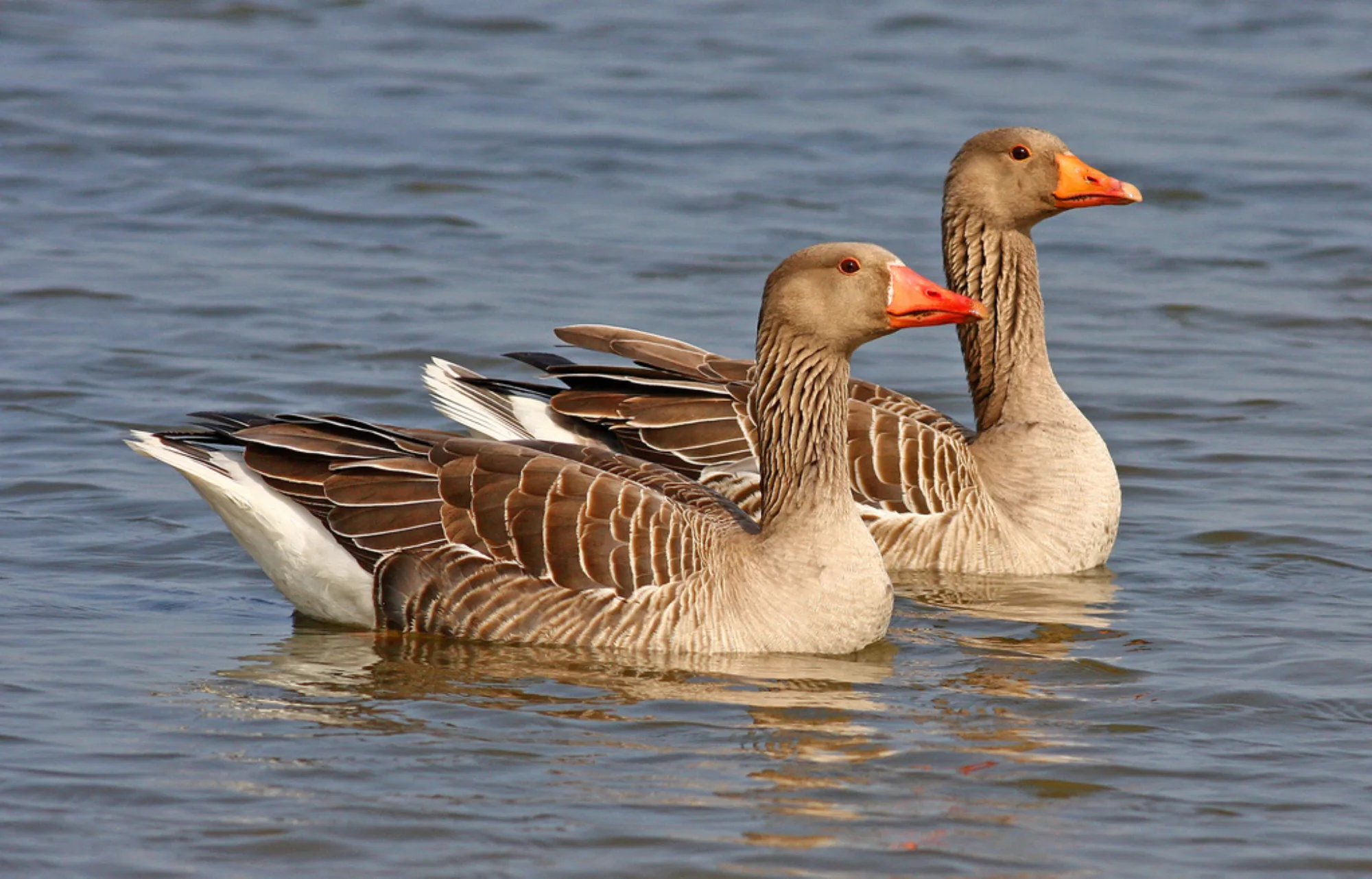
A bulky goose with a long, thick neck, the Greylag Goose has greyish-brown plumage, a darker head and a paler breast and belly. Its bill can be orange or pink, and its legs and feet are pink. In flight, look for the pale grey patches on its forewings and rump. It has a loud cackling call, heard both in the air and on the ground, while a flock can sound like baying hounds.
Greylags breed across parts of Europe and Asia, from Iceland eastwards to China. Their breeding habitats include moors, marshes, lakes and offshore islands, often with dense cover such as reeds, heather or willow. In winter they use estuaries, flooded fields, marshes and pasture near water. Some populations migrate south, while others remain near their breeding areas throughout the year. Birds breeding in Iceland spend winter in the British Isles, while some from central Europe travel as far as Spain and North Africa.
These sociable geese form flocks, with some birds keeping watch while others feed. They graze mainly on grasses, but also eat water plants, grain and crops. Pairs usually stay together for life and nest among ground vegetation or on floating plants. The female keeps the eggs warm, and the two parents raise their chicks together; the chicks can leave the nest soon after hatching. Families may join forces to defend their young against predators, and young birds migrate with their parents in a larger flock. Predators threaten young geese, while moulting birds face danger when they cannot fly. In the Orkney islands, extensive crop damage has led to a hunting season that now lasts most of the year.
Written from the English Wikipedia article Greylag goose (CC BY-SA 4.0).
- Records
- 959,046
- Countries
- 103
- Atlas places
- 2
These are open occurrence records, so they show where people looked for and recorded the Greylag Goose as much as where it lives. Cells are up to 25 km across, and every location is generalised to its cell.
Generalised encounter areas, not exact locations. Each shape is a grid cell coloured by how likely the species is there.
- Very likelyUnited Kingdom25 km zone · high confidence · 292773 records · updated 86 days ago
- Very likelyNorway25 km zone · high confidence · 285017 records · updated 86 days ago
- Very likelyNetherlands25 km zone · high confidence · 81554 records · updated 86 days ago
- Very likelyBelgium25 km zone · high confidence · 78206 records · updated 86 days ago
- Very likelySpain25 km zone · high confidence · 24867 records · updated 86 days ago
- Very likelyIceland25 km zone · high confidence · 22843 records · updated 86 days ago
- Very likelySweden25 km zone · high confidence · 18200 records · updated 86 days ago
- Very likelyGermany25 km zone · high confidence · 15508 records · updated 86 days ago
- Very likelyFrance25 km zone · high confidence · 14691 records · updated 86 days ago
- Very likelyHungary25 km zone · high confidence · 11904 records · updated 86 days ago
Conservation status not assessed here yet, so every location is generalised to its grid cell.