Greater White-fronted Goose
Anser albifrons
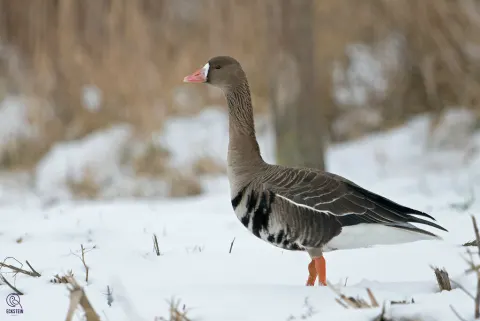
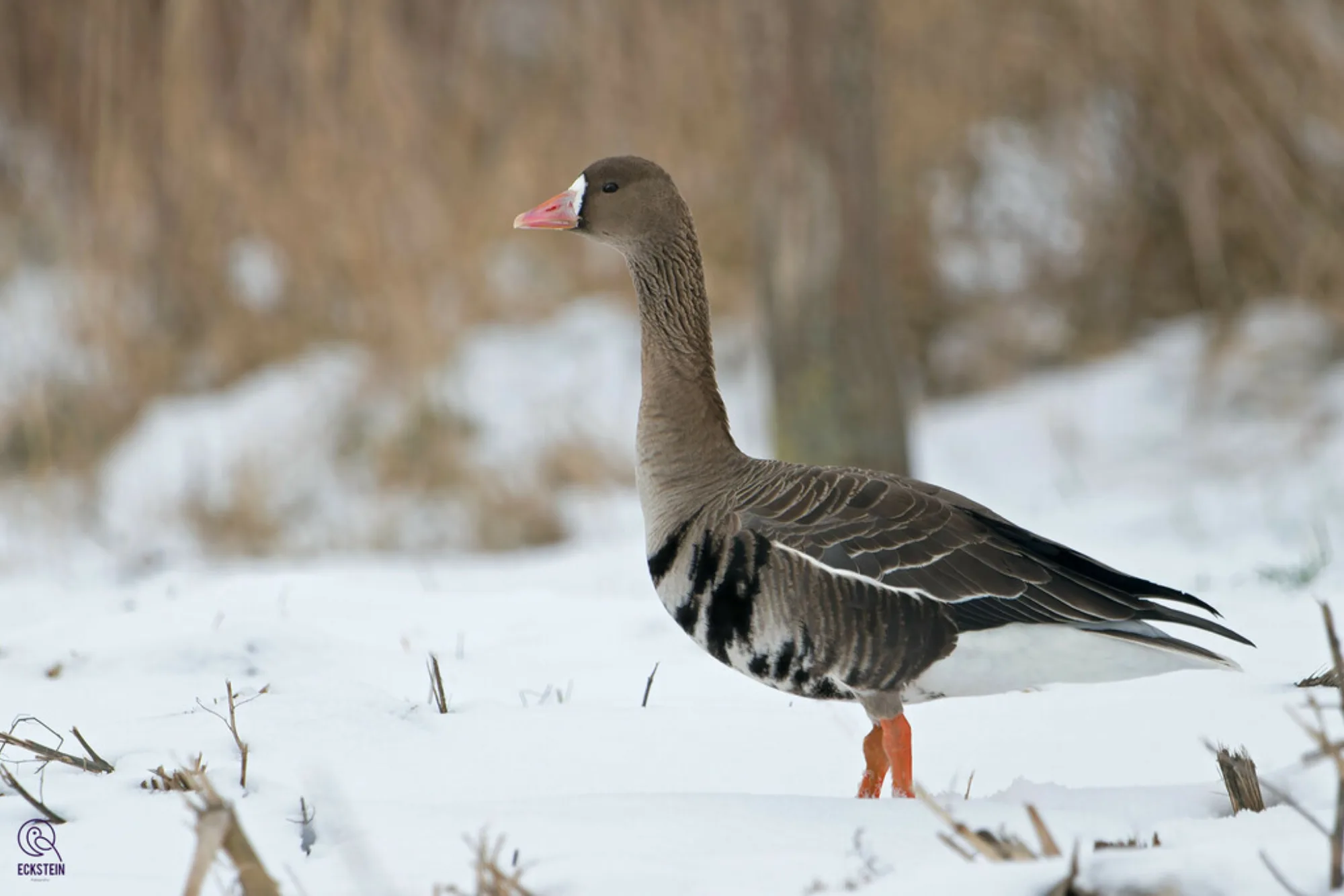
A white patch around the base of its bill gives the Greater White-fronted Goose its name, but adults are also recognisable by the dark speckles and bars across their pale grey breasts. These greyish brown geese have bright orange legs and generally pinkish bills, although Greenland birds usually have orange bills. Males and females look alike, though males are typically larger. Listen for the high-pitched, two-part cackle, often rendered as “he-he”. The birds measure 64 to 81 cm long, with a wingspan of 130 to 165 cm.
Migratory flocks breed across northern Canada, Alaska, Greenland and Russia, then winter in more southerly parts of Asia, Europe and North America. In the British Isles, Greenland birds gather in Scotland and Ireland, while Russian birds winter in England and Wales, using traditional sites on farmland. In North America, midcontinent birds spend several weeks feeding in the prairie regions of eastern Alberta and western Saskatchewan before continuing towards wintering grounds near the Gulf of Mexico and in northern Mexico. Pacific birds travel along the coast, stopping mainly in the Klamath Basin before wintering in California's Central Valley.
On Arctic breeding grounds, the season for nesting and raising young until they can fly lasts about three months. Clutches contain one to eight eggs, and newly hatched young depart the nest within 24 hours. Parents can remain associated with their offspring for several years, sometimes even helping with later generations. Delayed snowmelt and late spring storms can reduce breeding success, while increasingly extreme weather may help explain the decline of Greenland birds. Destruction of winter habitat following human settlement is thought to have affected the tule goose, and migrating white-fronted geese are sought by waterfowl hunters.
Written from the English Wikipedia article Greater white-fronted goose (CC BY-SA 4.0).
- Records
- 413,971
- Countries
- 16
- Atlas places
- 2
These are open occurrence records, so they show where people looked for and recorded the Greater White-fronted Goose as much as where it lives. Cells are up to 25 km across, and every location is generalised to its cell.
Generalised encounter areas, not exact locations. Each shape is a grid cell coloured by how likely the species is there.
- Very likelyUnited States25 km zone · high confidence · 341613 records · updated 80 days ago
- Very likelyBelgium25 km zone · high confidence · 24179 records · updated 80 days ago
- Very likelyNetherlands25 km zone · high confidence · 19308 records · updated 80 days ago
- Very likelyCanada25 km zone · high confidence · 11734 records · updated 80 days ago
- Very likelyUnited Kingdom25 km zone · high confidence · 3908 records · updated 80 days ago
- Very likelyNorway25 km zone · high confidence · 3795 records · updated 80 days ago
- Very likelyGermany25 km zone · high confidence · 2501 records · updated 80 days ago
- Very likelyMexico25 km zone · high confidence · 1394 records · updated 80 days ago
- Very likelyLithuania25 km zone · high confidence · 1147 records · updated 80 days ago
- Very likelyCzechia25 km zone · high confidence · 1039 records · updated 80 days ago
Conservation status not assessed here yet, so every location is generalised to its grid cell.