Brown Anole
Anolis sagrei
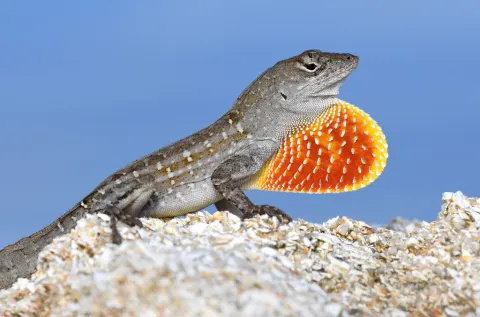
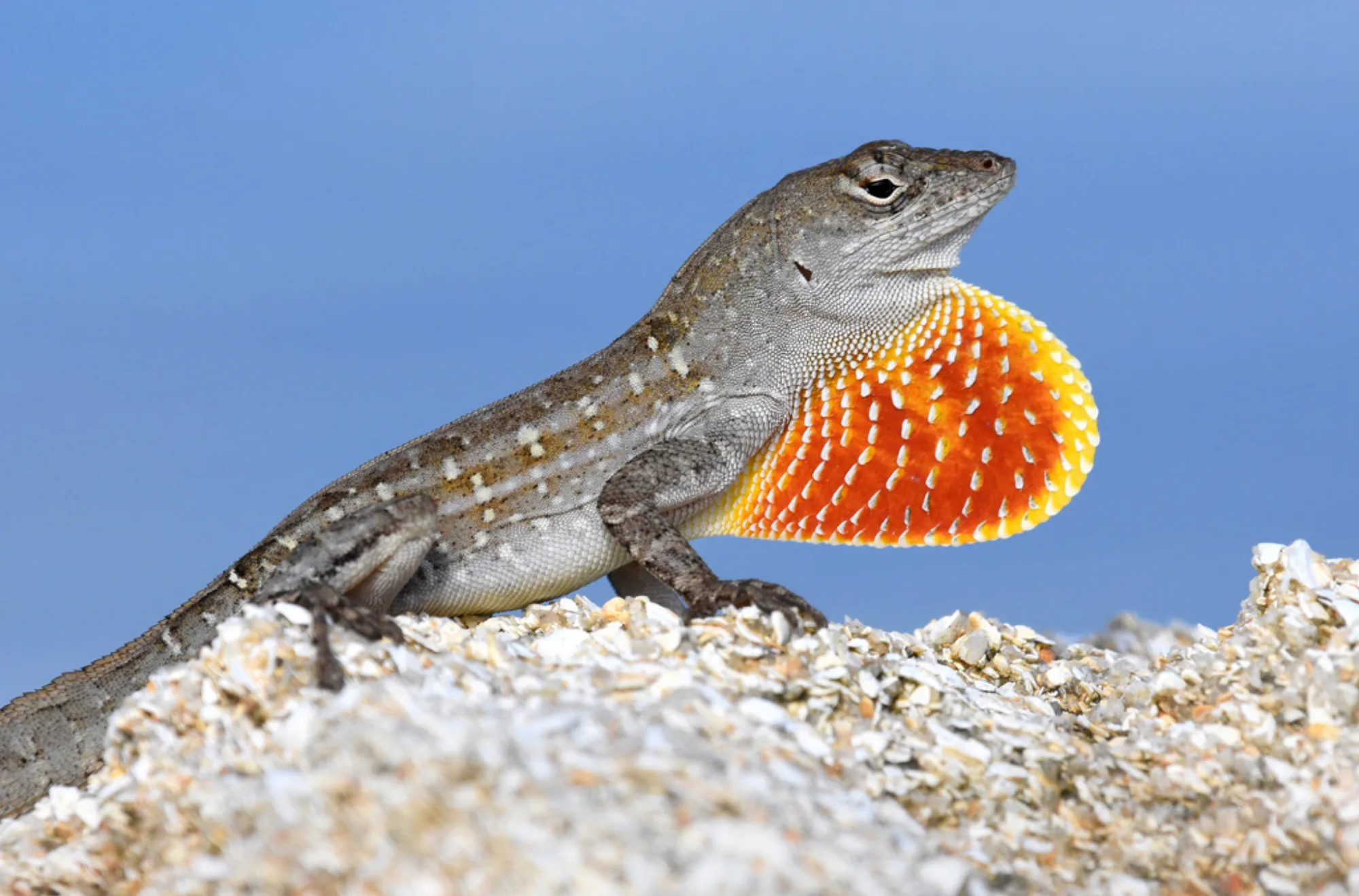
A wary little lizard, the Brown Anole usually wears light brown with darker markings across its back and pale lines along its sides. Its colour can shift quickly through shades of brown, black or grey, particularly when it faces a threat. Including the tail, it usually measures 13 to 22 cm, and its throat fan is typically red or yellow. Its native range includes Cuba, the Bahamas, Jamaica and other Caribbean islands, as well as the Yucatán Peninsula, Belize and the Caribbean coasts of Honduras and Guatemala. It has been introduced widely, including to parts of the United States, Singapore and Taiwan.
Look for it close to the ground among small plants and shrubs, including in urban and suburban areas. In warm weather it basks, while cold conditions send it looking for shelter. Males survey the ground from perches and may display to deter rivals, or attack when a competitor comes onto the same perch or reaches a similar height. The menu includes small arthropods such as crickets, beetles and spiders, as well as earthworms and snails. Brown anoles may also eat other lizards, their eggs and hatchlings, including those of their own species. Females breed during warmer parts of the year, laying single eggs in damp places; the young are independent from birth.
Snakes, birds and broad-headed skinks prey on these lizards, while spiders can take young anoles. A grabbed anole can shed its tail, which twitches as a distraction and later grows back smaller and duller. In Taiwan, a monitoring and removal plan has targeted the introduced lizard, which can compete with native species.
Written from the English Wikipedia article Brown anole (CC BY-SA 4.0).
- Records
- 9,665
- Countries
- 13
- Atlas places
- 1
These are open occurrence records, so they show where people looked for and recorded the Brown Anole as much as where it lives. Cells are up to 25 km across, and every location is generalised to its cell.
Generalised encounter areas, not exact locations. Each shape is a grid cell coloured by how likely the species is there.
- Very likelyUnited States25 km zone · medium confidence · 8479 records · updated 81 days ago
- Very likelyTaiwan25 km zone · high confidence · 355 records · updated 81 days ago
- Very likelyMexico25 km zone · medium confidence · 246 records · updated 81 days ago
- Very likelySingapore25 km zone · high confidence · 170 records · updated 81 days ago
- Very likelyPanama25 km zone · high confidence · 91 records · updated 81 days ago
- Very likelyCayman Islands25 km zone · medium confidence · 53 records · updated 81 days ago
- Very likelyEcuador25 km zone · medium confidence · 37 records · updated 81 days ago
- Very likelyJamaica25 km zone · medium confidence · 36 records · updated 81 days ago
- Very likelySt. Vincent & Grenadines25 km zone · medium confidence · 22 records · updated 81 days ago
- LikelyCuba25 km zone · medium confidence · 90 records · updated 81 days ago
Conservation status not assessed here yet, so every location is generalised to its grid cell.