Green Anole
Anolis carolinensis
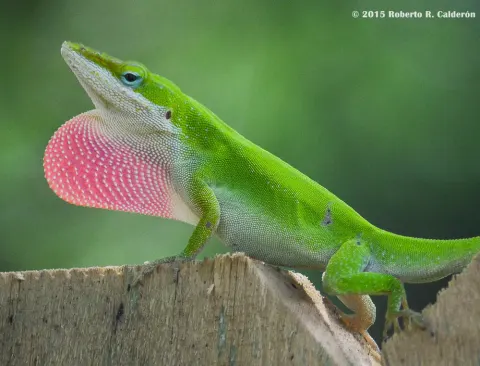
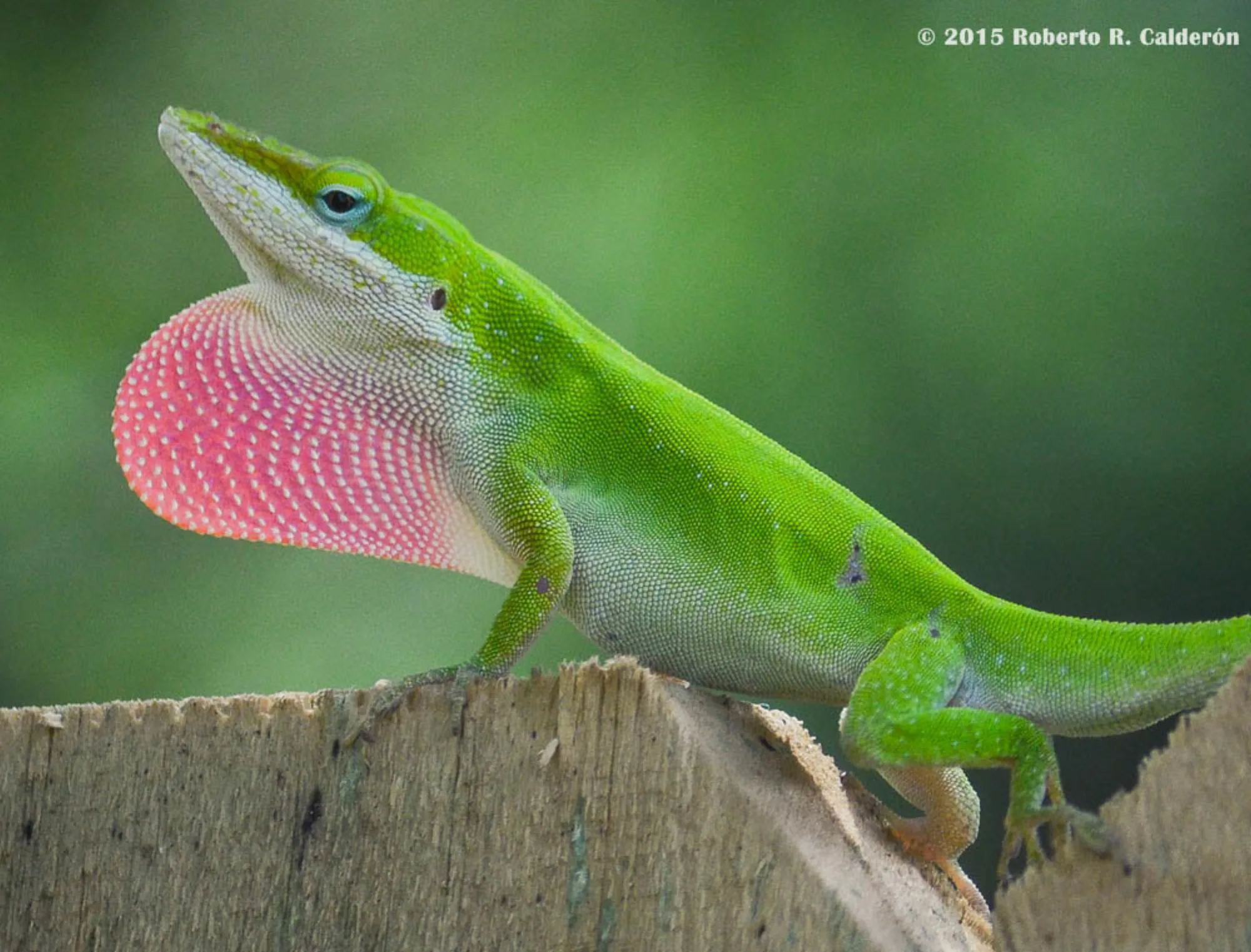
Look for a slender lizard with a long, pointed head and a colour that can shift from bright green to dark brown. The Green Anole has adhesive toe pads for climbing and often moves by jumping. Females and young have a conspicuous white stripe along the back, while most males lack it. A male may show a pink throat fan when communicating or confronting a rival.
Native mainly to the subtropical southeastern United States, it also occurs on introduced islands in the Pacific and Caribbean. It inhabits forests and grasslands, favouring open pine communities with plenty of shrubs. Although it lives in trees, it can also be seen on the ground, on shrubs, and on steps or railings beside foliage. In cities, it can live where there is enough vegetation and insect food. It is active by day throughout the year, with activity peaking in spring and autumn.
Small insects make up much of its diet, including crickets, grasshoppers, flies and moths, along with other arthropods such as spiders. Males defend territories, displaying their throat fans and bobbing their heads to drive away rivals. The breeding season can begin in April and last until late September. Females bury soft-shelled eggs in places such as soil, leaf litter or rotting wood, and the young receive no parental care after hatching. Snakes, birds and cats are among its predators, and parasitic flies can cause fatal infections. Competition from introduced brown anoles is a developing threat in some areas, with Green Anoles having shifted from ground-level territories into the treetops where the two meet.
Written from the English Wikipedia article Anolis carolinensis (CC BY-SA 4.0).
- Records
- 9,317
- Countries
- 4
- Atlas places
- 1
These are open occurrence records, so they show where people looked for and recorded the Green Anole as much as where it lives. Cells are up to 25 km across, and every location is generalised to its cell.
Generalised encounter areas, not exact locations. Each shape is a grid cell coloured by how likely the species is there.
- Very likelyUnited States25 km zone · medium confidence · 9028 records · updated 80 days ago
- Very likelyPalau25 km zone · high confidence · 240 records · updated 80 days ago
- Very likelyMexico25 km zone · medium confidence · 31 records · updated 80 days ago
- Very likelyGuam25 km zone · medium confidence · 18 records · updated 80 days ago
Conservation status not assessed here yet, so every location is generalised to its grid cell.