Lear's Macaw
Anodorhynchus leari
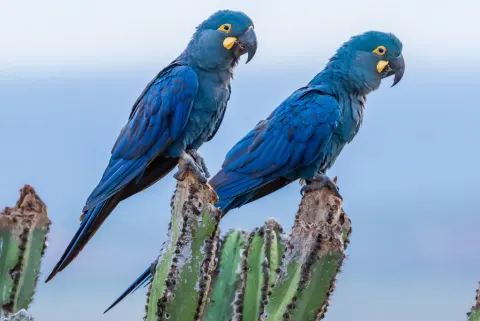
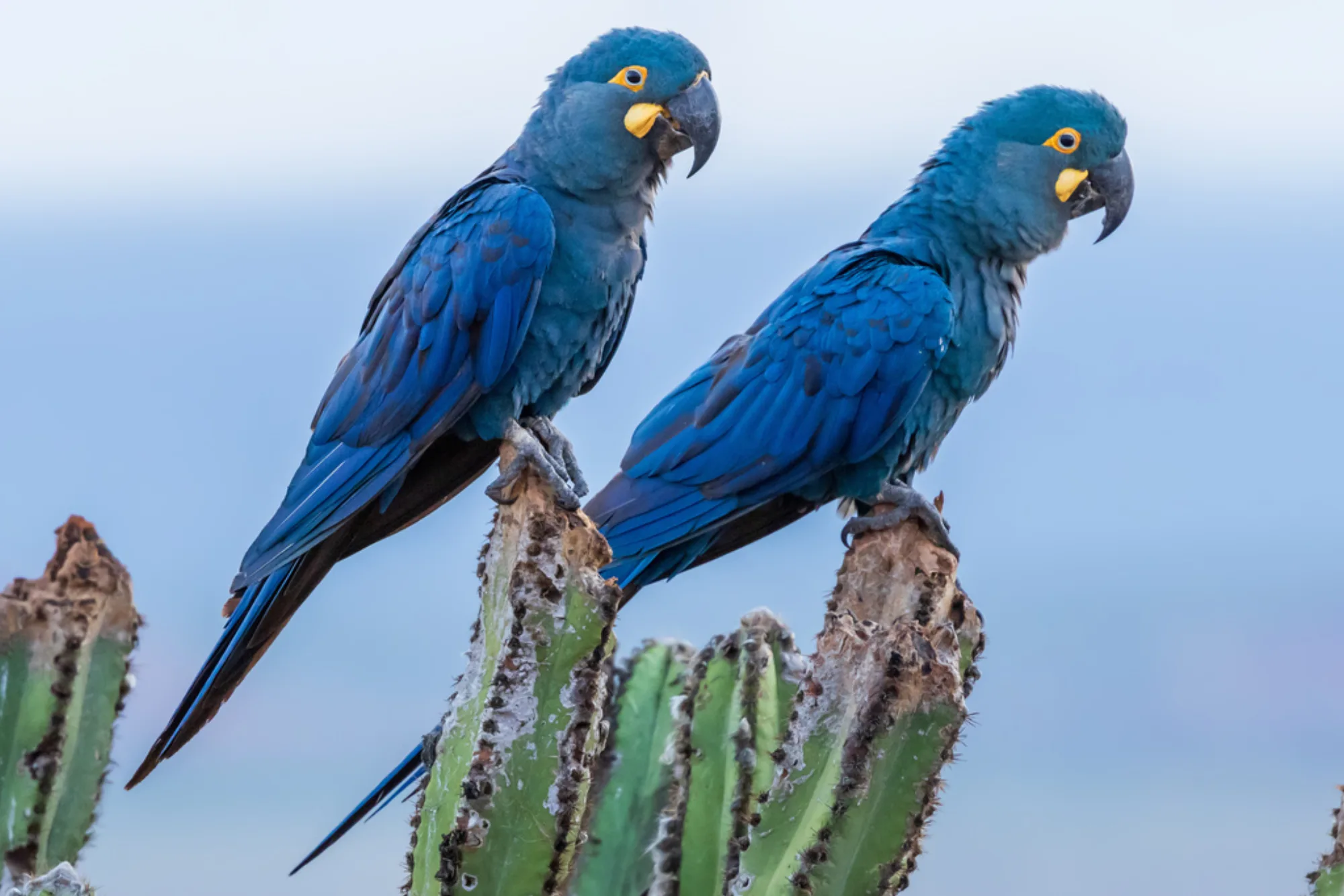
Deep blue plumage and a heavy black bill make the Lear's Macaw a striking sight in the dry interior of northeast Brazil. This large parrot measures 70 to 75 cm long and has a slightly paler head, orange-yellow eye rings and a patch of pale-yellow skin beside its beak. Its dark metallic blue wings, body and tail can show a faint green tinge. The similar hyacinth macaw is larger and darker, without that greenish tint.
Lear's Macaws live in a restricted range in Bahia, among the dry, desert-like scrub known as caatinga. They roost and nest in natural cavities in sandstone cliffs and travel across the region to feed, relying heavily on licuri palms. Flocks usually forage together, often choosing palm groves mixed with taller trees. From a tall tree, the birds inspect a feeding area, with a pair descending first before the flock follows. They strip the pulp from palm fruit and crack open the hard nuts, sometimes carrying them to a high perch. The birds also eat other seeds and agave flowers, and flocks search cattle resting areas for palm nuts that the animals have brought back up. Breeding begins with the summer rains, and young birds start leaving the nest by May. A pair lays two or three eggs a year, and the young may stay alongside their parents for as long as a year.
Clearing land for agriculture has reduced the palm habitat on which the birds depend, while cattle grazing can damage or kill young palms. Suitable natural nest cavities may also limit population growth. The macaws raid farmers' maize, and some have been shot; birds were also trapped for the aviary trade in the 1990s.
Written from the English Wikipedia article Lear's macaw (CC BY-SA 4.0).
- Records
- 889
- Countries
- 1
No atlas park has a record of the Lear's Macaw in or around it yet.
These are open occurrence records, so they show where people looked for and recorded the Lear's Macaw as much as where it lives. Cells are up to 25 km across, and every location is generalised to its cell.
Generalised encounter areas, not exact locations. Each shape is a grid cell coloured by how likely the species is there.
- Very likelyBrazil25 km zone · high confidence · 889 records · updated 80 days ago
Conservation status not assessed here yet, so every location is generalised to its grid cell.