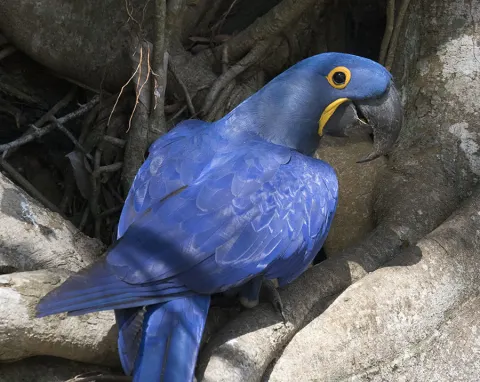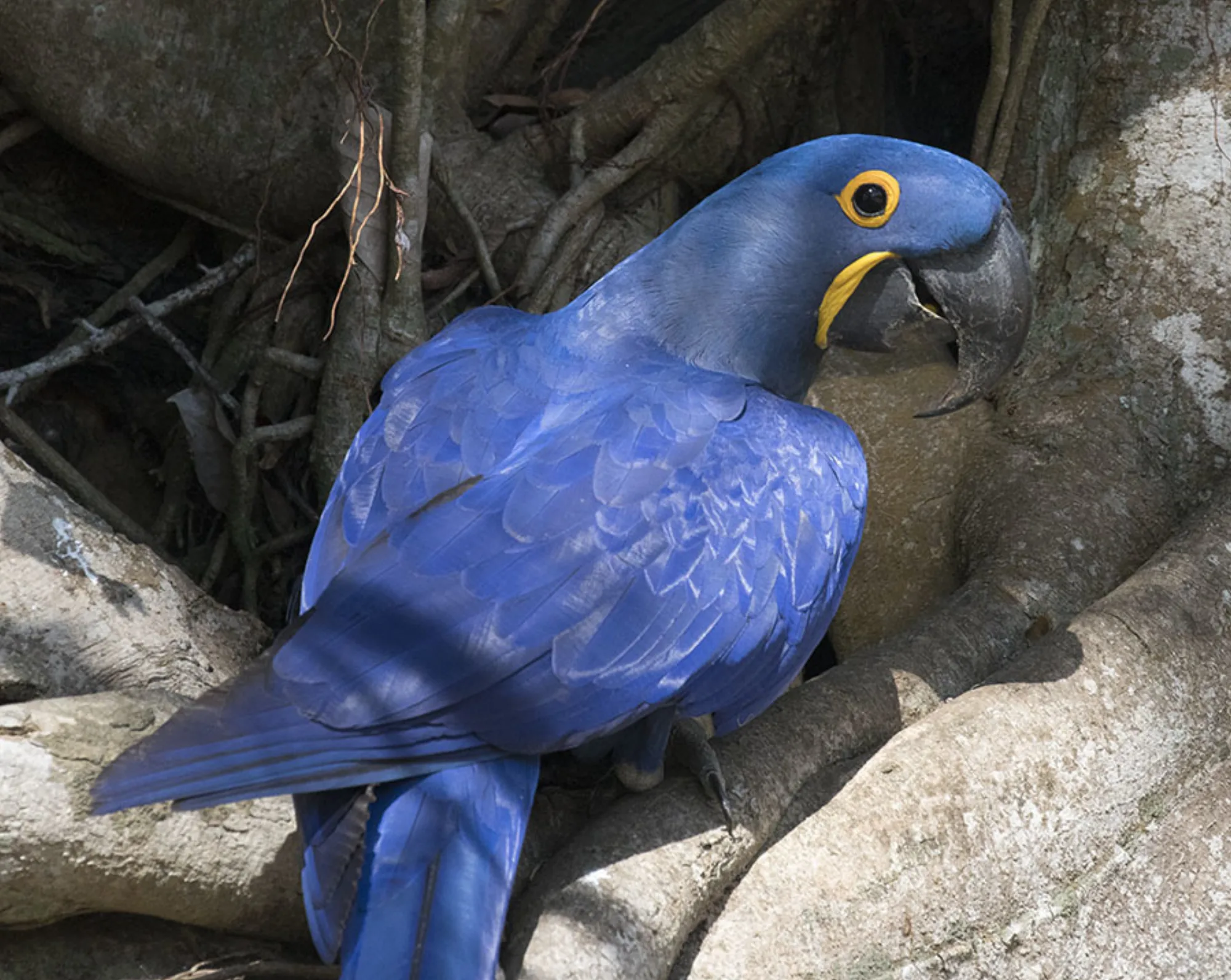
Hyacinth Macaw
Anodorhynchus hyacinthinus
A long, pointed tail and deep blue plumage make the Hyacinth Macaw a striking sight. This large South American parrot reaches about 1 m from head to tail, with yellow rings around its eyes and a yellow patch beneath its powerful beak. Its feathers are lighter blue above, while much of the underside of the wings and tail is black. It can be confused with Lear's macaw, which is smaller.
The bird occurs in the Pantanal of Brazil and neighbouring Bolivia and Paraguay, in Brazil's eastern interior, and in open parts of the eastern Amazon Basin. It favours semi-open country with some trees, including savannah, dry thorn forest, palm stands and swamps, generally avoiding dense, humid forest. Palm nuts make up much of its diet, but it also eats fruit and other plant matter, travelling widely in search of ripe food. Macaws have been seen using chewed leaves or pieces of wood to hold hard nuts steady while they gnaw into them.
From July to December, the birds nest in hollows in trees or on cliffs, depending on where they live. In the Pantanal, most nests are in manduvi trees, where suitable hollows are scarce and competition for them is fierce. A clutch contains one or two eggs, but usually only one chick survives to leave the nest. Loss of habitat and illegal capture for the pet trade have reduced wild populations, while fires can destroy nest trees and agriculture can make former habitat unsuitable. Toucans and other animals also take eggs, and the loss of large nesting trees limits opportunities to breed.
Written from the English Wikipedia article Hyacinth macaw (CC BY-SA 4.0).
- Records
- 15,727
- Countries
- 4
- Atlas places
- 3
These are open occurrence records, so they show where people looked for and recorded the Hyacinth Macaw as much as where it lives. Cells are up to 25 km across, and every location is generalised to its cell.
Generalised encounter areas, not exact locations. Each shape is a grid cell coloured by how likely the species is there.
- Very likelyBrazil25 km zone · high confidence · 15695 records · updated 80 days ago
- PossibleBolivia25 km zone · medium confidence · 18 records · updated 80 days ago
- PossibleUnited States25 km zone · medium confidence · 9 records · updated 80 days ago
- PossibleParaguay25 km zone · medium confidence · 5 records · updated 80 days ago
Conservation status not assessed here yet, so every location is generalised to its grid cell.