Slow Worm
Anguis fragilis
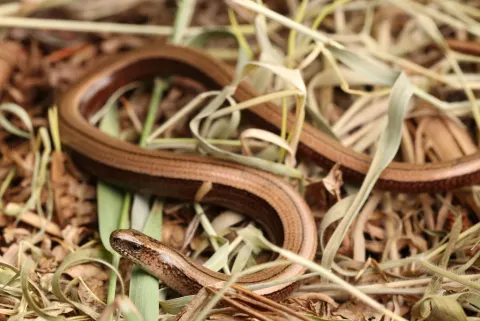
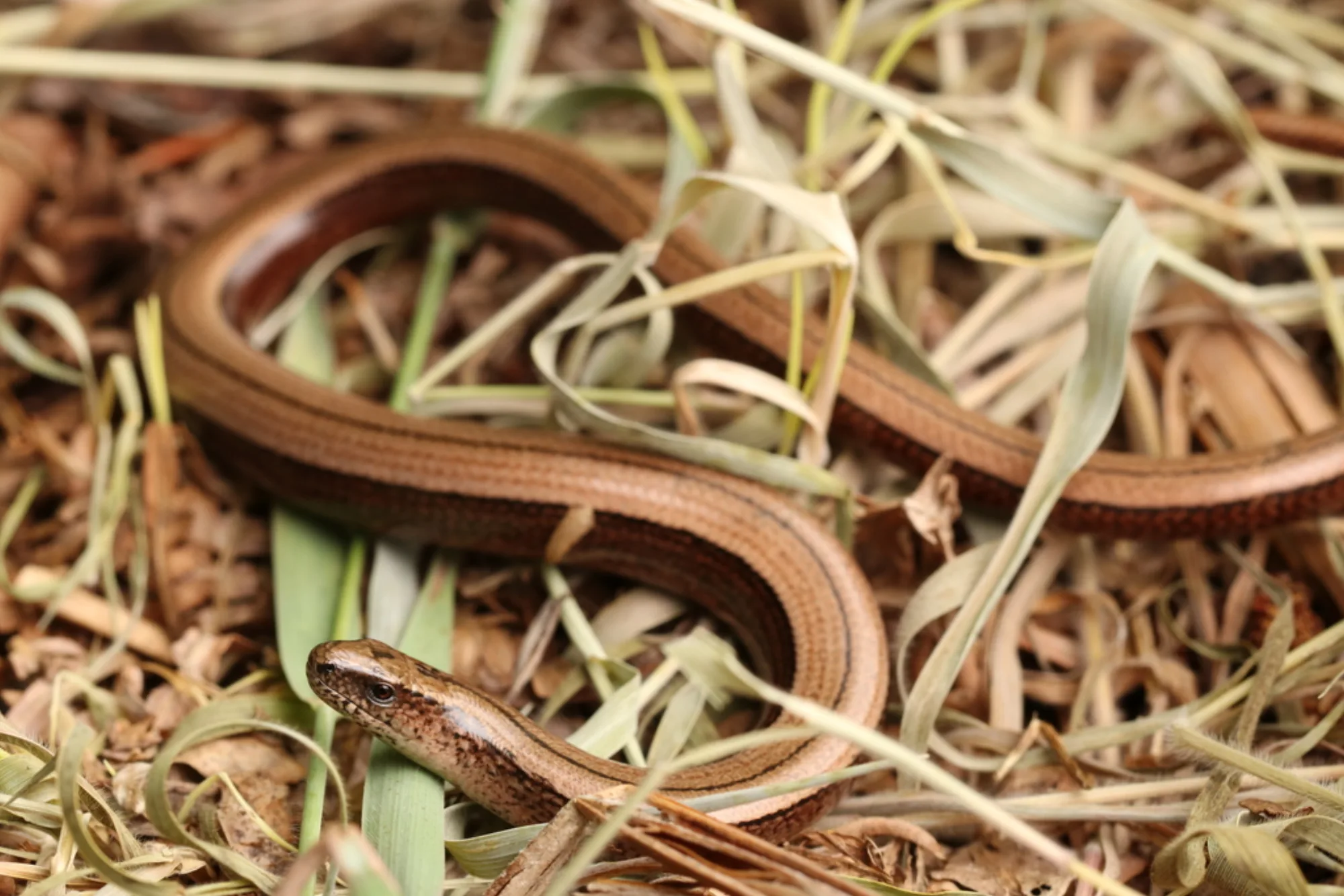
Look beneath a sun-warmed rock and you may find a Slow Worm sheltering in the heat. Despite its name and snakelike shape, this is a non-venomous legless lizard with smooth skin and small eyes. Most adults measure between 40 and 45cm, and their long bodies have no visible neck. Females often have dark sides and a stripe down the back, while males may show blue spots. Young slow worms are gold, with dark brown sides and bellies and a dark stripe along the back.
Native to Europe, Anguis fragilis occurs in western and northern Europe and the western Balkans. It spends much of its time hidden beneath objects and is often found in long grass and other damp places. In the UK, gardens and allotments offer places to look, including beneath logs, corrugated iron and tiles on warm days. Its activity varies with its surroundings, but it tends to be awake during the first hours of sunlight, at twilight and after rain. Rather than basking in direct sun, it warms itself under objects heated by the sun. Slugs, snails and earthworms are among the invertebrates it eats.
In Central Europe, mating usually takes place between late April and June. After 11 to 14 weeks, females generally give birth to eight to twelve young, usually from mid-July through August. Slow worms face predators including adders, birds of prey, domestic cats and foxes. If caught, a slow worm can shed its tail to escape, although the replacement remains shorter. Populations have been declining, and in the UK it is illegal to kill, injure or sell slow worms intentionally.
Written from the English Wikipedia article Common slow worm (CC BY-SA 4.0).
- Records
- 32,787
- Countries
- 12
No atlas park has a record of the Slow Worm in or around it yet.
These are open occurrence records, so they show where people looked for and recorded the Slow Worm as much as where it lives. Cells are up to 25 km across, and every location is generalised to its cell.
Generalised encounter areas, not exact locations. Each shape is a grid cell coloured by how likely the species is there.
- Very likelyFrance25 km zone · high confidence · 15534 records · updated 80 days ago
- Very likelyUnited Kingdom25 km zone · high confidence · 11558 records · updated 80 days ago
- Very likelyNorway25 km zone · high confidence · 2376 records · updated 80 days ago
- Very likelyGermany25 km zone · high confidence · 1048 records · updated 80 days ago
- Very likelyDenmark25 km zone · high confidence · 661 records · updated 80 days ago
- Very likelyAustria25 km zone · high confidence · 648 records · updated 80 days ago
- Very likelyBelgium25 km zone · high confidence · 378 records · updated 80 days ago
- Very likelyNetherlands25 km zone · high confidence · 292 records · updated 80 days ago
- Very likelySpain25 km zone · high confidence · 141 records · updated 80 days ago
- Very likelyJersey25 km zone · high confidence · 78 records · updated 80 days ago
Conservation status not assessed here yet, so every location is generalised to its grid cell.