American Eel
Anguilla rostrata
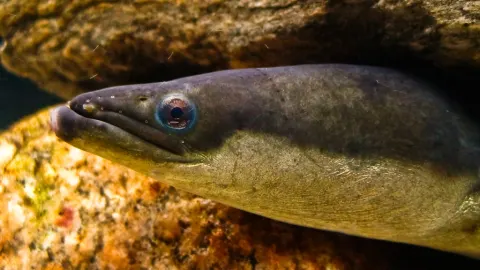
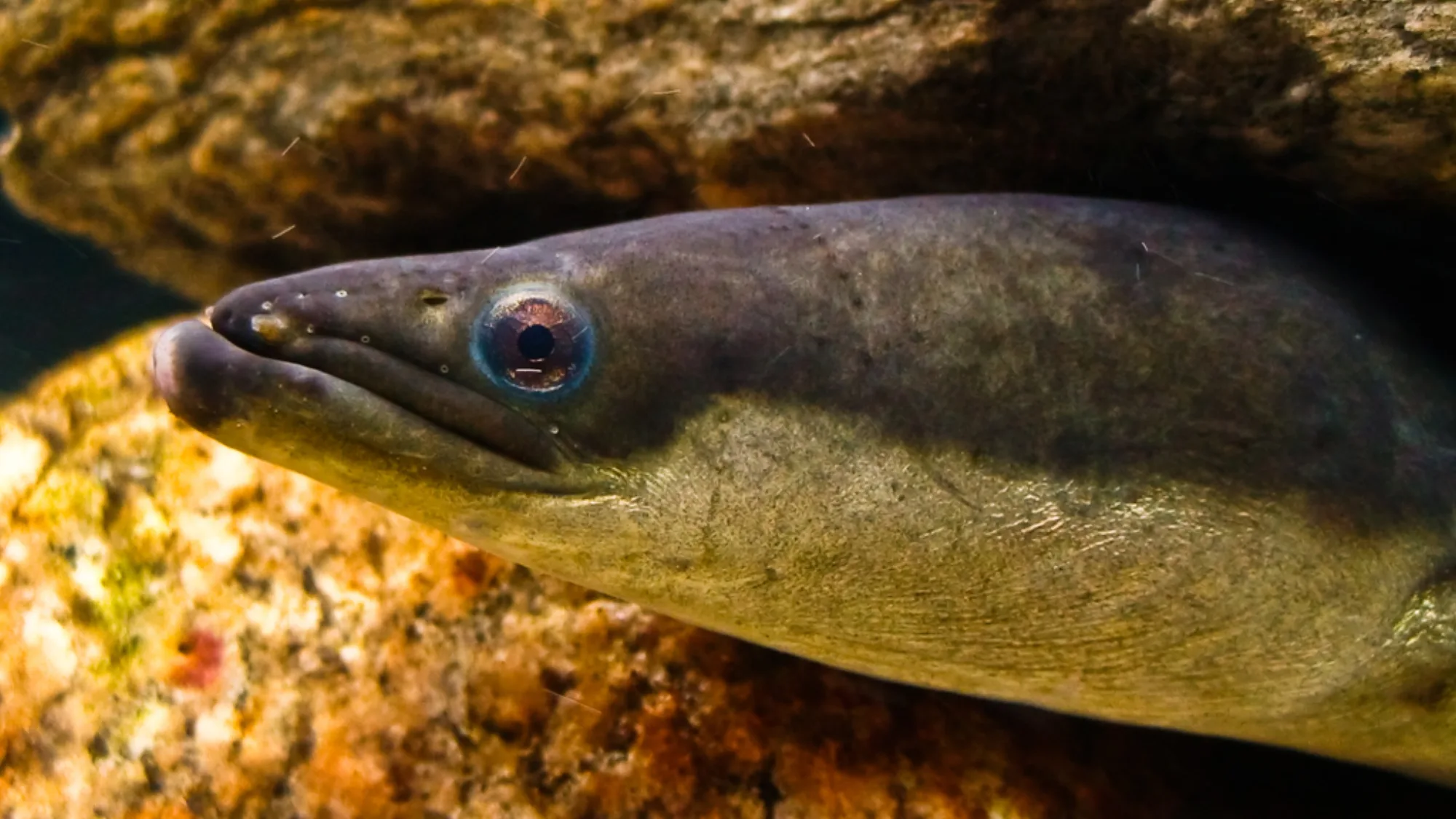
Along the eastern coast of North America, the American Eel moves between fresh water and the sea during a life that can span long journeys. Its supple, snake-like body is covered in mucus, while tiny scales are difficult to see. Its colour ranges from olive green and brown to greenish-yellow, with a pale grey or white belly; eels in clear water are often lighter than those in dark streams. It can grow to 1.22 m long and weigh up to 7.5 kg. The species lives along the western North Atlantic coast from Venezuela to Greenland, including Iceland; inland, its range includes the Great Lakes as well as the Mississippi and its tributaries. In fresh water it occupies streams, rivers and muddy or silty lakes, as well as coastal bays and estuaries.
A bottom dweller, it shelters among plants and snags or in burrows and tubes. It usually hunts at night, taking food that includes worms, small fish, molluscs, crustaceans and insects. In winter, it can burrow into mud and become torpid below 5 °C, though it may sometimes remain active. Young eels drift from the Sargasso Sea on ocean currents before travelling inland, a journey that can take years. After feeding and maturing in fresh water for approximately 10 to 25 years, they return to the Sargasso Sea to spawn. Hydroelectric dams block migrations and have eliminated eels from many watersheds, while turbines can kill eels travelling downstream. Habitat deterioration also restricts their available habitat, and pollutants can accumulate in their fat, causing toxicity and reduced productivity.
Written from the English Wikipedia article American eel (CC BY-SA 4.0).
- Records
- 35,949
- Countries
- 6
No atlas park has a record of the American Eel in or around it yet.
These are open occurrence records, so they show where people looked for and recorded the American Eel as much as where it lives. Cells are up to 25 km across, and every location is generalised to its cell.
Generalised encounter areas, not exact locations. Each shape is a grid cell coloured by how likely the species is there.
- Very likelyCanada25 km zone · high confidence · 32283 records · updated 80 days ago
- Very likelyUnited States25 km zone · high confidence · 2103 records · updated 80 days ago
- Very likelyUnnamed area25 km zone · medium confidence · 947 records · updated 80 days ago
- Very likelyBahamas25 km zone · medium confidence · 430 records · updated 80 days ago
- Very likelyTurks & Caicos Islands25 km zone · medium confidence · 101 records · updated 80 days ago
- LikelyDominican Republic25 km zone · medium confidence · 78 records · updated 80 days ago
- LikelyPuerto Rico25 km zone · medium confidence · 7 records · updated 80 days ago
Conservation status not assessed here yet, so every location is generalised to its grid cell.