Japanese Eel
Anguilla japonica
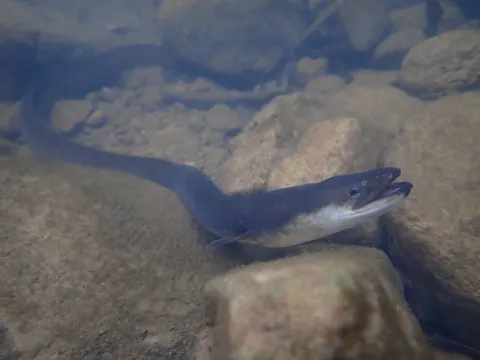
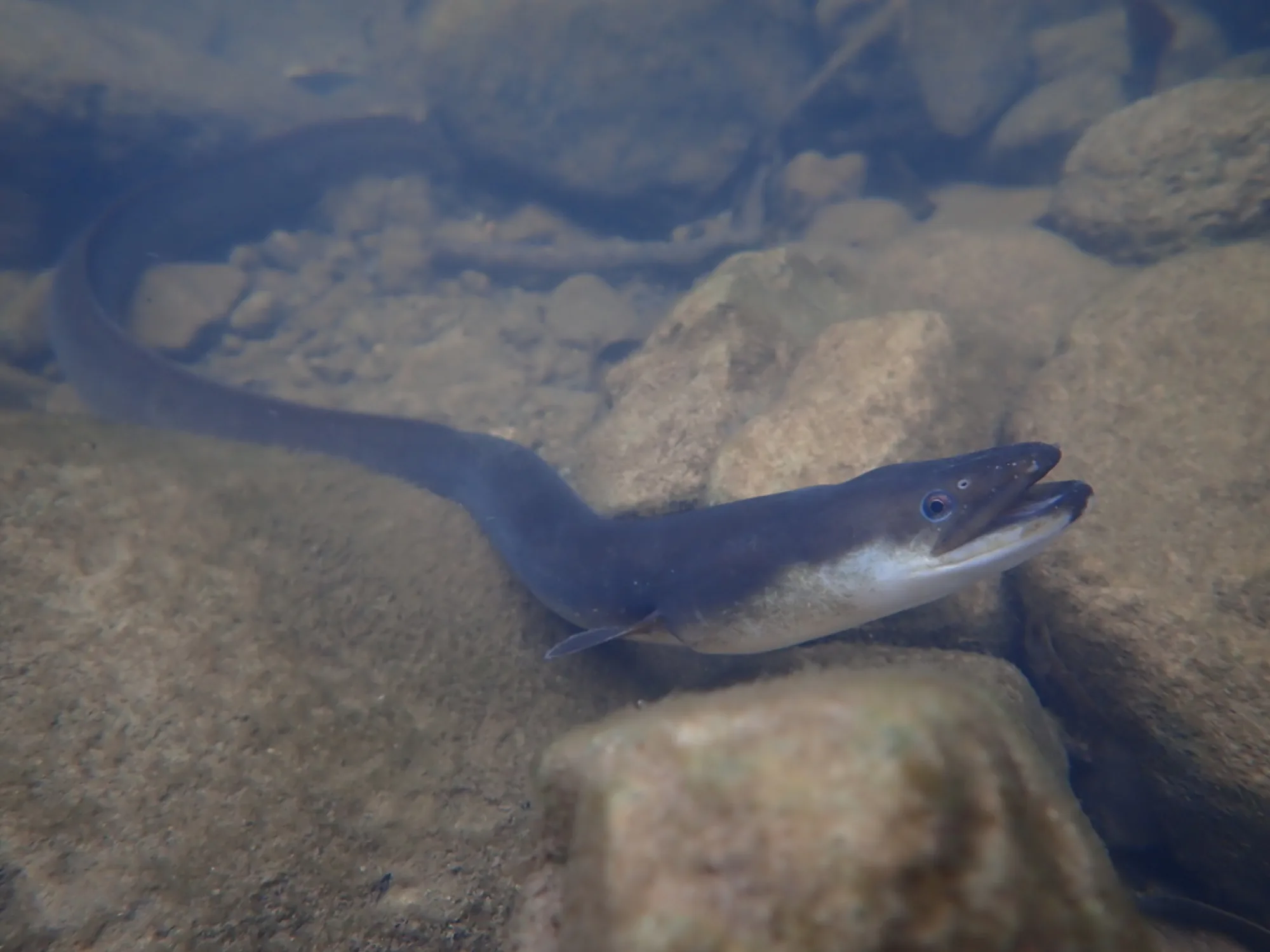
The Japanese Eel ranges from Japan and Korea to Taiwan, China, Vietnam and the northern Philippines. It spends most of its adult life in fresh water, occupying rivers and lakes as well as estuaries where rivers meet the sea. During its long brown or yellow stage, its upper side is dull grey, brown and greenish, with a white belly, though its colouring depends on the water. Females reach up to 57 to 60 cm, while males reach 35 cm. As adults approach their final stage, they develop a silvery colour.
Young eels arriving in fresh water are known as elvers. They generally travel upstream at night, hiding in river banks and beneath rocks during the day. In fresh water and estuaries, yellow eels eat mainly shrimp, other crustaceans, aquatic insects and small fish; they also feed on worms and insects during this stage. Adults leave East Asian rivers between April and November and travel thousands of kilometres to breed in the western North Pacific, without feeding along the way. After hatching at sea, the larvae feed on marine snow and are carried towards East Asia by ocean currents. After breeding at sea, the adults die.
Overfishing and habitat loss are among the pressures on wild populations. Changes in ocean conditions may interfere with spawning and the transport of larvae, while shifts in a salinity front may carry more larvae away from the routes that lead them back to Asian rivers. Eel farming also depends heavily on catching young wild eels for growing in ponds.
Written from the English Wikipedia article Japanese eel (CC BY-SA 4.0).
- Records
- 91
- Countries
- 3
No atlas park has a record of the Japanese Eel in or around it yet.
These are open occurrence records, so they show where people looked for and recorded the Japanese Eel as much as where it lives. Cells are up to 25 km across, and every location is generalised to its cell.
Generalised encounter areas, not exact locations. Each shape is a grid cell coloured by how likely the species is there.
- Very likelyTaiwan25 km zone · medium confidence · 76 records · updated 80 days ago
- Very likelySouth Korea25 km zone · medium confidence · 7 records · updated 80 days ago
- LikelyJapan25 km zone · medium confidence · 8 records · updated 80 days ago
Conservation status not assessed here yet, so every location is generalised to its grid cell.