European Eel
Anguilla anguilla
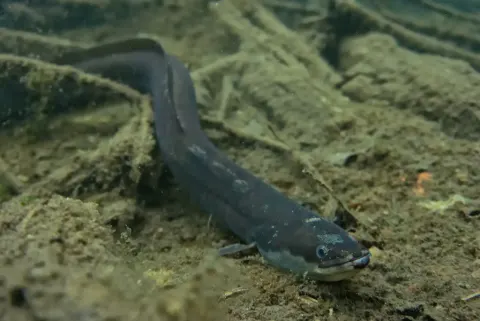
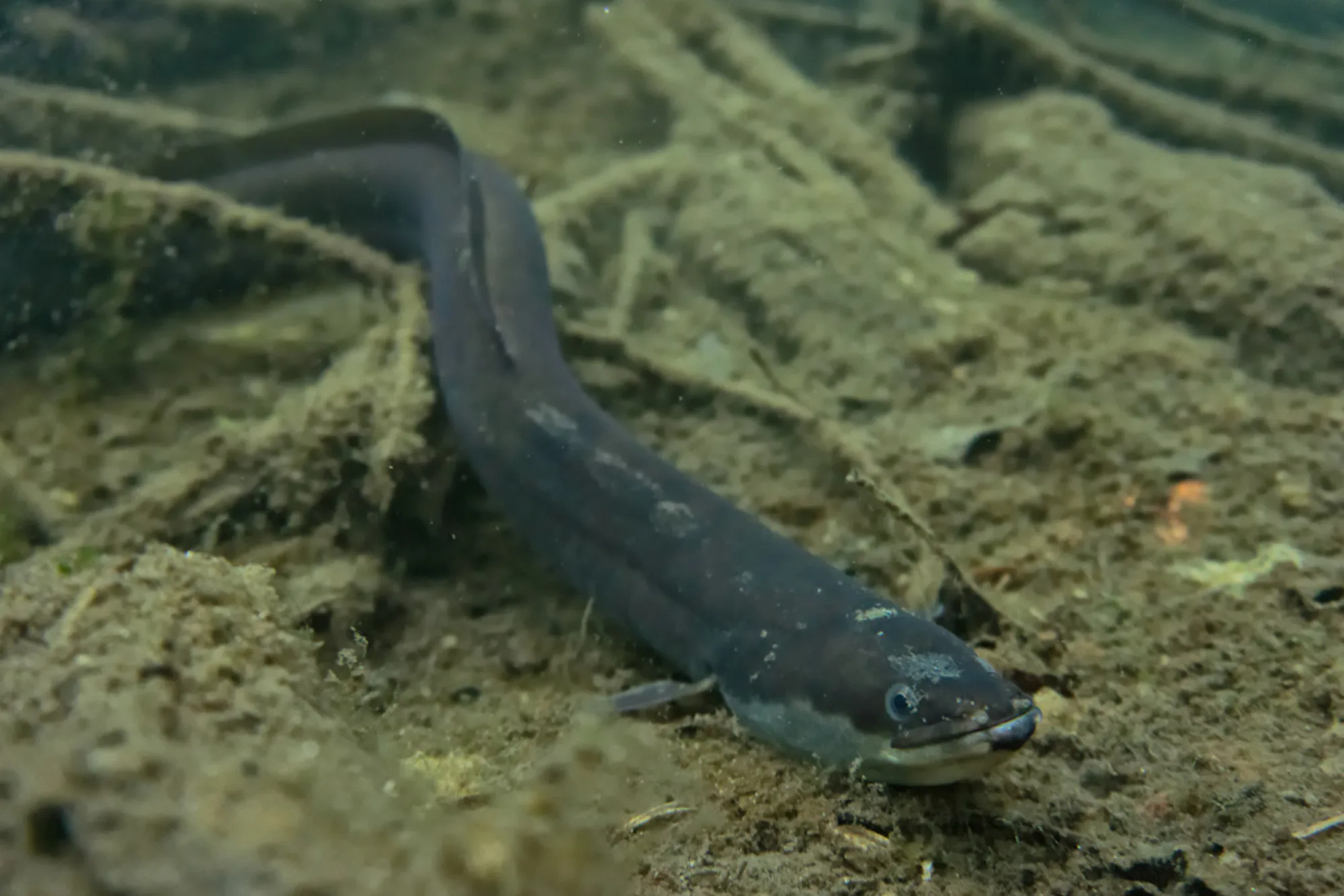
The European Eel changes appearance as it grows, passing through five stages from larva to silver eel. In the yellow stage, adults are typically around 45 to 65 centimetres long, with brownish-yellow sides and bellies. Later, their eyes grow larger, their flanks turn silver and their bellies become white. Wild eels tend to live for approximately 15 to 20 years.
European eels spawn in the Sargasso Sea, and their young drift towards Europe before entering estuaries. Many then travel upstream, with most spending much of their lives inland in fresh water or along coasts in brackish water. Some stay at sea for life, while others make repeated journeys among marine, brackish and fresh waters. They shelter among plants, in tube-shaped gaps in rocks and, inland, in muddy fields. Feeding mainly at night, they use scent to find worms, fish, molluscs and crustaceans, sometimes also eating plankton when it is plentiful. Larger eels, herons, cormorants and pike prey on them, while seagulls also take young elvers.
After 5 to 20 years in fresh or brackish water, mature silver eels begin the journey back to the Sargasso Sea to spawn. They die after spawning, although mating in the wild has yet to be observed. The number reaching Europe is thought to have fallen by around 90% since the 1970s, possibly even 98%. Overfishing, parasites and migration barriers such as hydroelectric dams contribute to the decline, as do natural changes in Atlantic currents and the North Atlantic oscillation. PCB pollution may also be a factor.
Written from the English Wikipedia article European eel (CC BY-SA 4.0).
- Records
- 596,519
- Countries
- 10
No atlas park has a record of the European Eel in or around it yet.
These are open occurrence records, so they show where people looked for and recorded the European Eel as much as where it lives. Cells are up to 25 km across, and every location is generalised to its cell.
Generalised encounter areas, not exact locations. Each shape is a grid cell coloured by how likely the species is there.
- Very likelyFrance25 km zone · high confidence · 365476 records · updated 80 days ago
- Very likelyBelgium25 km zone · high confidence · 181929 records · updated 80 days ago
- Very likelySweden25 km zone · high confidence · 18490 records · updated 80 days ago
- Very likelyNetherlands25 km zone · high confidence · 15760 records · updated 80 days ago
- Very likelyGermany25 km zone · high confidence · 6990 records · updated 80 days ago
- Very likelyUnited Kingdom25 km zone · high confidence · 3499 records · updated 80 days ago
- Very likelySpain25 km zone · high confidence · 1653 records · updated 80 days ago
- Very likelyLuxembourg25 km zone · high confidence · 1624 records · updated 80 days ago
- Very likelyDenmark25 km zone · high confidence · 1098 records · updated 80 days ago
Conservation status not assessed here yet, so every location is generalised to its grid cell.