Japanese Giant Salamander
Andrias japonicus
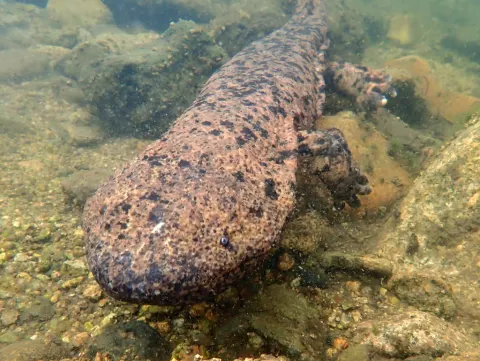
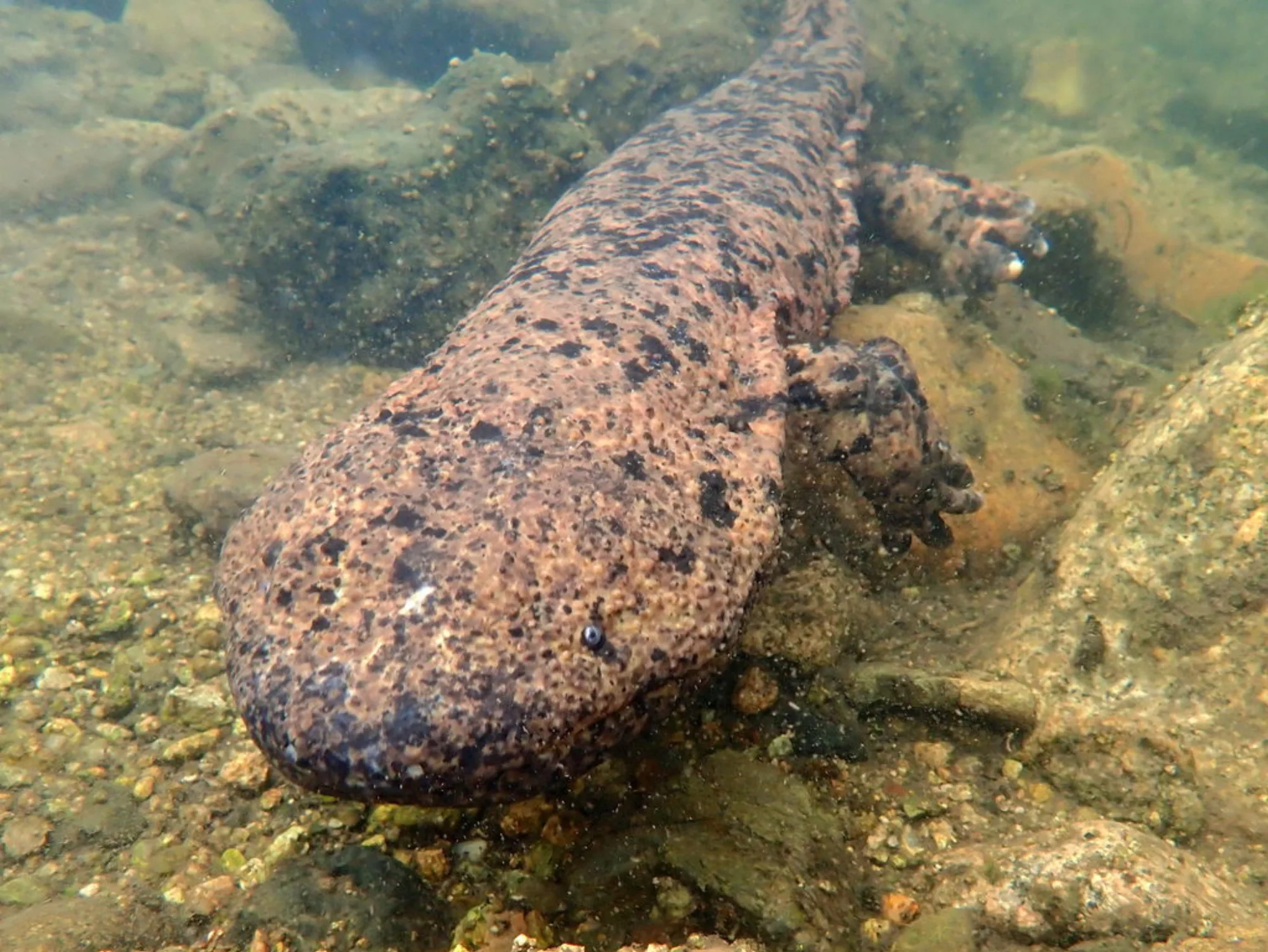
Mottled brown and black skin helps the Japanese Giant Salamander blend into the beds of streams and rivers. This fully aquatic animal can reach 1.5 m in length and 25 kg in weight. Look for its broad mouth, rounded snout, tiny eyes and many small warts, with more prominent warts on the head. Its eyesight is poor, but sensory cells in its skin detect small vibrations that help it hunt.
Found only in Japan, it lives across western Honshu, with smaller populations on Shikoku and in northern Kyushu. It favours clear, cool, flowing water, including fast mountain streams, and occurs in waterways from large rivers to small headwaters. It can also inhabit disturbed streams among rice paddies, where frogs provide food for adults. Almost entirely nocturnal, it stays in water throughout its life, absorbing oxygen through its skin and sometimes raising its head to breathe air. Adults eat freshwater crabs, insects, worms, frogs, fish and other small animals, and can sometimes go for weeks without food.
During the breeding season, usually in late August and early September, mature males seek nesting places, often moving upstream into smaller channels or tributaries. A male guards his den and the eggs inside, fanning water over them with his tail, and continues caring for the young until they begin to disperse the following spring. Pollution, habitat loss, invasive species and the silting of rivers threaten the salamander. Concrete banks remove suitable nesting habitat, while dams block migration routes and fragment habitat. Interbreeding with introduced Chinese giant salamanders is another major challenge, and appears to be spreading across several watersheds.
Written from the English Wikipedia article Japanese giant salamander (CC BY-SA 4.0).
- Records
- 8
- Countries
- 1
No atlas park has a record of the Japanese Giant Salamander in or around it yet.
These are open occurrence records, so they show where people looked for and recorded the Japanese Giant Salamander as much as where it lives. Cells are up to 25 km across, and every location is generalised to its cell.
Generalised encounter areas, not exact locations. Each shape is a grid cell coloured by how likely the species is there.
- Very likelyJapan25 km zone · medium confidence · 8 records · updated 80 days ago
Conservation status not assessed here yet, so every location is generalised to its grid cell.