Chinese Giant Salamander
Andrias davidianus
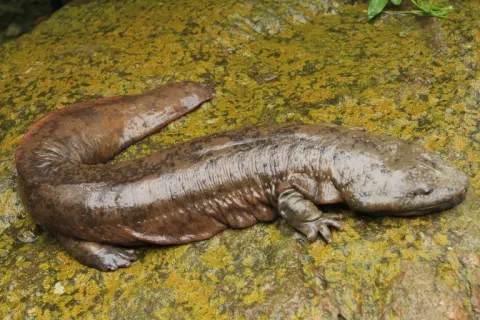
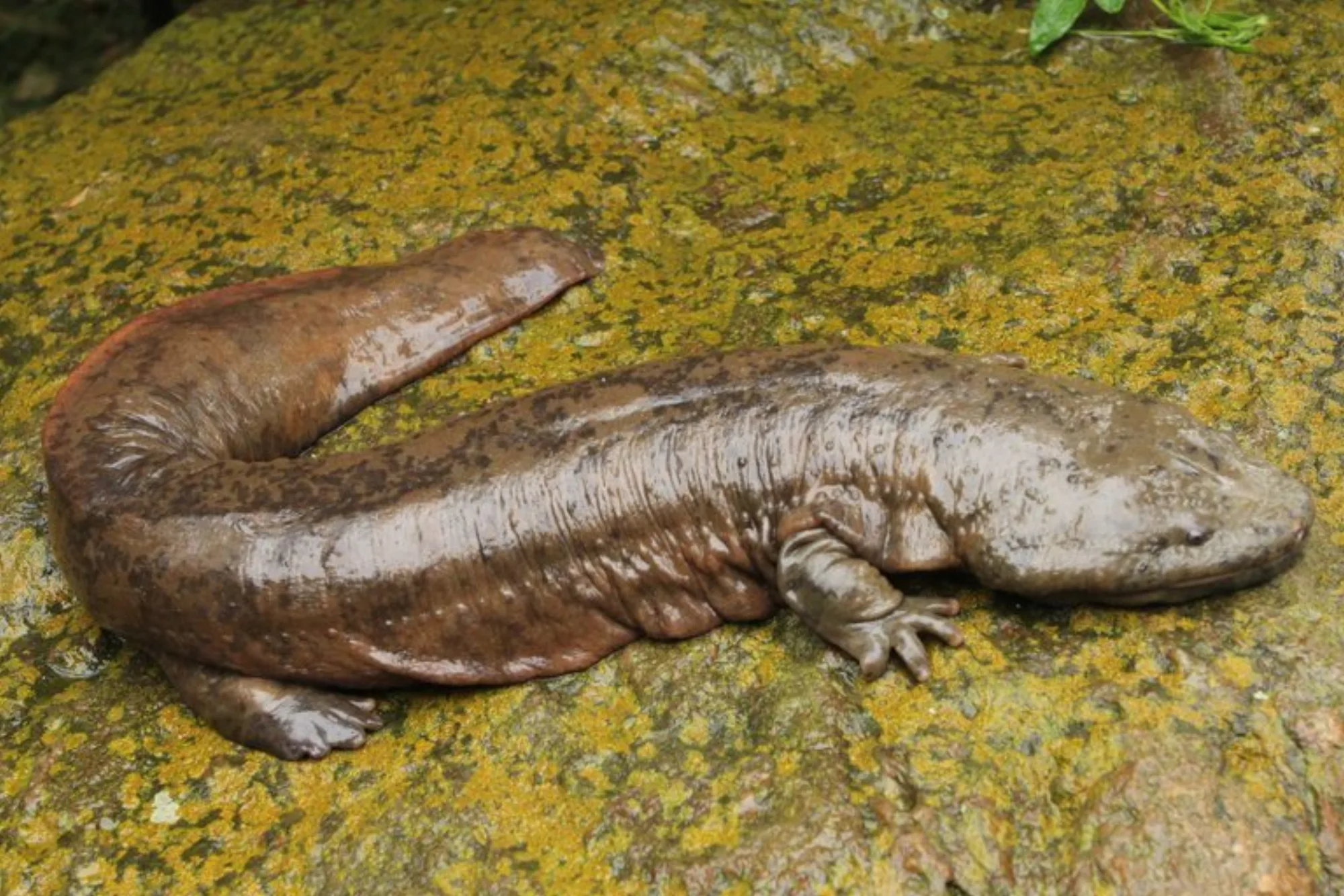
Reaching up to 1.8 m in length, the Chinese Giant Salamander is the largest amphibian on the planet. This animal has a broad, flat head with a wide mouth and tiny, lidless eyes. Its dark skin is wrinkled and often mottled with brown, black, or reddish tones. Because it has very poor eyesight, it relies on sensory nodes running from head to tail to detect vibrations in the water. It also produces a white, sticky secretion to ward off predators.
Native to the lakes and rocky mountain streams of the Yangtze, Yellow, and Pearl River basins, these salamanders are entirely aquatic. They prefer clear, quick-flowing water and usually hide in dark crevices or muddy burrows along the banks. These creatures are most active from the early evening into the night. Their diet includes insects, crabs, shrimp, and fish, and they are even known to eat other salamanders. During the breeding season between July and September, females lay 400 to 500 eggs in underwater cavities. The male then guards these eggs for 50 to 60 days until they hatch.
Wild populations have dropped by more than 80% since the 1950s due to several human-related factors. They are hunted as a luxury food and for use in traditional medicine. Industrialization and the building of dams have destroyed 90% of their habitat by drying up streams or causing siltation. Additionally, the release of captive-bred individuals from farms poses a risk to the remaining wild population by spreading diseases like Ranavirus. Because they cannot survive water temperatures above 35 °C, they are also particularly vulnerable to the effects of global warming.
Written from the English Wikipedia article Chinese giant salamander (CC BY-SA 4.0).
- Atlas places
- 0
These are open occurrence records, so they show where people looked for and recorded the Chinese Giant Salamander as much as where it lives. Cells are up to 25 km across, and every location is generalised to its cell.
No encounter zones yet
Where and when you can expect to see Chinese Giant Salamander is calculated from observation density. No zones have been computed for this species yet.