Wyoming Toad
Anaxyrus baxteri
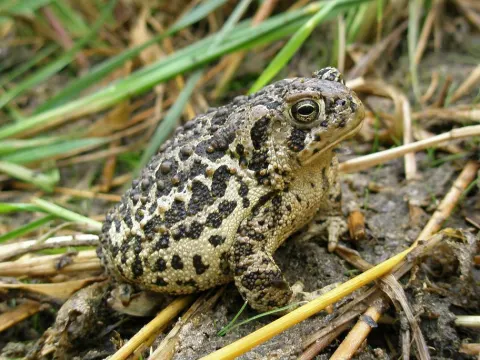
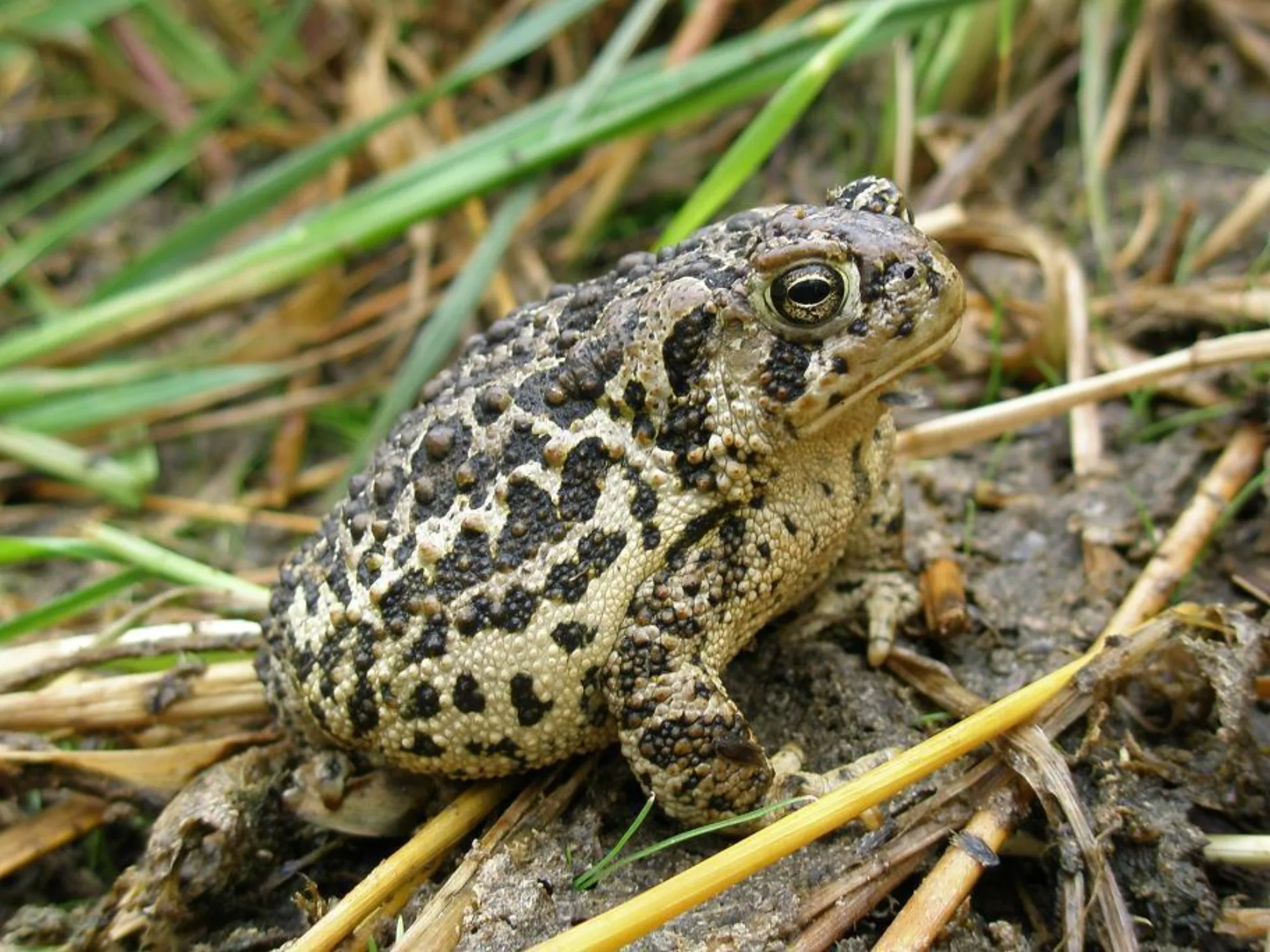
Dark brown, grey or green, the Wyoming Toad has small dark marks underneath and rounded, blotchy warts and blurred pale lines across its back. Individuals can be told apart by their colours and wart patterns, while males have dark throats. It grows up to 5.6 cm long, with females slightly larger than males. This rare amphibian lives in captivity and in Wyoming, at the Mortenson Lake National Wildlife Refuge. Historically, it was found in floodplains, ponds, shallow lakes and seepage pools in the Laramie Basin. It frequents floodplains and short grass beside ponds, creeks and lakes, and often uses abandoned pocket gopher or ground squirrel burrows for hibernation.
At Mortenson Lake, adults tend to favour more heavily vegetated ground farther from shore, while younger toads settle nearer the water in areas with less vegetation. Adults move very little from place to place. Mainly active at night, the toad has poor eyesight and hunts by detecting the movement of its prey. Toads emerge from hibernation in early May and move to the north shore to breed, then return south for hibernation in late September or early October. Males mature at two years and females at three, and the breeding call is low and slow. Released captive toads have reproduced at Mortenson Lake, where egg masses were found in 1998 and 1999.
Disease has played a major part in the population's decline, particularly infection by chytrid fungus. Increased irrigation has reduced the area and quality of the floodplain wetlands the toad once occupied, while water shortages can further diminish wetland quality. Changing weather and water levels can also affect tadpole survival, and birds and mammals prey on the toads at all life stages.
Written from the English Wikipedia article Wyoming toad (CC BY-SA 4.0).
- Records
- 12
- Countries
- 1
No atlas park has a record of the Wyoming Toad in or around it yet.
These are open occurrence records, so they show where people looked for and recorded the Wyoming Toad as much as where it lives. Cells are up to 25 km across, and every location is generalised to its cell.
Generalised encounter areas, not exact locations. Each shape is a grid cell coloured by how likely the species is there.
- Very likelyUnited States25 km zone · medium confidence · 12 records · updated 80 days ago
Conservation status not assessed here yet, so every location is generalised to its grid cell.