American Toad
Anaxyrus americanus
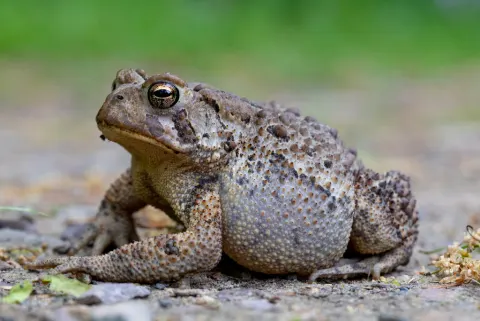
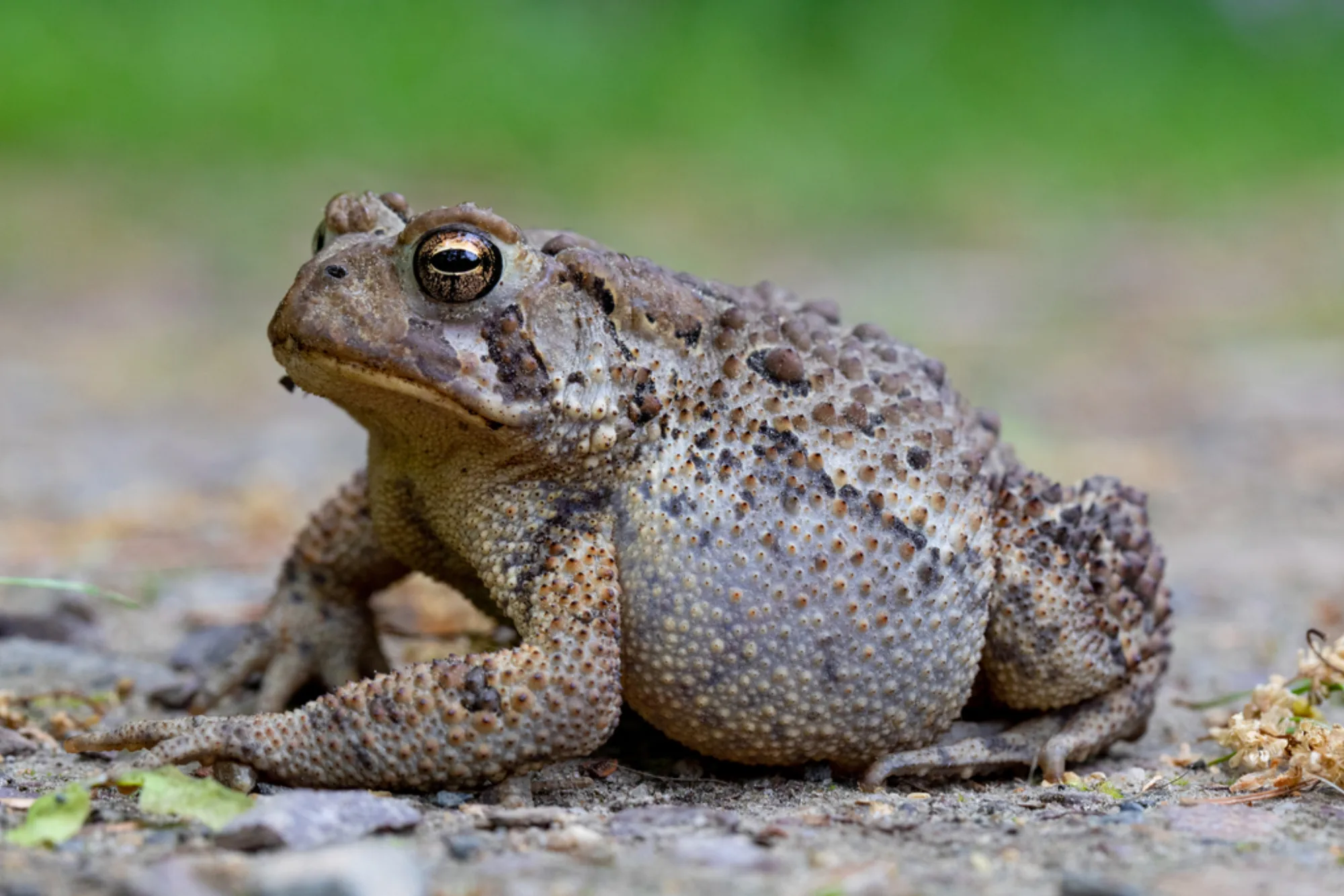
The American Toad ranges across eastern Canada and the eastern United States, living in places as varied as forests and flat grassland. It needs dense vegetation for cover and hunting, a supply of insects, and a freshwater pond or pool with shallow water. The eastern American toad usually measures 5 to 9 cm, though its colour and pattern vary. Its skin can be yellow, brown or black, either plain or speckled, and may change with conditions. Its spots contain one or two warts, and its belly is usually spotted. The smaller dwarf American toad reaches about 6 cm and is generally dark reddish, sometimes with a white line down its back.
Adults are mostly active at night, while juveniles often move about during the day. Rain brings the toads out to feed on worms and insects. They commonly shelter beneath logs, stones, boards and wood piles, or in burrows. In cold weather, they dig backwards into the soil and hibernate. During the breeding period, a male gives a high trill resembling a ringing telephone, lasting 6 to 30 seconds. Females lay long strings of eggs in shallow water, often around vegetation or on the pond bottom. The eggs hatch in 3 to 12 days, and the young eventually leave the water for life mostly on land. Groups of newly transformed toadlets may move together towards higher ground and shaded forest bordering their breeding marshes.
Tadpoles face predators, though their skin produces chemicals that discourage some attacks. Invasive plant leaves in nursery waters can also increase the burden of trematode parasites on tadpoles.
Written from the English Wikipedia article American toad (CC BY-SA 4.0).
- Records
- 7,598
- Countries
- 2
- Atlas places
- 3
These are open occurrence records, so they show where people looked for and recorded the American Toad as much as where it lives. Cells are up to 25 km across, and every location is generalised to its cell.
Generalised encounter areas, not exact locations. Each shape is a grid cell coloured by how likely the species is there.
- Very likelyUnited States25 km zone · medium confidence · 5660 records · updated 80 days ago
- Very likelyCanada25 km zone · medium confidence · 1938 records · updated 80 days ago
Conservation status not assessed here yet, so every location is generalised to its grid cell.