Pacific Black Duck
Anas superciliosa
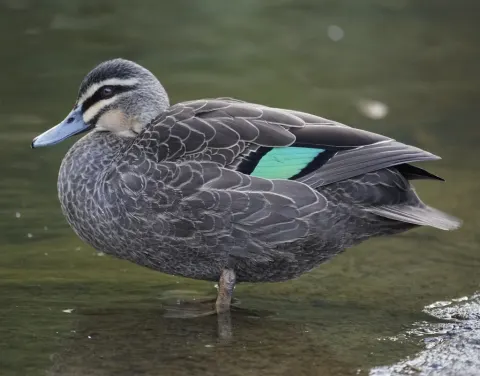
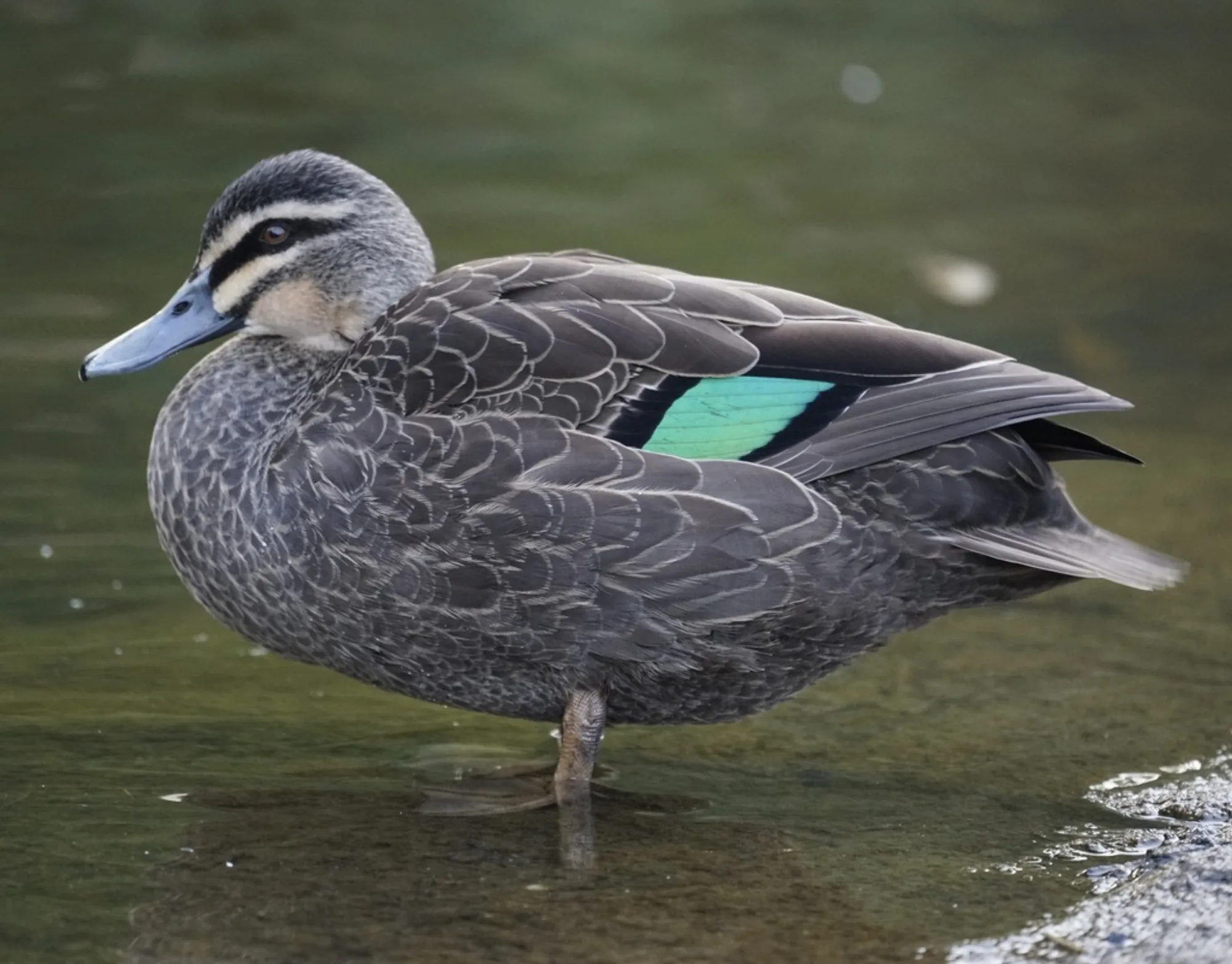
Look for a dark-bodied duck with a paler head, dark crown and stripes across its face. In flight, the Pacific Black Duck shows a green wing patch and pale underwings. It measures 54 to 61 cm, with males tending to be larger than females; some island birds have a darker colour and are smaller than birds in the main populations. The female gives a series of rapid, harsh quacks that gradually grow quieter. This sociable duck lives in a variety of wetlands across much of Indonesia, New Guinea, Australia and New Zealand, as well as many islands in the southwestern Pacific. Its range extends north to the Caroline Islands and east to French Polynesia; it also sometimes visits the Marianas during migration.
Pacific Black Ducks feed mainly on the seeds of aquatic plants, adding small crustaceans, molluscs and aquatic insects to their diet. They tip up in the water with their heads and necks submerged, sometimes searching for food on damp grassland too. A nest is usually set in a tree hole, although an old corvid nest or a site on the ground may be used. The female alone incubates the clutch of 8 to 10 pale cream eggs, which hatch after 26 to 32 days. She cares for the downy ducklings, which leave the nest once dry and can fly at around 58 days old.
Numbers have fallen sharply in New Zealand and on several Australian islands, with introduced mallards competing and interbreeding with the ducks. Similar effects are occurring in many parts of Australia, particularly Tasmania and Adelaide. In New Zealand, larger mallards can physically dominate grey ducks, whose numbers also fell markedly because of overhunting in the mid-20th century.
Written from the English Wikipedia article Pacific black duck (CC BY-SA 4.0).
- Records
- 709,204
- Countries
- 19
- Atlas places
- 9
- Blue Mountains National Park· Australia
- Great Sandy National Park (K'gari)· Australia
- Daintree National Park· Australia
- Grampians (Gariwerd) National Park· Australia
- Fiordland National Park· New Zealand
- Lamington National Park· Australia
- Lore Lindu National Park· Indonesia
- Mount Aspiring National Park· New Zealand
- Tongariro National Park· New Zealand
These are open occurrence records, so they show where people looked for and recorded the Pacific Black Duck as much as where it lives. Cells are up to 25 km across, and every location is generalised to its cell.
Generalised encounter areas, not exact locations. Each shape is a grid cell coloured by how likely the species is there.
- Very likelyAustralia25 km zone · high confidence · 703344 records · updated 86 days ago
- Very likelyNew Zealand25 km zone · high confidence · 2143 records · updated today
- Very likelyPapua New Guinea25 km zone · high confidence · 1231 records · updated today
- Very likelyCocos (Keeling) Islands25 km zone · high confidence · 472 records · updated today
- LikelyIndonesia25 km zone · high confidence · 403 records · updated today
- LikelyNew Caledonia25 km zone · high confidence · 325 records · updated today
- LikelyFiji25 km zone · high confidence · 303 records · updated today
- LikelyVanuatu25 km zone · high confidence · 257 records · updated today
- LikelyFrench Polynesia25 km zone · high confidence · 228 records · updated today
- LikelySolomon Islands25 km zone · medium confidence · 114 records · updated today
Conservation status not assessed here yet, so every location is generalised to its grid cell.