Mallard
Anas platyrhynchos
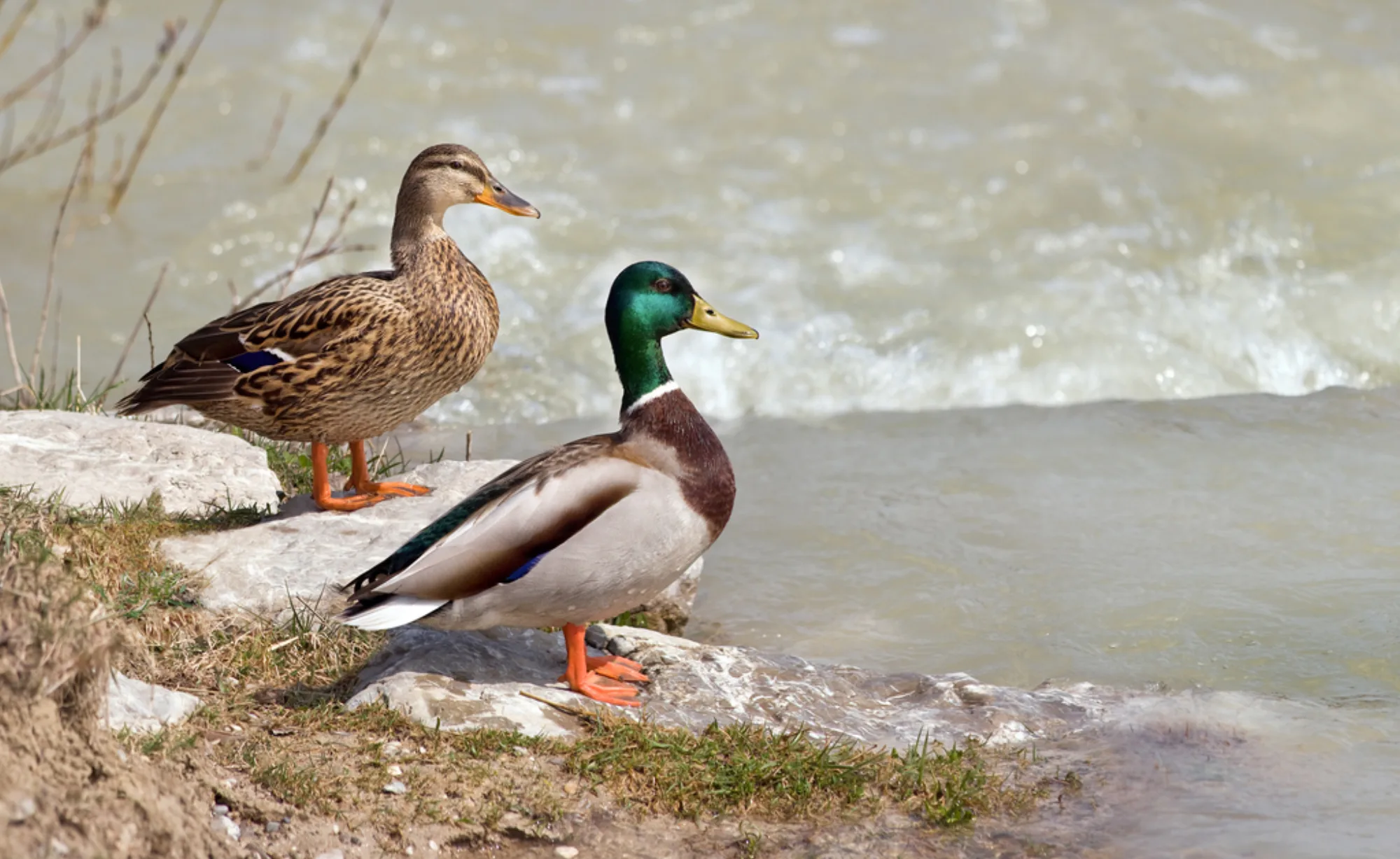
A familiar sight on wetlands and urban ponds, the Mallard (Anas platyrhynchos) is a dabbling duck with a wide range. The breeding male has a glossy green head, a white collar and a brown breast tinged with purple, while the female is mostly mottled brown. Both have a white-edged patch of iridescent purple-blue feathers on each wing, visible in flight or at rest. A female often gives a series of deep quacks, beginning loudly and becoming quieter.
Mallards breed across temperate and subtropical parts of Eurasia, North Africa and North America, and have been introduced to places including New Zealand, Australia and South Africa. They use fresh and salt water, from small ponds and rivers to estuaries and shallow coastal inlets, and favour water with aquatic vegetation. Birds in the northern parts of the breeding range migrate strongly, spending winter farther south. Outside the breeding season, they gather in large flocks. They usually feed by dabbling for plants or grazing, but also eat insects, crustaceans, worms and other small animals.
Nests are usually hidden in vegetation on the ground, although females also use places such as tree hollows and roof gardens. A clutch contains 8 to 13 eggs, and the ducklings can swim as soon as they hatch. They stay close to their mother for warmth and protection and to learn where to find food. Mallards face hunting and predators, including foxes and birds of prey, while botulism outbreaks can cause mass deaths. Interbreeding with domestic and feral mallards also affects the wild Mallard's genetic diversity.
Written from the English Wikipedia article Mallard (CC BY-SA 4.0).
- Records
- 8,348,735
- Countries
- 147
- Atlas places
- 11
- Annapurna Conservation Area· Nepal
- Hemis National Park· India
- Table Mountain National Park· South Africa
- Dorob National Park· Namibia
- Kaziranga National Park· India
- Kinabalu Park· Malaysia
- Koshi Tappu Wildlife Reserve· Nepal
- Minneriya National Park· Sri Lanka
- Nahuel Huapi National Park· Argentina
- Wasgamuwa National Park· Sri Lanka
- Zambezi National Park· Zimbabwe
These are open occurrence records, so they show where people looked for and recorded the Mallard as much as where it lives. Cells are up to 25 km across, and every location is generalised to its cell.
Generalised encounter areas, not exact locations. Each shape is a grid cell coloured by how likely the species is there.
- Very likelyUnited States25 km zone · high confidence · 5732645 records · updated 86 days ago
- Very likelyCanada25 km zone · high confidence · 1386676 records · updated 86 days ago
- Very likelyNorway25 km zone · high confidence · 194934 records · updated 86 days ago
- Very likelyBelgium25 km zone · high confidence · 148286 records · updated 86 days ago
- Very likelyUnited Kingdom25 km zone · high confidence · 99969 records · updated 86 days ago
- Very likelySpain25 km zone · high confidence · 59983 records · updated 86 days ago
- Very likelyPortugal25 km zone · high confidence · 58994 records · updated 86 days ago
- Very likelyFrance25 km zone · high confidence · 57364 records · updated today
- Very likelyIceland25 km zone · high confidence · 36687 records · updated today
- Very likelyNetherlands25 km zone · high confidence · 34445 records · updated 86 days ago
Conservation status not assessed here yet, so every location is generalised to its grid cell.