Eurasian Teal
Anas crecca
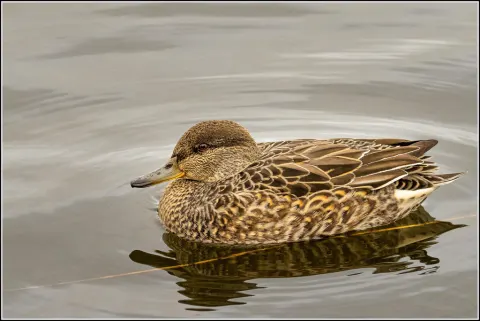
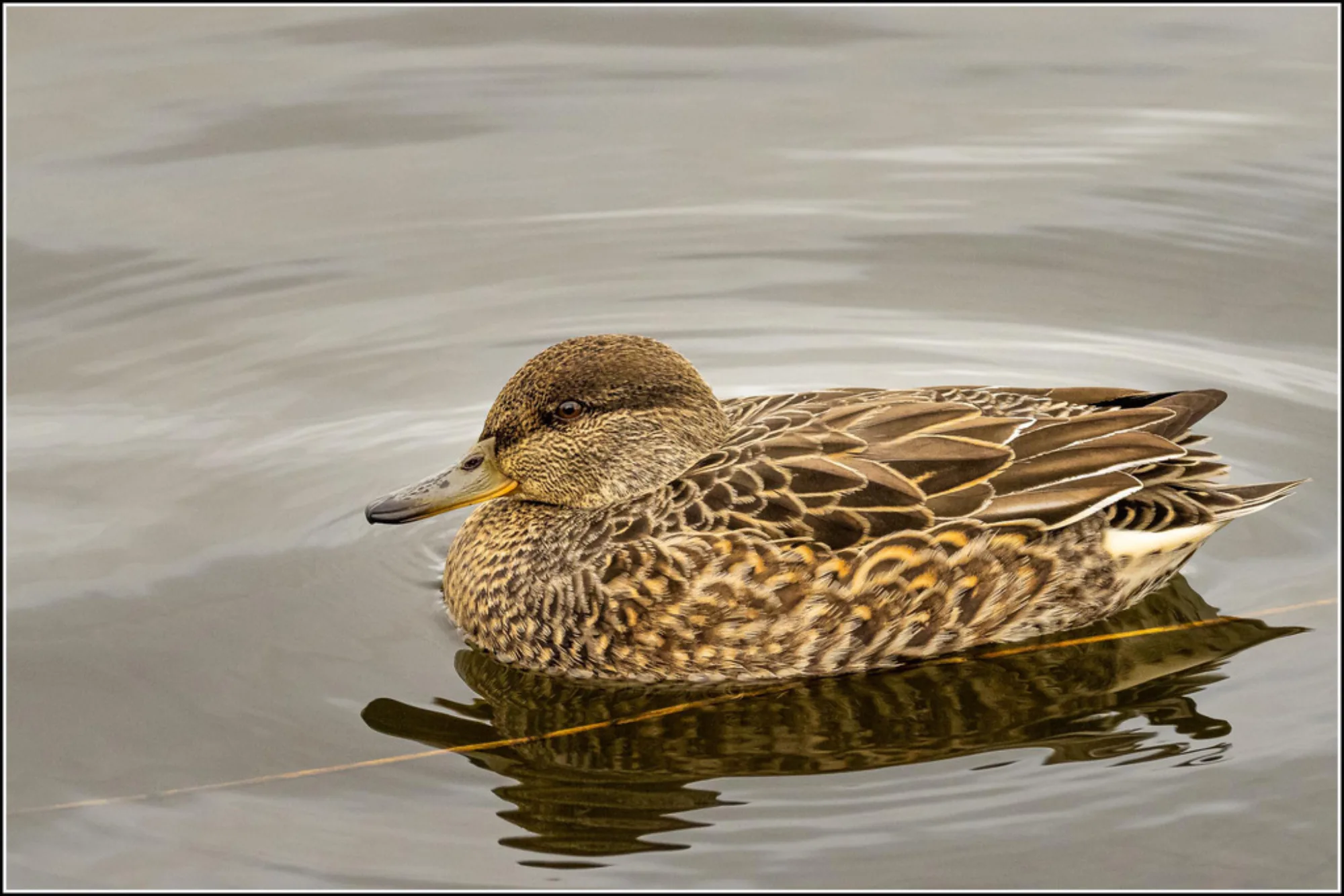
Small, sociable and quick on the wing, the Eurasian Teal is a dabbling duck that gathers in large flocks outside the breeding season. In flight, these flocks twist rapidly and resemble waders. A breeding male looks grey from a distance, with a dark head, a yellowish rear and a white stripe along each side. Closer views reveal a chestnut head with a broad, iridescent dark green patch sweeping back from the eye. Females are yellowish-brown, darker on the back and wings, while males outside the breeding season resemble them. Listen for the male's whistle or the female's quack.
Eurasian Teal breed across the Palearctic and mostly spend winter farther south, though some remain year-round in places including the Caucasus and southern Iceland. Winter concentrations occur around the Mediterranean, in South Asia and in Japan and Taiwan. Only a small population breeds in Britain and Ireland, where far more birds arrive from Siberia for the winter. Breeding birds favour sheltered freshwater wetlands, including bogs, small lakes and ponds with extensive reeds. In winter they also use brackish water, sheltered coastal inlets and lagoons.
The ducks feed by dabbling, upending or grazing, sometimes dipping their heads or diving. Aquatic invertebrates make up much of their breeding-season diet, while seeds of water plants and grasses become more prominent in winter. They nest on the ground in dense cover near water, lining a hollow with dry leaves and down. Ducklings leave soon after hatching and stay with their mother until they can fly. Drainage and pollution of wetlands were considered likely contributors to a slow decline in the 1990s.
Written from the English Wikipedia article Eurasian teal (CC BY-SA 4.0).
- Records
- 1,771,971
- Countries
- 16
- Atlas places
- 1
These are open occurrence records, so they show where people looked for and recorded the Eurasian Teal as much as where it lives. Cells are up to 25 km across, and every location is generalised to its cell.
Generalised encounter areas, not exact locations. Each shape is a grid cell coloured by how likely the species is there.
- Very likelyUnited States25 km zone · high confidence · 1085348 records · updated 80 days ago
- Very likelyCanada25 km zone · high confidence · 215774 records · updated 80 days ago
- Very likelyUnited Kingdom25 km zone · high confidence · 117863 records · updated 80 days ago
- Very likelyBelgium25 km zone · high confidence · 116137 records · updated 80 days ago
- Very likelyNorway25 km zone · high confidence · 116026 records · updated 80 days ago
- Very likelyTaiwan25 km zone · high confidence · 58083 records · updated 80 days ago
- Very likelyFrance25 km zone · high confidence · 14214 records · updated 80 days ago
- Very likelyFinland25 km zone · high confidence · 10546 records · updated 80 days ago
- Very likelySpain25 km zone · high confidence · 9800 records · updated 80 days ago
- Very likelyChina25 km zone · high confidence · 6503 records · updated 80 days ago
Conservation status not assessed here yet, so every location is generalised to its grid cell.