Northern Pintail
Anas acuta
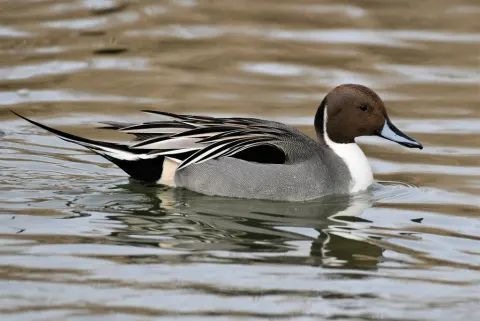
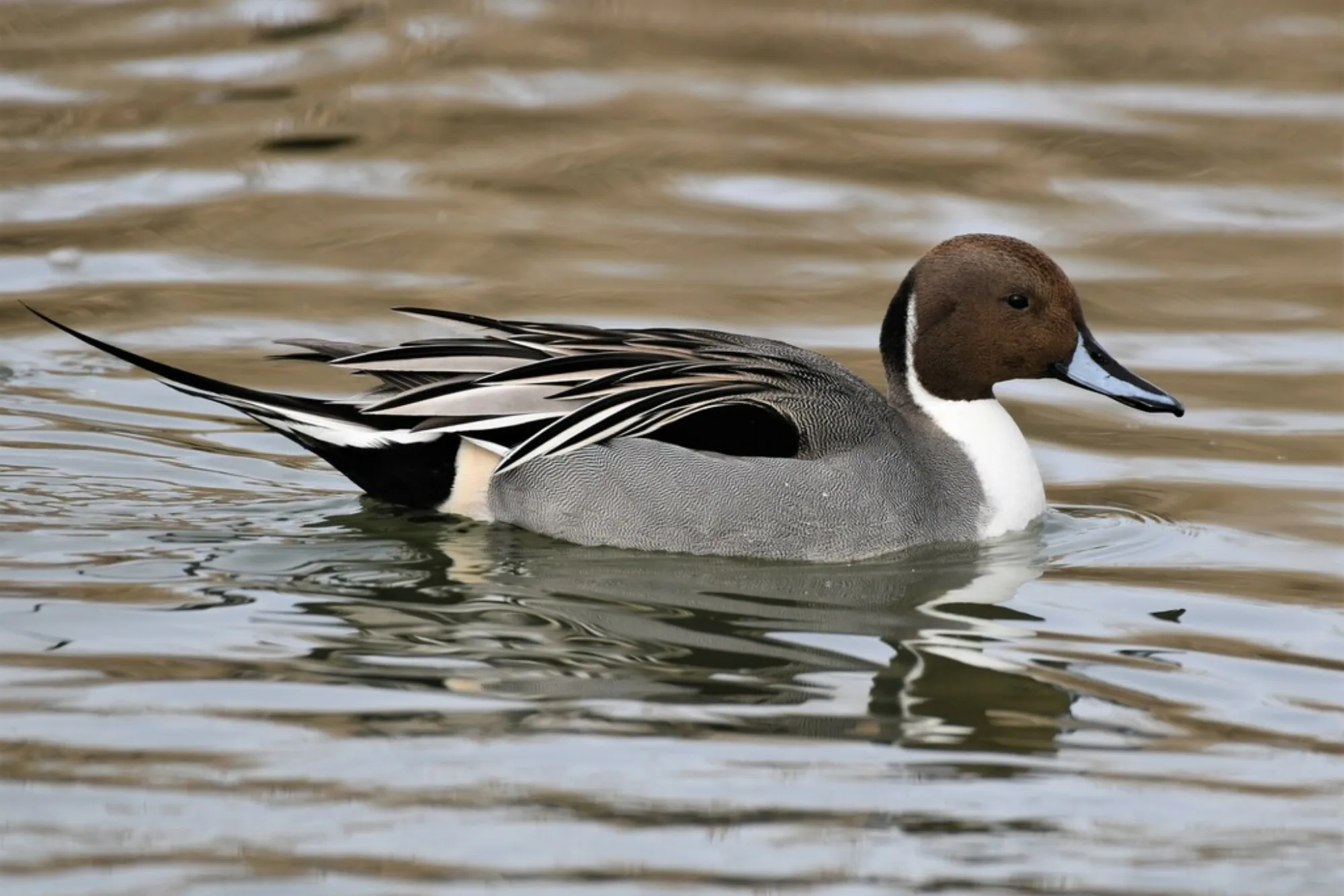
With its long neck and slender shape, the Northern Pintail cuts an elegant figure on open water. The male in breeding plumage has a chocolate-brown head, a white breast and a narrow white stripe up the neck. Long central tail feathers sharpen his silhouette, while grey feathers lie across his back and sides. The female is mottled light brown, with a shorter pointed tail and a long grey bill. Listen for the male's soft whistle or the female's descending quack.
Pintails breed across northern Europe, the Palearctic and North America, using open, treeless wetlands such as wet grasslands, lake shores and tundra. They migrate south for winter, travelling as far as Panama, tropical South Asia and parts of Africa just south of the Sahara. Some remain year-round in places including Great Britain and the northwestern United States. Winter habitats include sheltered estuaries, brackish marshes and coastal lagoons, where pintails may gather in large mixed flocks with other ducks. They feed mainly in the evening or at night, tipping up in shallow water to reach plant food, and rest for much of the day. In winter they eat mostly plants, while during breeding they take mainly small animals such as aquatic insects, molluscs and crustaceans.
Between April and June, the female makes a ground nest concealed in vegetation, often some distance from water. She incubates the eggs alone and leads the chicks to water after they hatch. Foxes, badgers and birds prey on nests and chicks, while diseases and parasites also affect pintails. Hunting has contributed to population declines, and wetland and grassland conversion removes feeding and nesting areas. Farming can destroy nests, while lead shot and fishing sinkers are sources of poisoning.
Written from the English Wikipedia article Northern pintail (CC BY-SA 4.0).
- Records
- 1,099,815
- Countries
- 18
- Atlas places
- 1
These are open occurrence records, so they show where people looked for and recorded the Northern Pintail as much as where it lives. Cells are up to 25 km across, and every location is generalised to its cell.
Generalised encounter areas, not exact locations. Each shape is a grid cell coloured by how likely the species is there.
- Very likelyUnited States25 km zone · high confidence · 790790 records · updated 80 days ago
- Very likelyCanada25 km zone · high confidence · 186788 records · updated 80 days ago
- Very likelyBelgium25 km zone · high confidence · 35025 records · updated 80 days ago
- Very likelyTaiwan25 km zone · high confidence · 26132 records · updated 80 days ago
- Very likelyUnited Kingdom25 km zone · high confidence · 19274 records · updated 80 days ago
- Very likelyNorway25 km zone · high confidence · 10442 records · updated 80 days ago
- Very likelyIndia25 km zone · high confidence · 7356 records · updated 80 days ago
- Very likelyFrance25 km zone · high confidence · 5290 records · updated 80 days ago
- Very likelyHong Kong SAR China25 km zone · high confidence · 3926 records · updated 80 days ago
- Very likelySpain25 km zone · high confidence · 3287 records · updated 80 days ago
Conservation status not assessed here yet, so every location is generalised to its grid cell.