Wolf-eel
Anarrhichthys ocellatus
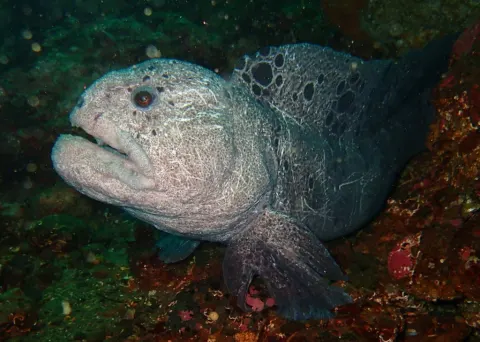
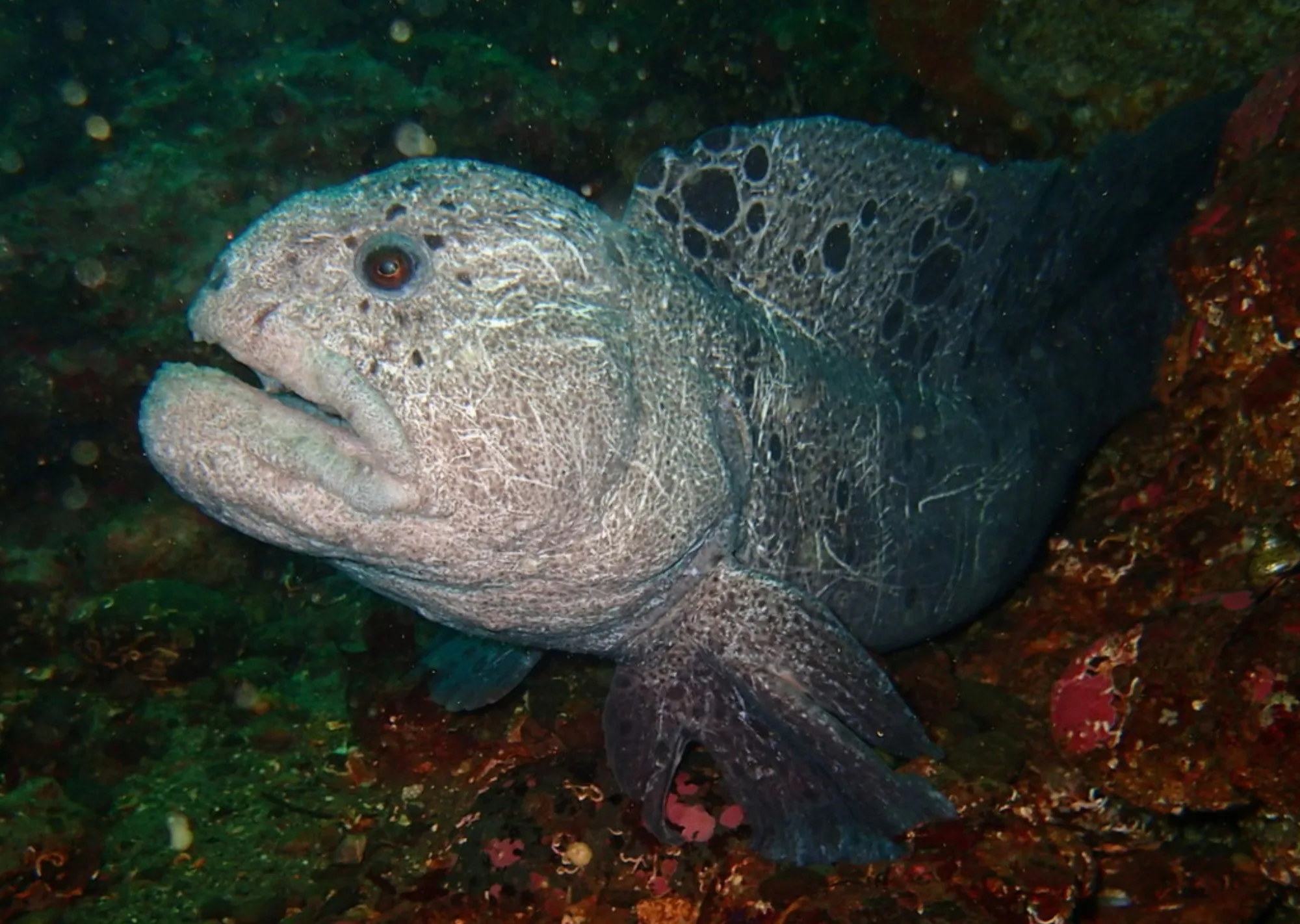
With its long body and powerful jaws, the Wolf-eel looks like an eel, but it is a marine fish rather than a true eel. It can reach 2.4 m in length and weigh up to 18.4 kg. Young fish are orange, with large dark spots towards the rear of the body; as they age, they become grey, greyish brown or dark olive. Eye-like spots mark its body and its dorsal fin, which extends along its back from head to tail. Males have large lips and a raised area on top of the head. Large Wolf-eels are curious and rarely aggressive, although they can give people a painful bite.
In the North Pacific, Wolf-eels occur from Northern California across to the Bering Sea and the Sea of Japan. They shelter among rocky reefs, caves and crevices, from shallow water down to 226 m. Their strong jaws crush hard-shelled prey, including crustaceans, sea urchins, mussels and clams, and they also eat some fish. In captivity, they have shown a preference for soft food such as squid over hard food, which can damage their back teeth. Pairs tend to stay together for life and share a cave. Breeding takes place from October until the end of winter, and both parents protect the eggs. While the eggs develop, one parent remains with them whenever the other leaves to feed; hatching takes 91 to 112 days.
Adult Wolf-eels face predators including sharks, large fish and harbour seals. Eggs and young fish are threatened by a wider range of species, with rockfish and kelp greenling among the predators of juveniles. Young Wolf-eels are at risk because they are small and lack powerful jaws.
Written from the English Wikipedia article Wolf eel (CC BY-SA 4.0).
- Records
- 74,007
- Countries
- 2
- Atlas places
- 3
These are open occurrence records, so they show where people looked for and recorded the Wolf-eel as much as where it lives. Cells are up to 25 km across, and every location is generalised to its cell.
Generalised encounter areas, not exact locations. Each shape is a grid cell coloured by how likely the species is there.
- Very likelyUnited States25 km zone · high confidence · 71785 records · updated 80 days ago
- LikelyCanada25 km zone · high confidence · 2222 records · updated 80 days ago
Conservation status not assessed here yet, so every location is generalised to its grid cell.