Atlantic Wolffish
Anarhichas lupus
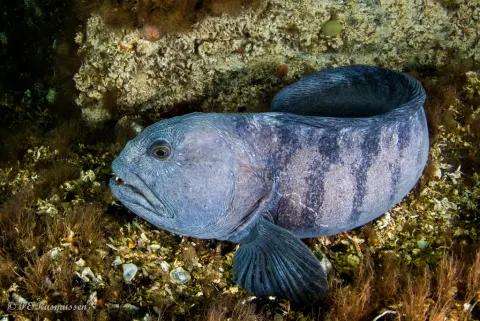
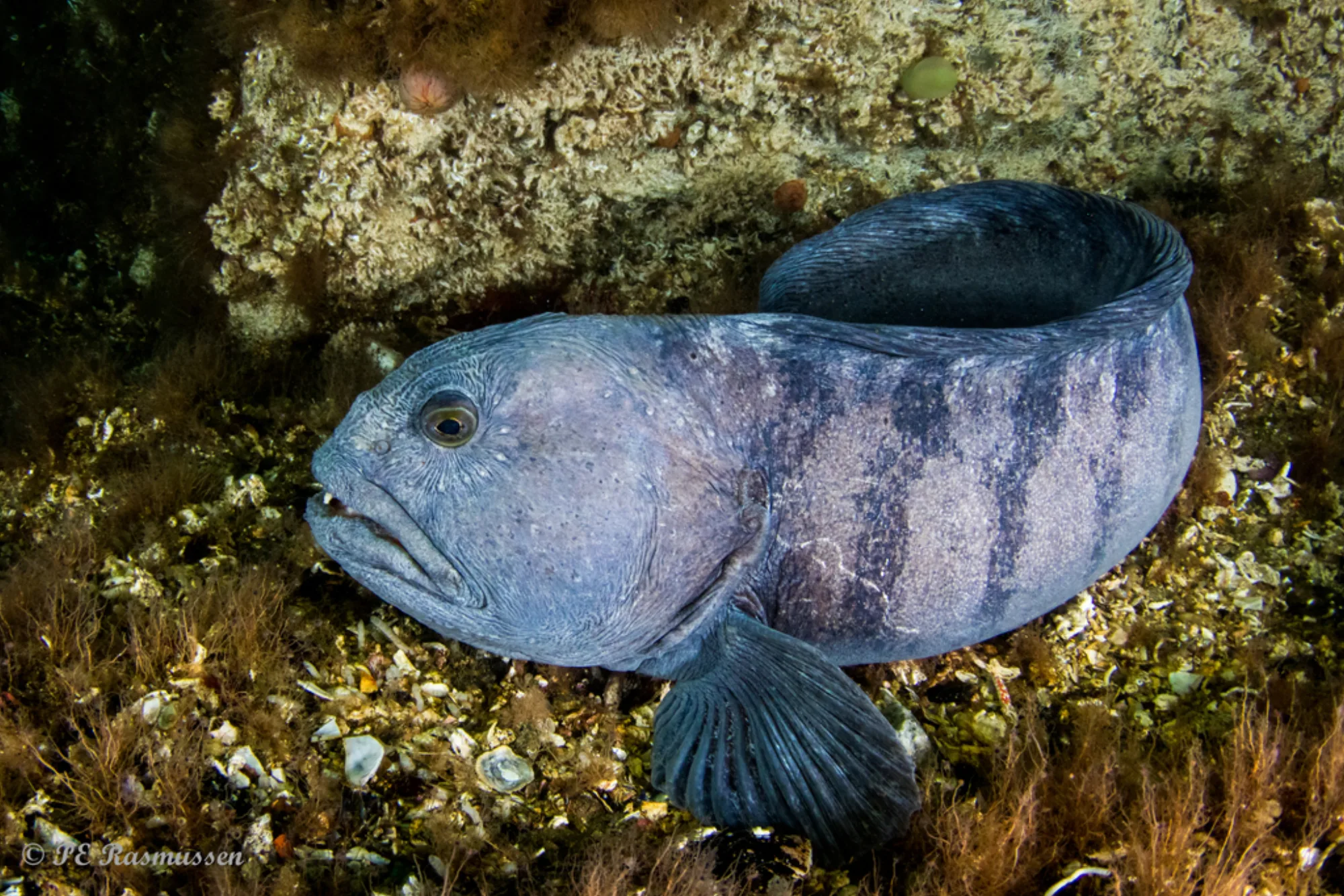
With its long, eel-like body and prominent teeth, the Atlantic Wolffish cuts a distinctive figure on the North Atlantic seabed. Its colour varies from purplish-brown and dull olive green to blueish grey, and a continuous fin runs the length of its back. The largest recorded specimen was 1.5 m long and weighed almost 18 kg. It swims slowly, moving its body from side to side, and has strong front teeth backed by teeth suited to crushing hard prey.
Atlantic wolffish occur on both sides of the ocean, ranging from Greenland, Newfoundland and Nova Scotia south to Cape Cod in the west. In the east, their range reaches from the White Sea to the Bay of Biscay, taking in the British Isles and Nordic countries. They favour cold water over hard, rocky seabeds, often sheltering in crevices and small caves at depths of 20 to 500 m. Usually stationary, they rarely venture away from these rocky homes. A natural antifreeze helps their blood flow in water that can be close to freezing.
Their powerful jaws break into hard-shelled molluscs, crustaceans and echinoderms, including whelks, hermit crabs, starfish and sea urchins. They also prey on green crabs, helping to keep their numbers in check, but do not eat other fish. Eggs are laid on the seabed in loose clumps among stones and seaweed, and the male guards the nest for up to four months. Wolffish mature relatively late, at six years old. In US waters, their numbers are falling rapidly, most likely because of overfishing and accidental capture in fishing gear.
Written from the English Wikipedia article Atlantic wolffish (CC BY-SA 4.0).
- Records
- 10,550
- Countries
- 5
No atlas park has a record of the Atlantic Wolffish in or around it yet.
These are open occurrence records, so they show where people looked for and recorded the Atlantic Wolffish as much as where it lives. Cells are up to 25 km across, and every location is generalised to its cell.
Generalised encounter areas, not exact locations. Each shape is a grid cell coloured by how likely the species is there.
- Very likelyCanada25 km zone · medium confidence · 8332 records · updated 80 days ago
- Very likelyNorway25 km zone · medium confidence · 1157 records · updated 80 days ago
- Very likelySvalbard & Jan Mayen25 km zone · medium confidence · 638 records · updated 80 days ago
- Very likelyUnited States25 km zone · high confidence · 325 records · updated 80 days ago
- Very likelyUnnamed area25 km zone · medium confidence · 59 records · updated 80 days ago
- Very likelyUnited Kingdom25 km zone · medium confidence · 39 records · updated 80 days ago
Conservation status not assessed here yet, so every location is generalised to its grid cell.