Clown Anemonefish
Amphiprion ocellaris
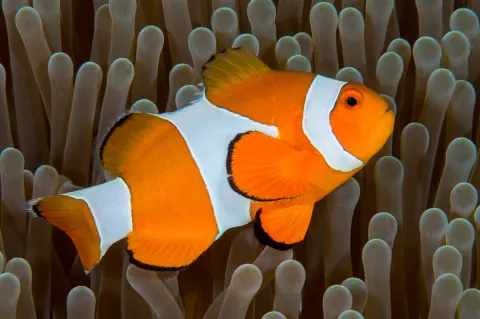
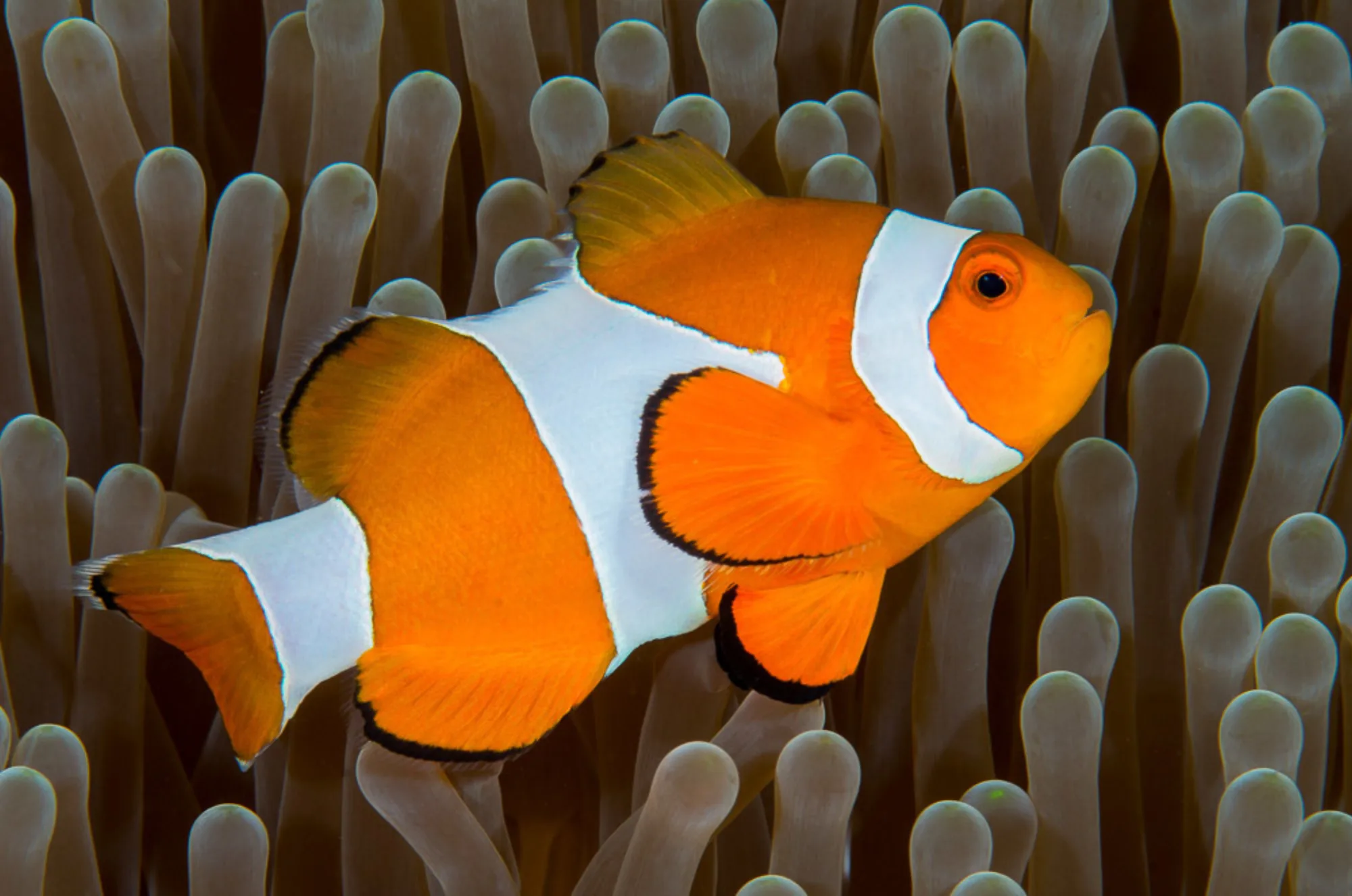
Among the tentacles of a sea anemone, the Clown Anemonefish finds shelter on a reef. This small marine fish has a stocky, oval body and grows to about 11 cm long. Its colouring can be orange to reddish-brown, with three vertical white stripes edged in black; in some places it is black with white bands. Females are larger than males, and the fins have fine black outlines. It is easily confused with the similarly coloured orange clownfish, though the thickness of the black outlines helps distinguish them.
Clown Anemonefish occur in the Eastern Indian Ocean and western Pacific Ocean, as well as places including northern Australia, Southeast Asia, Japan and Hawaii. They tend to gather in small groups along the outer slopes of reefs and in sheltered lagoons, down to 15 meters. Active by day and aggressively territorial, they depend on anemones for shelter, while the tentacles also protect their nests. The fish may help their hosts by removing parasites, fanning them and defending them from some reef fish that eat tentacles. They feed on algae, copepods and zooplankton, but smaller, lower-ranking fish face aggression and greater danger when they leave the anemone to forage.
Groups have a social hierarchy, and the dominant pair reproduce more often than subordinate fish. Males can become females during their lives, and eggs are laid in a nest close to the anemone. After hatching near the surface, young fish move down to the bottom as juveniles and look for an anemone of their own. Finding one can be difficult: established fish may chase a newcomer away. Demand for the aquarium trade has led to overexploitation, putting populations at risk.
Written from the English Wikipedia article Ocellaris clownfish (CC BY-SA 4.0).
- Records
- 318
- Countries
- 13
- Atlas places
- 3
These are open occurrence records, so they show where people looked for and recorded the Clown Anemonefish as much as where it lives. Cells are up to 25 km across, and every location is generalised to its cell.
Generalised encounter areas, not exact locations. Each shape is a grid cell coloured by how likely the species is there.
- Very likelyIndonesia25 km zone · medium confidence · 123 records · updated 80 days ago
- Very likelyPhilippines25 km zone · medium confidence · 101 records · updated 80 days ago
- Very likelyThailand25 km zone · medium confidence · 34 records · updated 80 days ago
- Very likelyMalaysia25 km zone · medium confidence · 28 records · updated 80 days ago
- Very likelyJapan25 km zone · medium confidence · 15 records · updated 80 days ago
- LikelyIndia25 km zone · medium confidence · 8 records · updated 80 days ago
- LikelyPalau25 km zone · medium confidence · 3 records · updated 80 days ago
- LikelyTaiwan25 km zone · medium confidence · 3 records · updated 80 days ago
- LikelySingapore25 km zone · medium confidence · 2 records · updated 80 days ago
- PossibleTimor-Leste25 km zone · medium confidence · 1 record · updated 80 days ago
Conservation status not assessed here yet, so every location is generalised to its grid cell.