Buff Striped Keelback
Amphiesma stolatum
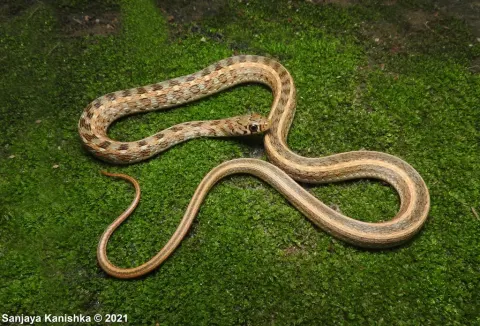
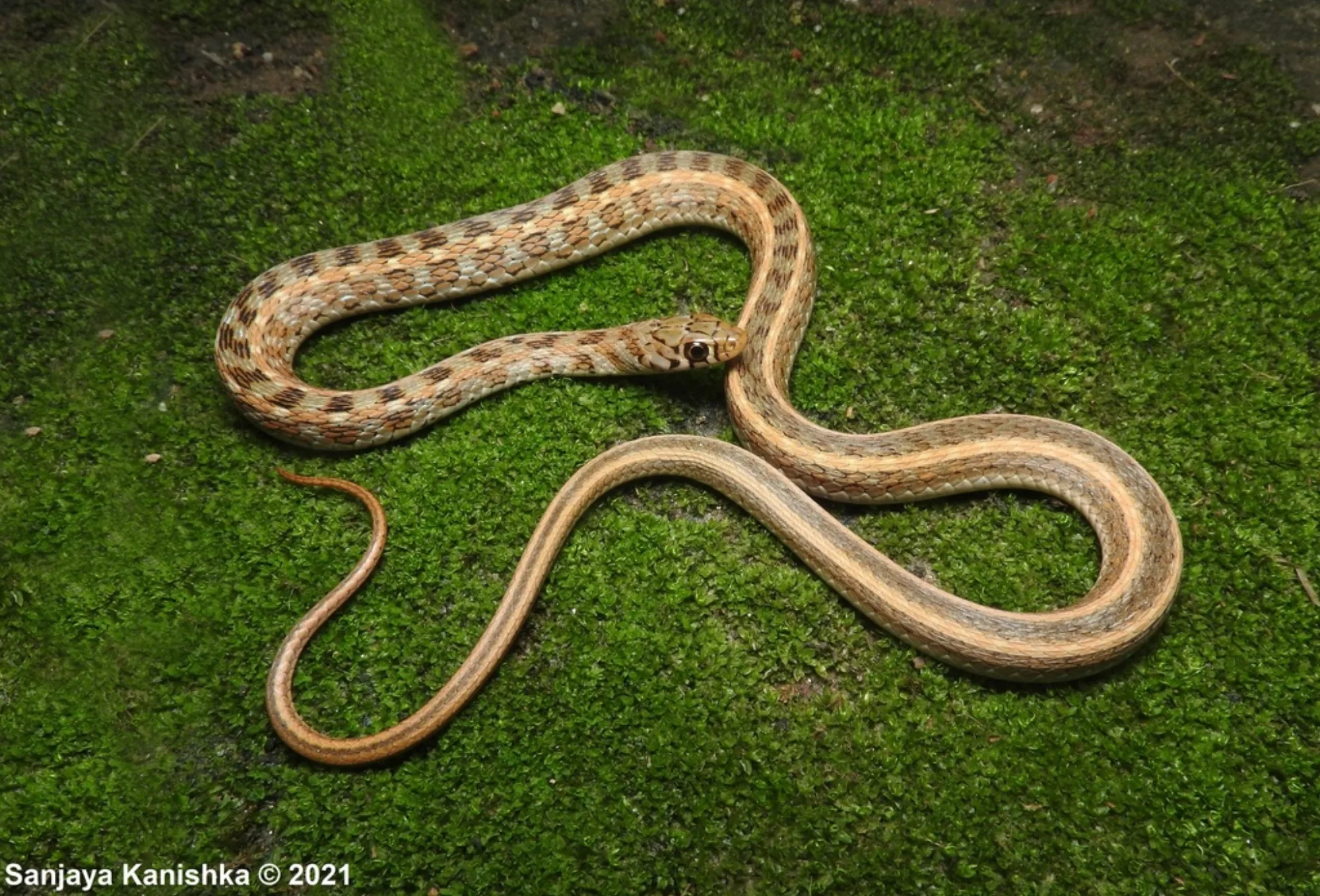
Small and slender, the Buff Striped Keelback is a nonvenomous snake found across South and Southeast Asia. It is usually 50 to 80 cm long, with females generally longer than males. Its olive-brown to grey body carries two yellow stripes along either side of the spine, brightest towards the rear. Dark crossbars stand out near the head and become less distinct farther back. The sides of the head are yellow, the underside is pale cream with small black spots along its edges, and the tail is long and slender. During the breeding season, the back of the neck turns red.
Its range stretches from Pakistan and Sri Lanka through India and much of Southeast Asia to Taiwan and parts of China, and includes Bhutan. In India it occurs up to 2,000 metres above sea level. It lives on well-watered plains and hills, spending much of its time on land but readily entering water. Though common across its range, it is rarely seen. Active by day, it eats mainly small frogs and toads, as well as earthworms, small lizards and rodents. It is usually non-aggressive, but when alarmed it can puff up its body, revealing colour between its scales, or flatten its head into a hood.
The snake aestivates in hot weather, appears at the end of summer and is abundant during the rains. Females lay 5 to 15 white eggs in underground holes from May to September and stay with them until they hatch. At birth, the young are 9 to 14 cm long and eat insects, tadpoles and small frogs and toads.
Written from the English Wikipedia article Buff striped keelback (CC BY-SA 4.0).
- Records
- 246
- Countries
- 9
- Atlas places
- 1
These are open occurrence records, so they show where people looked for and recorded the Buff Striped Keelback as much as where it lives. Cells are up to 25 km across, and every location is generalised to its cell.
Generalised encounter areas, not exact locations. Each shape is a grid cell coloured by how likely the species is there.
- Very likelyMyanmar (Burma)25 km zone · medium confidence · 79 records · updated 80 days ago
- Very likelyTaiwan25 km zone · medium confidence · 72 records · updated 80 days ago
- Very likelyIndia25 km zone · medium confidence · 66 records · updated 80 days ago
- Very likelyChina25 km zone · medium confidence · 16 records · updated 80 days ago
- Very likelyVietnam25 km zone · medium confidence · 8 records · updated 80 days ago
- LikelyHong Kong SAR China25 km zone · medium confidence · 4 records · updated 80 days ago
- LikelyBangladesh25 km zone · medium confidence · 1 record · updated 80 days ago
- UncommonSri Lanka25 km zone · low confidence · 0 records · updated 80 days ago
- RareMacao SAR China25 km zone · low confidence · 0 records · updated 80 days ago
Conservation status not assessed here yet, so every location is generalised to its grid cell.